Dragon Lady’s weekly update, chapter 4, is now available

The fourth chapter of The Dragon Lady of Stockbridge, “Realizations, responsibilities, and regrets,” is now available. What is the significance of the headless dog? What does James really think about his employers? Follow the link to find out.

If you’ve not been reading Dragon Lady before this, it is, as its subtitle says, a story about magic in the Gilded Age, 1886 to be precise. I post a new chapter every Friday before noon. Chapters 1 – 3 are still up, so if you want to start from the beginning, follow this link.

Stockbridge is a town in Massachusetts. Along with adjacent Lenox, it was a well-known resort town back in 1886. Here’s a picture of one of Stockbridge’s scenic attractions from a tourist guide book published that very year.

Posted in Dragon Lady, Writing fiction | Tagged , , , , | Leave a comment

Supernatural fiction

Since The Dragon Lady of Stockbridge is historical supernatural fiction, and I talked about historical fiction last week, it’s time to talk about supernatural fiction this week. Rather than talk theory, I’m going to discuss some examples. Mind you, this is a personal review, not an exhaustive survey. You’re welcome to offer comments and suggestions.

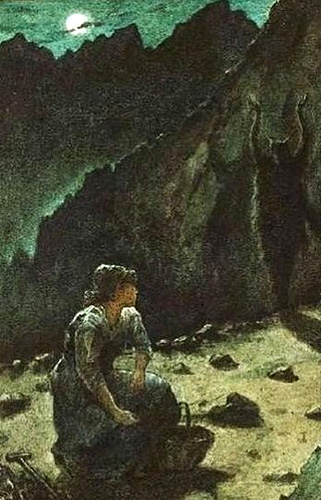
I have to give the palm to Wilhelm Meinhold’s Maria Schweidler: Die Bernsteinhexe (1839) for historical supernatural fiction. Meinhold published the story, claiming it was partly an authentic 17th century narrative, partly his interpolations, and challenged the critics to figure out which parts were which. He eventually revealed he had written the whole thing himself, making fools of the critics. Naturally, the critics all turned on him, and Maria Schweidler fell out of favor in its native Germany. However, thanks to a wonderful 1844 translation by Lady Duff-Gordon, The Amber Witch eventually became more famous in the English language, and has been in print ever since. Meinhold’s use of his historical setting really carries this story, which is otherwise just a romantic triangle combined with an early modern witch hunt. The moral for a writer: do your research, put it to use in your story, and you’ll win people over to suspending their disbelief and accepting your story as “real.”

Illustration for “The Amber Witch” by Edward Burne-Jones, 1895

Bram Stoker did a better job writing an exciting story with Dracula (1897), in which he combined a contemporary setting with a historically-rooted horror. Unfortunately, Stoker himself didn’t seem to understand Dracula‘s appeal, and botched it when he tried to recreate it using the same techniques for The Jewel of the Seven Stars (1903) and The Lair of the White Worm (1911). Lair in particular shows what can go wrong in imitating Dracula: the supernatural elements are poorly explained, the characters are not developed, and the plot drags. The characters don’t really engage the supernatural at a personal level, so neither does the reader. Another rule for writers: don’t repeat yourself too often, because you’ll get tired and boring.

Stoker’s devolution raises another point about supernatural fiction worth considering. In short fiction, mood can carry your story. Marghanita Laski, who usually didn’t write supernatural stories, used mood to good effect in “The Tower” (1955), making it one of the most disturbing stories I’ve ever read. Trying to think logically about the story is besides the point. However, longer fiction in general demands character development to sustain interest in the supernatural elements, and those supernatural elements need to be explained. Dracula is a splendid example of both those features. In contrast, Laski’s The Victorian Chaise-longue (1953) probably pushes the limit for how long a good supernatural story can be that relies on mood and doesn’t explain what’s going on . . . if in fact The Victorian Chaise-longue is a story about the supernatural. That it can be questioned demonstrates how much Laski left for the reader to interpret.

Sometimes the supernatural is primarily external: Ambrose Bierce’s “The Damned Thing” (1893) wreaks havoc in the material world. Sometimes it is primarily internal: Guy de Maupassant’s “Le Horla” (1887) is the psychological kissing cousin of “The Damned Thing.” And some writers are clever enough to have it both ways: Henry James’s The Turn of the Screw (1898) and Shirley Jackson’s The Haunting of Hill House (1959), each in its own way, rely on supernatural elements that may be external, psychological, or both. Probably The Victorian Chaise-longue belongs in this category as well. The point here is that the violation of the natural order inherent in the supernatural have as much to do with the characters’ expectations of the world as what actually happens. Even “The Damned Thing” ultimately relies on the narrator’s reaction to what he is experiencing.

Many supernatural stories rely on people confronting supernatural phenomena in what they assumed was a natural world. Psychological supernaturalism hints at another possibility: what if the rules of the supernatural world aren’t what people expect them to be? James Blish offered up the Christian “Problem of Evil” in Black Easter (1968), and proceeded to use Renaissance ceremonial magic to offer an unexpected and tragic solution. H.G. Wells, on the other hand, exploited wrong expectations to (mostly) humorous effect with “The Inexperienced Ghost” (1902). In both cases, the authors went beyond simply using common ideas about the supernatural, and explored their possibilities. Any writer who wants to get away from hackneyed ideas would be well advised to do the same.

To round out this essay, I must mention Edith Wharton’s “Afterward” (1910). If The Victorian Chaise-longue shows how long a story can go relying on mood, “Afterward” demonstrates how a short story can rely on character development and an explicitly defined logic for its supernatural element. To top it off, the supernatural in this story by its very logic doesn’t work the way one would expect, a paradox that I leave the reader to explore. “Afterward” is a good model for a writer to study, in part because it is pointless to imitate it!

Posted in Uncategorized | Tagged , , | 4 Comments

Dragon Lady chapter 3 is up

The third chapter of The Dragon Lady of Stockbridge, “Well-matched partners,” is now up and available. Read how Rebecca draws on the lessons she learned from her Uncle Israel to confront a man who has no soul! Just click on the chapter link and start reading.

As Dragon Lady is a tale about magic, It’s appropriate to note today is the birthday of Heinrich Cornelius Agrippa (1486-1535), whose Three Books of Occult Philosophy serve as both a summary, interpretation, and foundation of European magical thought.

Posted in Dragon Lady | Tagged , , , , | Leave a comment

Dragon Lady and Oneida: A historical note

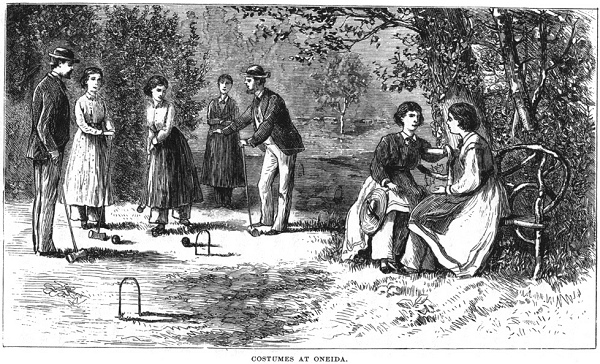
As mentioned in chapter 2 of The Dragon Lady of Stockbridge, Rebecca Maxwell put on clothing based on that worn by women in the Oneida Perfectionist community. But what was the Oneida Perfectionist community? Why was it considered scandalous? And how did Rebecca happen to see an engraving of the attire worn there?

You might recall how hippies in the 1960s were said to have gone off and formed communes and lived off the land? Well, there were quite a few people in this country between 1815 and 1860 who had similar ideas. They organized communities where everything was held in common and people worked for the community’s benefit. Most didn’t last long, falling victim to inadequate financial means or internal dissension.

One of the most famous, and oddest, of these communities was that of the Perfectionists of Oneida in New York State. This community was founded in 1848 and endured until 1879. It was based on the ideas of a minister named John Humphrey Noyes (1811 – 1886). Noyes had radical religious ideas. He believed people could become perfect, that is, able to live completely in accordance with God’s will and sin no more. To mainstream religious groups, this was scandalous, because it seemed to imply that Christ’s sacrifice on the cross was not necessary for salvation.

More scandalous yet, Noyes believed that people should live communally and love everyone equally . . . and unlike some, Noyes extended that idea to sex. Everyone at Oneida was married to everyone else, spiritually and carnally. It wasn’t “free love:” there were rules about with whom you could have sexual relations, with the goal of improving your spiritual state as well as attending to the needs of your body. Exactly how this was managed is more than I can go into here. However, it’s worth noting that men and women entered into sex, as with everything else in the community, as equals.

The last major oddity about Oneida was that over time it shifted from farming to manufacturing as its main source of income. Indeed, when the community collapsed, the manufacturing business was formed into a joint stock company which went on to successfully produce Oneida brand cutlery up to the beginning of the 21st century.

In the early 1870s, a journalist named Charles Nordhoff visited Oneida, along with every other remaining commune in the United States. He wanted to see if communes were a viable way for working men to achieve financial independence. His book, The Communistic Societies of the United States, came out in 1875, and is still in print. It had several engravings, including one opposite page 282 showing Oneidans at leisure. It was seeing that engraving that gave Rebecca the idea of creating the outfit she wore on her trip to the Taylors’ home.

Posted in Dragon Lady | Tagged , | Leave a comment

Dragon Lady chapter 2 is up

As promised, the second chapter of The Dragon Lady of Stockbridge, entitled “How to make an unfavorable impression every time,” has been posted this morning. Just why does Rebecca carry a walking stick? And what is wrong with Ellen Taylor’s brother? Find out by pointing at “The Dragon Lady of Stockbridge” just under the header picture, and clicking on “DLS Ch. 2” when it drops down.

Chapter 3 is scheduled to be published a week from today, September 14, by noon time.

Posted in Dragon Lady | Tagged , , , | Leave a comment

Ahistorical fiction

We have this category called “historical fiction.” There are two problems with it. First, the history is supposed to be factual, but isn’t. Second, the fiction is supposed to be historical, but isn’t.

You want to write historical fiction that’s real? We have a name for that: it’s called History. Despite those horribly dry textbooks you had to read in high school and college, there are some really neat stories in history. You want sex, violence, and a detective story, with a lot of real history thrown in? Try reading Patricia Cline Cohen’s The Murder of Helen Jewett. Want to find out how the frontier was really settled, and get an in-depth analysis of an important American novelist, to boot? Try Alan Taylor’s William Cooper’s Town. Want an entertaining read that will teach you about the history of money in this country? Tackle Stephen Mihm’s A Nation of Counterfeiters.

If you want to write fiction with a historical setting, you are really saying that you want to use certain features of the past to tell a story that will mean something to people today. Historical fidelity is not your priority, a meaningful story is. Sometimes, this means the historical trappings are merely there to disguise a story about modern people. See the TV miniseries Rome? It took a lot of criticism for playing fast and loose with history, including having its lead character live more than a decade after her demise. It should have taken even more for being completely false to the values and behavior of actual Romans of the  period. It was really a cat fight between two 21st century American women. I called it “Desperate Roman Housewives.”

In The Dragon Lady of Stockbridge, I’ve obviously deviated from actual history. If there were magicians wandering around the Berkshires in 1886, I’ve not seen the records. But the historical scaffolding isn’t just there for color. It sets social and cultural limits on the characters, limits that are not the same as ours. Mrs. Maxwell has problems with her husband, but she is not going to start quoting from The Feminine Mystique; 1960s women’s lib is not available to her. She has to resolve her problems within the range of possibilities available to her in 1886 . . . possibly with some help from magic, possibly not.

To my mind, having to work within the bounds of another society’s structures, practices, and values is what makes historical fiction worthwhile. And yet, to be enjoyable, it has to be understood by people today. The story has to be ahistorical, bridging two times, to be worth reading today. And that’s why, when you come down to it, Dragon Lady is really ahistorical fiction, trying to use a story set in 1886 to say something to readers in 2012.

Posted in Writing fiction | Tagged , , | Leave a comment

Kicking off Dragon Lady

My serial publication of The Dragon Lady of Stockbridge: A Tale of Magic in the Gilded Age begins today with chapter 1, “A need and a necronym.” What exceedingly odd request does servant Ellen Taylor make of her employer, Mrs. Maxwell? And just what is a necronym, anyhow? Swing your cursor over the story title, up there in the header, and then click on “DLS ch. 1” when it drops down, and start reading!

I’ll be putting up a new chapter every Friday morning by noontime, so you all have something to read over the weekend.

Posted in Dragon Lady | Tagged , , , | Leave a comment

Writing fiction at length, at length

Some nights ago, at a party, I mentioned to a friend that I’d already written two long stories, one running 250 pages. He thought about it, and then asked how one could possibly write anything that long. I gave him an answer, well, several answers, but I wasn’t satisfied with them myself. And now that I’m writing The Dragon Lady of Stockbridge in weekly installments, I’ve been thinking about his question some more.

Ever have some grand idea or plan for what you were going to do, and then not have it work out the way you expected? Writing fiction is a lot like that. I’ve never started writing a long story without a good idea about what it was about and what its plot would be. Yet by the time I have finished the story, I’ve changed the theme and plot. What happened?

Life happened, life in detail. People lead complicated lives, with many conflicting demands made by many parties, and with unplanned events cropping up as well. So our grand plans go astray amidst the conflicts and details. My grand visions for my stories go astray for much the same reasons. Everything I write about a character helps define that character. I’m making the character into a real, if fictional, person. That person is very much more complicated than the character when I first imagined him or her. Often enough, that character doesn’t fit the old story line, or, better yet, suggests a more interesting story. To top it all off, sometimes inspiration strikes, seemingly at random, just like an unexpected event in one’s life.

Let me offer an example. I was writing a story earlier this year about a vile creature who was preying on people. To track the creature, I created a cop. And to help the cop, I gave him an informant. The informant was meant to be an incidental character, a mechanism to help the cop solve the case. In a moment of inspiration, I had the vile creature convince other people that the informant was the real criminal. It led to a scene in which the informant, all 4’10” of her, walks into a bar carrying a dagger in each hand, crying defiance. I loved the scene. It was melodramatic and even cinematic as I visualized it.

You won’t find that scene in the story any more.

Why not? I fell in love with the informant. Which is to say, I began wondering about what motivated her, how she came to be the type of person who might go walking into a bar with daggers drawn. The more I thought about her, the more useful she became in the story. To make her more useful, I had to tie her to other characters in the story. By the time I was finished, the story had changed. It was not about the vile creature, who had few meaningful interactions with any of the other characters. No, it was now about the main characters and the world they lived in. In a happy inspiration, I took an anomalous feature of the informant (not her height) and made it integral to the plot and even the nature of the world she lives in. It was a different story. And there was no scene of my informant walking into the bar carrying daggers. Indeed, she wasn’t even an informant any more. That role and that scene no longer fit who she had become.

I regret the loss of that scene. I still love it. But the story is the better for having evolved far beyond it.

What this demonstrates is that, for me at least, writing a long story is an iterative process. I start with some ideas, I write about them, and then I reflect on what I’ve written. That produces new ideas, which may necessitate changes in what I’ve written. The process doesn’t stop until I have produced a story that satisfies my sense of coherence: the world in which the story takes place makes sense, the characters make sense, and the story makes sense on its own and in how it connects to the world and its characters.

In writing The Dragon Lady of Stockbridge as a serial, I’m giving up the flexibility to revise the story along the way. So it is an experiment. I already know the rules of the world in which the story is set. And I’ve worked through a few false starts. So I think there’s a good chance the story will come off. We’ll see, starting Friday.

Posted in Writing fiction | Tagged , | 4 Comments

An appetizer to tide you over until next week

The Dragon Lady of Stockbridge will start up next week on Friday, August 31. For this week, I’ve posted a letter from George S. Boutwell, who was Secretary of the Treasury in the first Grant Administration, to his daughter Georgianna, who loved politics and gossip, about a meeting with an old acquaintance of his named Israel Farnsworth. It connects “The Troubles of the Farnsworths” with Dragon Lady. You can link to it by clicking where it says “Boutwell letter about Israel Farnsworth” under the picture heading up the top of the page.

Posted in Uncategorized | Leave a comment

What’s the story going to be about?

Like the earlier story, The Dragon Lady of Stockbridge is a historical fantasy, set in a historical environment with a dose of magic. If people can practice magic, what does that do to their perception of the world? What ethics might they develop? Would they hang out with each other? How would they pass on their knowledge? Dragon Lady addresses these questions. But it is not a dry meditation on these subjects. It’s an adventure story. You live in a summer cottage in the Berkshires and one of your laundry maids comes to you with an extraordinary and improbable request. What do you do? And what are the consequences of your actions?

Posted in Dragon Lady | Tagged , , | Leave a comment