Dragon Lady chapter 9 and the Secret Service

The previous chapter of The Dragon Lady of Stockbridge introduced Abigail Lane, practicing magician in the United States Secret Service, Office of Occult Affairs. In this new chapter, “Defender of the Nation,”which you can link to here, we get to see just who Abigail is, and why she is trying to recruit the dragon lady’s help.

As I said in my previous post, the reason why there are magicians in the Secret Service has to do with history, particularly the history of Tennessee Claflin (1845 – 1923), whose birthday coincidentally is today. Tennessee’s name is probably unfamiliar to you. You might recognize the name of her older sister, though: Victoria Claflin Woodhull, free love advocate and the first woman to run for the United States Presidency, in 1872!
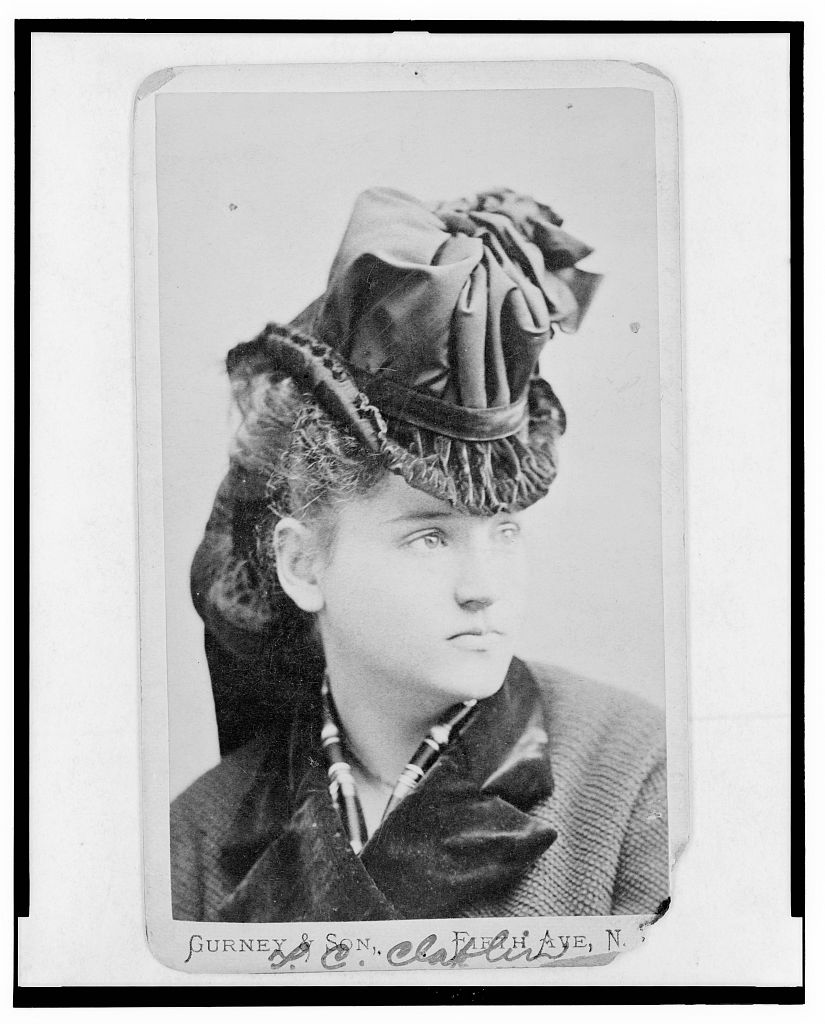
Tennessee Claflin

To explain how the Secret Service and Tennessee Claflin crossed paths, I offer the following abridged quotation from The History of the Office of Occult Affairs, P. S. Hughes, ed. (Washington, D.C.: Government Printing Office, 1931):

“The Secret Service began in 1865 as a collection of wild men. They were hunting counterfeiters, and they needed to be as tough and wily and ruthless as the criminals they hunted. The Service’s second chief, Hiram Whitley, was a former military officer who had personally fought rebels, bushwhackers, smugglers, rustlers, thieves, and other criminals. There was no question that he was tough. But he was also respectable, orderly, and methodical, and when he took control of the Secret Service in 1869, he was determined to impose order and respectability on the agency. The Service has wrestled with its divided nature ever since, part wild law men, part orderly enforcers of the law. Nowhere has this been such an acute and continuing problem as in the Service’s offshoot, the Office of Occult Affairs.

“The Secret Service had originally been chartered only to hunt counterfeiters. However, in 1868, Congress expanded its scope to cover other acts of fraud against the government. So when Fisk and Gould tried to corner the gold market in 1869, the Service decided to investigate. Insuring the stability of the nation’s currency was a logical extension of their mission. And their new headquarters at 63 Bleecker Street in New York City were conveniently located to the Exchange.

“The very first magician the Secret Service ever hired set a portentous precedent for the future of what became the Office of Occult Affairs. First of all, it was a woman. The Service proper was and is a man’s world; there has never been a female agent. [No longer true: the first female agents were hired in 1970. – B.] But to investigate the gold corner, the Service had to work with the one magician who was in so many ways central to the scheme: Tennessee Claflin. Tennessee had shown magical talents since the age of five. She could read minds, locate missing objects, and communicate with spirits, as well as with her sister Victoria. Although she had a checkered past that included allegations of prostitution and a charge of manslaughter, in 1869 she was a respected member of society.

“What led Whitley to her was that Tennessee was also the mistress of Cornelius Vanderbilt, and was connected by a web of relations to the major players in the gold corner. Whitley hired Tennessee, both for inside intelligence and for her abilities as a magician. The information she supplied to the Secret Service was critical to the decision by President Ulysses S. Grant and Treasury Secretary George S. Boutwell to intervene in the gold market and break the corner on Black Friday.

“Tennessee Claflin may be regarded as the beginning of the Office of Occult Affairs. But it was a tenuous beginning. Claflin was not an official agent, just a person who was regularly employed by the Service in its investigations. She remained on the Service’s payroll into 1871 before Whitley decided he had no further use for her. She had no further contact with the Secret Service, and in 1877 departed for England.

“The Secret Service’s use of magicians might have ended with Tennessee, had it not been for Campbell Fitzhugh. In 1870, this enigmatic magician approached Chief Whitley . . .”

Ah, but that’s another story for another day.
Posted in Dragon Lady, History, Writing fiction | Tagged , , , , | Leave a comment

Magic in Dragon Lady

I’ve already written about the dangers of using magic in fiction. This week, I’m going to write about the magic that I do use in my fiction, particularly in The Dragon Lady of Stockbridge, which is going up, chapter by chapter, every week.

My long-ago inspiration for using magic was a 1953 novel by Fritz Leiber entitled Conjure Wife. Unlike many writers, Leiber spelled out the basics of magic in his story. He showed how magic might function as an orderly system. Leiber’s use of magic is structured around three principles. First, every woman on the planet practices magic, but no men do. Second, despite this prevalence of magic, the world still looks very much like our own. Third, the magic itself operated by rules. In the novel, Leiber actually has one of the characters analyze a collection of related spells using symbolic logic to establish the fundamental magical spell underlying all the variations.

Two of these principles I carried over into Dragon Lady: that the world would seem normal, and that magic operates by rules. So in Dragon Lady there are folk stories about witches and magic, but educated people by and large do not believe in them. This places constraints on the magic in Dragon Lady. For example, magicians are not going around threatening to destroy the universe or turning the Washington Monument into gold. There’s a limit to their power. That’s one of the rules. One of the other rules is that performing magic requires energy and has consequences. If you’ve read the story, you’ll have noticed that Rebecca finds it easier to use magic on people to get them to do things they were inclined to do, anyhow, and that major magical operations tire her out. Finally, there can’t be that many magicians in the world, or their existence would be common knowledge. Some people know about them. In fact, some people in government definitely know about them, or there would be no United States Secret Service, Office of Occult Affairs to which Abigail Lane belongs. (Why is the Office of Occult Affairs in the Secret Service, whose main job is busting counterfeiters? Well, why is Presidential protection a duty of the Secret Service? It has to do with history.)

One of the rules I did not carry over from Conjure Wife is the idea that only women engage in magic. Why not? Leiber was writing specifically about gender relations in his day, 1953. My purpose in writing Dragon Lady is different. To me, it seemed unrealistic that men, who hold so much power in the world, could be completely shut out from a system of power. In the world of Dragon Lady, men and women both practice magic, and there is no clear domination by one or the other, except insofar as men tend to hold the reins of power generally. Abigail’s boss, the head of the Office of Occult Affairs, is a man, and no one would even consider appointing a woman to that post in 1886.

There’s one other rule about magic, or at least about magicians, that applies to the world of Dragon Lady. People learn. Magicians learn. They try out new things. They test the limits of their powers. Admittedly, they may make mistakes and be killed by hostile magical entities, or fall victim to other hazards unique to their profession. But over time, magicians get better at magic. Magic is no static institution in the world of Dragon Lady, but an evolving set of practices magicians use to control their world. And just as men and women have developed theories about how the physical world works, which we call science, so, too, someday may magicians develop a theory about how the magical world works. And we’ll call that science, too.

What are the spiritual implications of this? If magic becomes scientific, are we ruling out religion or values? No, no more than science does so already. The great spiritual questions are about our relationship to ourselves, to other sentient beings, and to the cosmos. Science has clarified those questions in certain ways, not answered them. A science of magic would do much the same. Indeed, because it would expose a new realm in the world, and provide a new perspective and new knowledge of ourselves, it would enrich our ability to address those questions.

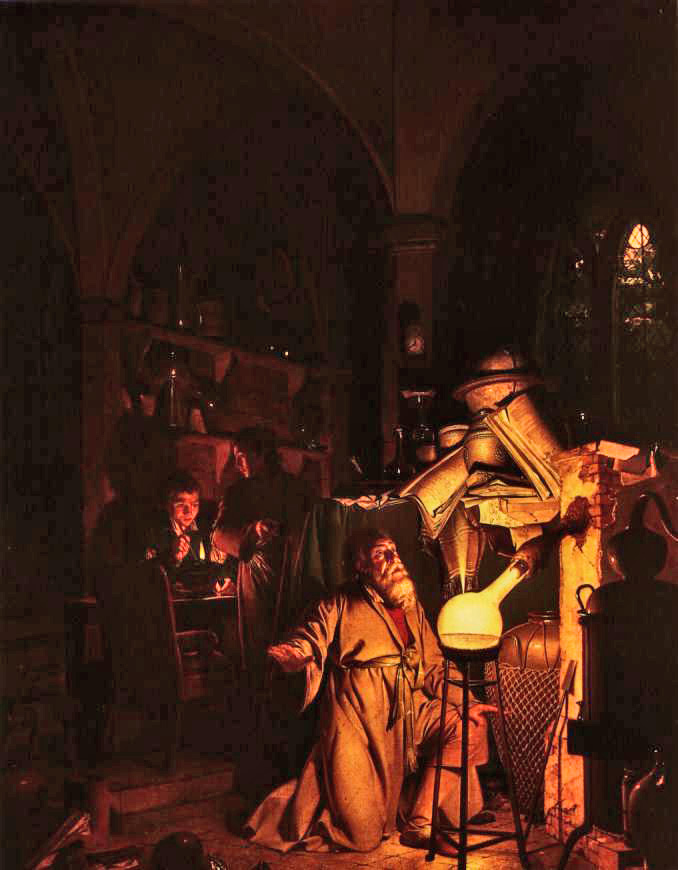
The alchemists used physical instruments and spiritual exercises to try to realize the Philosopher’s Stone. They saw no firm dividing line between the two. In the world of Dragon Lady, that dividing line does not exist, either. Scientists and magicians are both trying to manipulate the world using their respective skills, but both are trying to answer the great questions. Who are we? Why are we here? And what should we aspire to become?

The Alchemist in Search of the Philosopher’s Stone (Joseph Wright, 1771)

Posted in Dragon Lady, History, Writing fiction | Tagged , , , | 7 Comments

The Dragon Lady meets Rev. Field in Chapter 8

A whole new chapter of The Dragon Lady of Stockbridge is up on my blog this morning. The heat is on in chapter 8, “Allies and enemies,” as Rebecca struggles to deal with the consequences of the literally smashing conclusion to the previous chapter. Read all about it here, or, if you’re just joining the story, you can start from the beginning here.

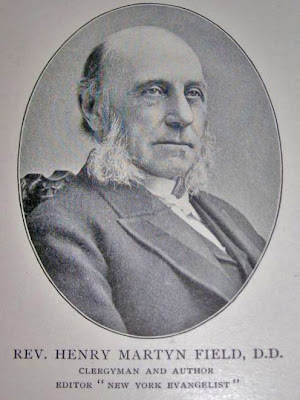
This chapter includes an appearance by Rev. Henry Martyn Field (1822 – 1907), an unusual man in a notable family. His father was a prominent Congregational minister and local historian. One of his brothers was a noted legal reformer, another was a Supreme Court Justice, and yet another laid the first successful trans-Atlantic telegraph cable. Henry was no slouch, either. He was a minister himself, and long-time editor of a religious periodical. He chronicled the doings of his family and became a noted travel writer in his own right.


In a strange quirk of fate, Henry is best remembered today for something his first wife supposedly didn’t do. Henriette Deluzy-Desportes was the governess to the children of the Duc de Praslin. The Duke bludgeoned his wife to death, and then committed suicide rather than be tried by his peers in the French Senate. It was alleged that the Duke had fallen in love with Henriette, and she had been his mistress, something she of course denied. Although she was a decade his senior, Henry married her not long afterward, and she went to live with him in Stockbridge, trying to escape her Parisian notoriety. (She died in the 1870s, and Henry had remarried by the time of the events in Dragon Lady.) Henry’s grand-niece, Rachel Field, wrote a fictionalized version of the scandal in 1938, entitled All This and Heaven, Too. It was a best seller, and was made into a Hollywood movie only two years later, starring Bette Davis as Henriette. An actor playing Henry briefly appears in the film to rescue Henriette from despair and offer to take her to America as his wife.

I have to wonder at Rachel Field for writing All This and Heaven, Too. I can understand why she, as a family member, would consider herself the author most entitled to tell the story. And the story itself is irresistible melodrama. But did she not understand that, no matter how she depicted Henriette, she was reviving an old scandal in her family? Or did she just decide that since all the people involved had been dead for decades that it didn’t matter?

Posted in Dragon Lady, History, Writing fiction | Tagged , , , , , | Leave a comment

The Berkshire cottages and Dragon Lady

In a previous post, I described what the Berkshires were like in 1886. But there’s a few groups of people I left out: the visitors and the rich.

In the antebellum period, the Berkshires acquired a reputation for scenery, and for the literary figures who visited or stayed there. The best-known today are Nathaniel Hawthorne and Herman Melville. In fact, Melville wrote Moby Dick while staying in the Berkshires, and dedicated it to Hawthorne, who was also living there at the time.

After the Civil War, an era of unprecedented industrial growth created a new class of rich people. And like rich people everywhere, they wanted to enjoy their wealth, preferably in a nice place with other rich people. So they went to Newport and Saratoga . . . and the Berkshires. First they stayed at the better hotels, such as the Stockbridge House (now the Red Lion Inn). These hotels had detached cottages which became the favored residences of the rich when they came to visit. After a while, they naturally thought of building their own. And so between roughly 1880 and the First World War, they built increasingly larger homes, “cottages” they were called, where they could enjoy their wealth in between the summer season in Newport and the late fall season at the spa and racetrack in Saratoga.

Lenox and Stockbridge were where most of them built their homes. Stockbridge was an older town, and had the Sedgwicks and the fabulous Field brothers (David Dudley, a legal reformer, Stephen, a Supreme Court Justice, Cyrus, who laid the first trans-Atlantic telegraph cable, and Henry, a noted author and traveler). But Lenox attracted more of the moneyed, and acquired more prestige.

It was an era when the rich spent money without shame, and their cottages were lavish. People admired (or at least envied) their wealth, and wanted to see it and rub elbows with the rich, if possible. I’ve a guidebook to the Berkshires from 1886-7. It lists the towns in order of their social importance. Lenox and Stockbridge come first, of course (and in that order), and their lengthy entries include long descriptions of which rich and notable people visit or live in each town. Less prestigious towns get later and shorter entries, until the factory towns such as Dalton and the poverty-stricken hill towns such as Savoy get the briefest mention.

Cleveland Amory described a cycle for resort communities: first they attract artists, then the “good” rich people (the ones who enjoy scenic and artistic pleasures), then the “bad” rich people (who are there to flaunt their wealth and behave badly), and then the resort goes out of fashion. The Berkshires follow the pattern, though New England dignity seems to have restrained the “bad” phase more so than at other resorts of the era. That may be one reason why the Berkshires declined even more rapidly than the other resorts of the rich after the First World War. Many of the cottages were abandoned, razed, or sold to institutions. A few, such as Naumkeag (see picture) have been preserved and are open to the public to let us today get a taste of what it was like to be a wealthy resort dweller at the end of the nineteenth century.

Naumkeag, maintained by the Trustees of Reservations

How does all this fit into The Dragon Lady of Stockbridge? Rebecca, as a good Berkshire native, identifies with the other old families more than the new wealthy, even though her husband is a member of the latter group. So she persuaded him to build their cottage in Stockbridge in 1883-4. And she tends to socialize with the old Berkshire families, who are around in the early summer. When the story opens, most of the wealthy are still in New York or have gone to Newport. They will come to Lenox and Stockbridge later, in September.

If you want to read more about this era, you can start with The Berkshire Cottages: A Vanishing Era by Carole Owens, which combines a general history of the era and the cottages with a detailed description of each one. Carole has written some other books on this era, which you can find here, a page from the web site of the Berkshire bed and breakfast which she runs. What could be more appropriate?

Cleveland Amory’s The Last Resorts offers an overview of the major haunts of the vacationing American rich of that era. Be aware that while Amory is trying to write about the entire era, his sources were heavily weighed toward the end of the era, the post-World War I years when the resorts were in decline. Berkshire’s swift decline means it gets prominent mention at the very beginning of the book, and scarcely any thereafter.

The 1886-7 guidebook I mentioned is called The Book of Berkshire: Describing and Illustrating Its Hills and Homes . . .  and was originally written and published by Clark W. Bryan. It has since been reprinted at least once as a curiosity.

Posted in Dragon Lady, History | Tagged , , | Leave a comment

Dragon Lady chapter 7 is available

“Visitors,” the seventh chapter of The Dragon Lady of Stockbridge: A Tale of Magic in the Gilded Age, is now up at this link. Who is the madman lurking in the parlor? Is Rebecca’s party a smashing success? If you’ve not read the previous chapters, you can start here. A new chapter arrives each week.

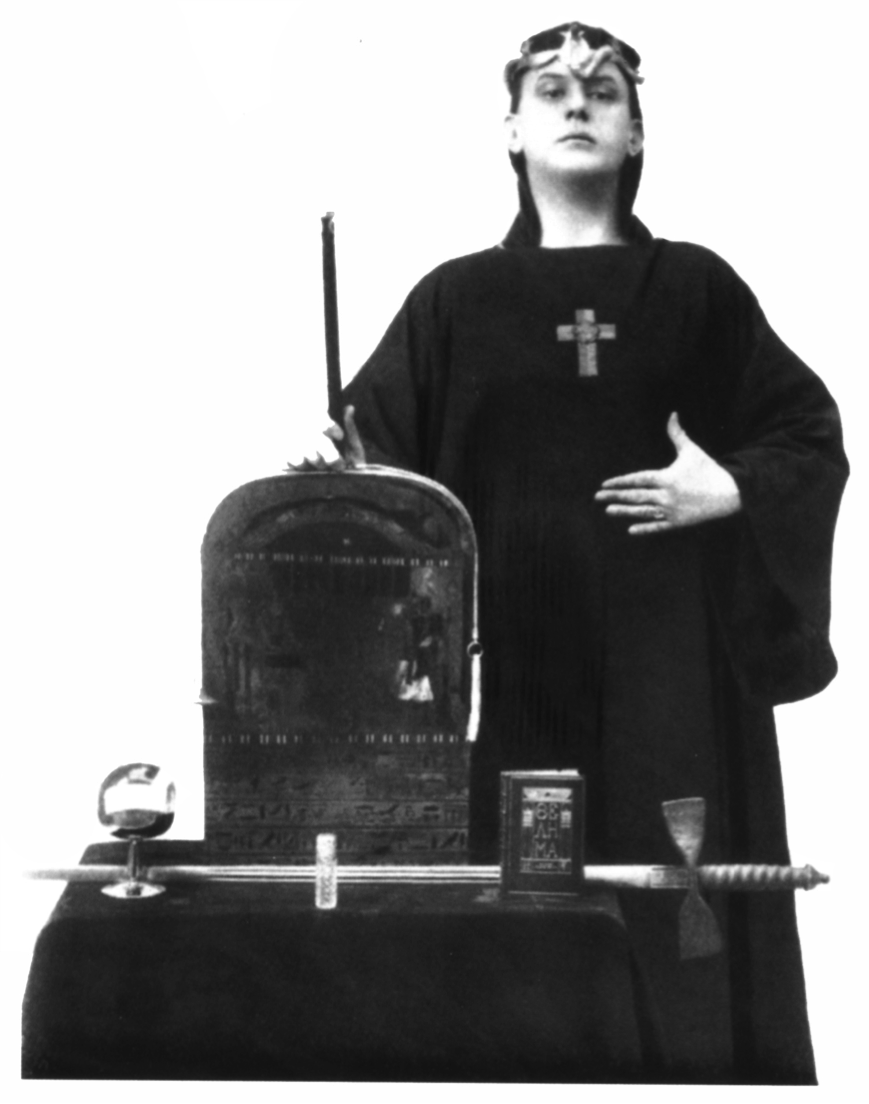
A few weeks ago, it was Cornelius Agrippa’s birthday. Today is the birthday of a more notorious magician, Aleister Crowley (1875 – 1947). “Do what thou wilt” was his rule. His emphasis on will, sex, and occult magic in the many orders he founded shaped much magical thinking in the 20th and now the 21st century.


At the time The Dragon Lady of Stockbridge begins, Crowley is not quite 11 years old. I suspect he would have a poor opinion of Rebecca Farnsworth Maxwell, and she would have an equally dim view of him. In the Sillyverse, the world in which my story is set, the two of them never meet. However, in two weeks’ time, it will be the birthday of another historical figure who is connected to one of the characters in this story.

Posted in Dragon Lady, History, Writing fiction | Tagged , , , , , | Leave a comment

The Berkshires in 1886

The Dragon Lady of Stockbridge is set in the Berkshires in 1886. But just where are the Berkshires, and what were they like in 1886?

There’s an old English county called Berkshire. “Berk-” comes from a Celtic word meaning hilly, and a “shire” is a county, so the original “Berkshire” was a hilly county. Not surprisingly, when the English colonized New England, they organized the hilly region of western Massachusetts as the redundantly named Berkshire County, and named the hills on its eastern side the Berkshire Hills.

Geographically, Berkshire County is a valley that runs along a north-south axis, with the Taconic Hills to the west and the Berkshires to the east. The northern part of the valley is drained by the Hoosac River, the southern part by the Housatonic. The hills and streams provided ample sources of water power, so many mills sprung up in the region in the nineteenth century.

The European colonists settled in the region in the eighteenth century to farm the land. It was not a great region for farming. Not only was the land hilly, but it was covered in trees, had thin, rocky soil, and the higher elevation shortened the growing season. Once the Midwest opened up, the farms at the highest elevations were abandoned. Those a bit lower down turned their land to hay fields and pasture. After the Civil War, most of the remaining farms went over to sheep farming. It required few people and was reasonably profitable, though the price of wool declined steadily through the last part of the century. In another few decades, the price would drop so low that farmers would convert to dairy farming.

Every small watercourse had a mill built on it at one time or another, but only a few sites could support major factories. Pittsfield and North Adams had most of the sites and had become industrial communities with about 15,000 inhabitants in each city. Adams was about half their size, and Dalton, which had the Crane mills, about half the size of Adams.

Most of the towns were small communities of under 1,000 people, and they had been slowly losing population for decades as people abandoned farms and moved to the mill towns, or to the West looking for better land and more opportunities. Hal Barron wrote a good book about what these small towns were like called Those Who Stayed Behind.

There were a few exceptional communities. Williamstown had the famous Williams College, so was a sizable community without having an industrial base. And Lenox and Stockbridge were homes to the cottages of the wealthy. I’ll talk about why in a subsequent post.

The railroads had penetrated Berkshire in the antebellum years, connecting the valley with markets in Boston, Albany, and New York City, and bringing Irish and French Canadian factory workers to add to the English and Scotch-Irish farmers, with Italians and Poles just beginning to show up.

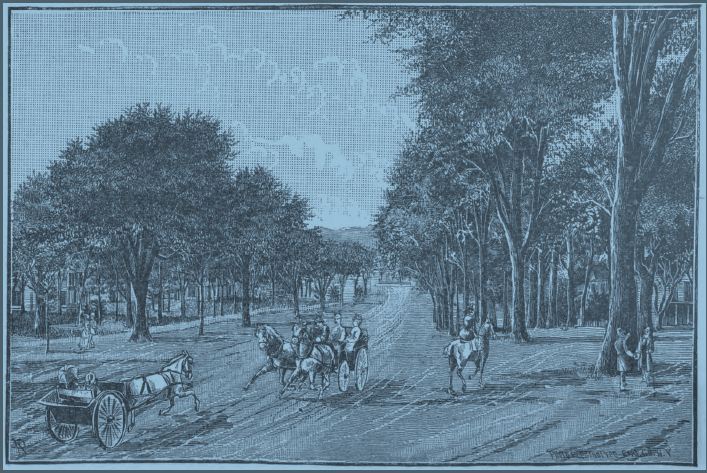
The spring was muddy, the summers relatively cool, the fall foliage gorgeous, and the winter snows heavy. Most of the land had been cleared for farming when it was settled, but the hills were reverting to forests, and the wealthier towns were aggressively planting shade trees along their streets, as you can see below in Williamstown. Berkshire was probably a nicer place to visit than to live in in 1886. In that respect, Rebecca Farnsworth Maxwell, fictional character though she is, fits right in.

Main Street in Williamstown, 1886

Posted in Dragon Lady, History | Tagged , , | Leave a comment

Chapter 6 of Dragon Lady is available

“Worthy of Trust,” the new chapter of The Dragon Lady of Stockbridge, is now available at this link. What did the walking stick do to Amy? What does it do to Rebecca? If you’ve not dived into my weekly serial of magic in the Gilded Age Berkshires, you can start from the beginning.

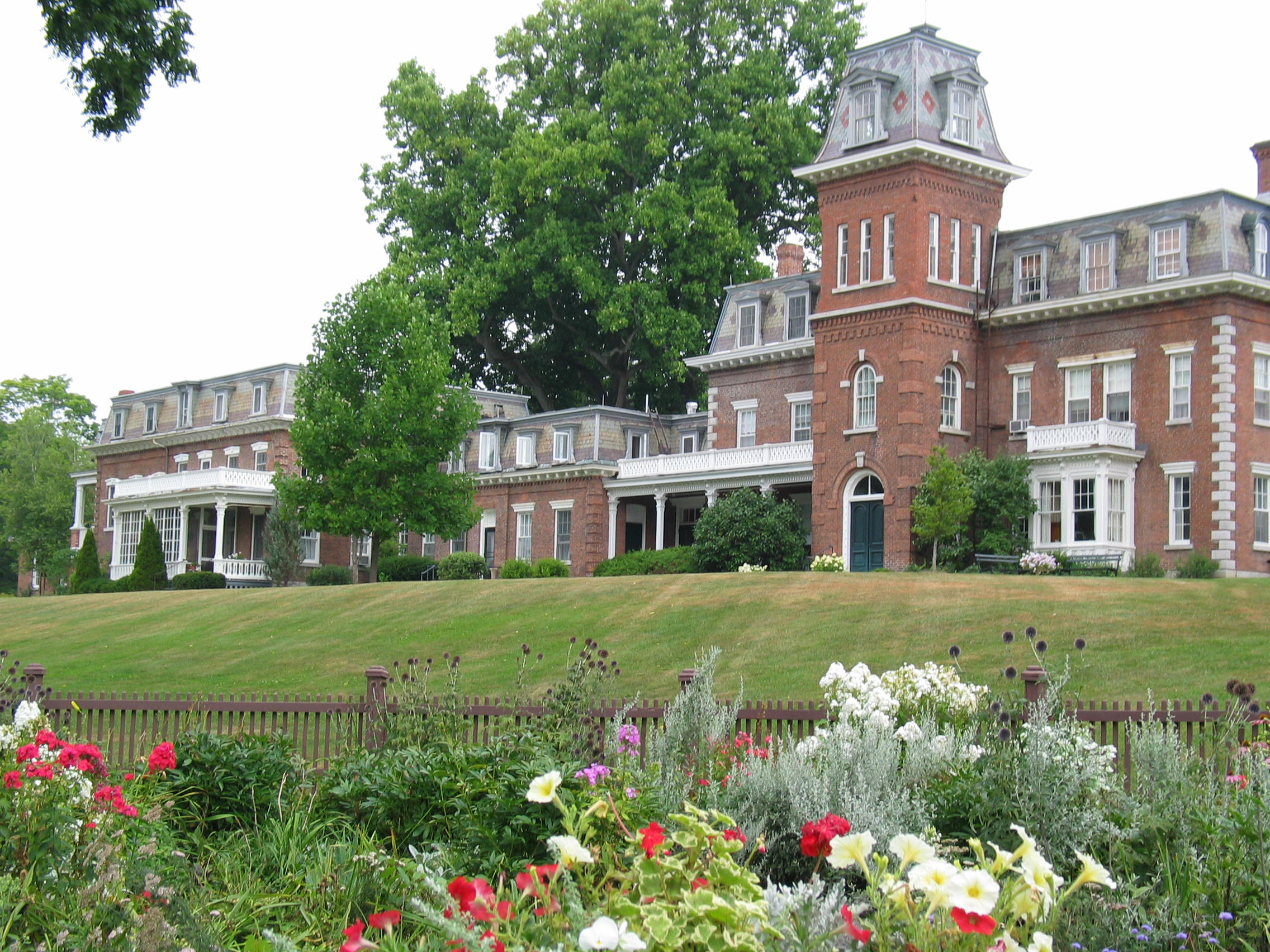
Back in chapter 2, I mentioned the Oneida Community, which I briefly described in a later post. As it so happens, I’m actually attending a conference being held in the Mansion House, the main residence at the Oneida Community, seen here:

Oneida Mansion House

It’s been a busy week, what with this conference and squiring some friends around town. So I’ve been neglecting the blogs. I’ll be catching up next week.

Posted in Dragon Lady, Writing fiction | Tagged , , , , | Leave a comment

Writing on the computer

I recently had to buy a new laptop. The old one had inadequate memory, and not only had its battery died, but even its clock battery had died. (I had to reset the time every time I powered it up.) In the process, I realized just how complicated writing has become.

When I was a college student, I had three tools: my books, the college library, and my typewriter. I composed while typing. Hence I had to use corrasable paper, which allowed you to erase what you had typed and type over again, without being as obvious as white-out.

Now, just to write The Dragon Lady of Stockbridge, I still have my books and a nearby university library. I’ve chucked the typewriter and corrasable paper for a laptop and word processing software. But that’s not all I need anymore, thanks to the laptop. I need my old files of drafts and ideas, browser bookmarks of useful sites for facts and pictures, the books and images I’ve downloaded, the articles I’ve pulled from scholarly databases, all my accounts and passwords, and all of the various software programs (not to forget the high-speed Internet connection and electrical outlet) to support all this.

It’s not obvious how complex all this is until you have to transfer it from one computer to another, particularly when that involves upgrading across a few generations of software. For example, compared to typewriters and corrasble paper, word processing makes my writing so much easier. However, the new version of my word processing software uses new file formats and has significantly restructured the user interface. I’m going to have to port my files, convert the more important ones, straighten out problems created by the conversion, and spend some time figuring out the important differences in the new software.

Multiply that example by 10, and toss in a few unexpected twists (such as the boot block becoming corrupted on the new laptop, forcing me to reinstall the factory software image), and the amount of work needed just to continue what I was already doing is daunting. Yet I can’t live and write without it. It’s a richer environment, and a easier one to use, once I get the hang of it.

My story, The Dragon Lady of Stockbridge (which you can read here as it goes up a chapter a week), is a fantasy about magic, but the computer really is magical. Imagine a dutiful amanuensis who instantly takes down and formats everything you write, will provide you with endless related information if you but ask, and will print out a book in minutes. True, sometimes it crashes, and you’d better back up your files, but, hey, medieval scribes would get drunk and spill wine on the parchment and have to start over. And they were a lot slower and more error-prone. All this from a device that originally took up a whole room just to do calculations!

ENIAC 1946 (U.S. Army photo.)

Posted in Uncategorized | Tagged | Leave a comment

Chapter 5 of Dragon Lady is up

“Unintended consequences” is the title of chapter 5 of The Dragon Lady of Stockbridge, and that’s what Rebecca faces. Magic can do all sorts of things for you. But they aren’t always the things you expected! If you’ve been following along, read the new chapter. If you haven’t been reading my story of magic in the Gilded Age so far, start at the beginning.

Chapter 6 should go up a week from today, by noon, as scheduled. However, I’m going to be on the road, and using a new laptop as well, so there could be “unintended consequences” for me. Like Rebecca, I’ll try to cope with them. Sometimes I think it’s easier to deal with magic than with new software. Magic, at least, has rules.

Posted in Dragon Lady, Writing fiction | Tagged , , , , | Leave a comment

Using magic in fiction

Including magic in your fiction is probably the most dangerous thing you can do, short of writing explicitly about sex. Sex will only excite or bore your readers (probably both). Magic can disrupt your metaphysical framework, create major flaws in your narrative, and make you a habitually lazy writer. And it will drive off a fair number of your potential readers, either because they don’t like stories with magic, or they find your use of it to be incomprehensible, manipulative, or destructive to your story’s credibility.

So when I decided to use magic in my fiction, I thought the most sensible thing to do was to look at actual manuals of magic, grimoires, to see how to structure a plausible and consistent system of magic. After all, James Blish had used actual grimoires for Black Easter (1968). Certainly I could do as well. I picked up some copies of old grimoires and read through them, stumbled on Owen Davies’ Grimoires: A History of Magic Books (2009), and spent some time on Joseph Peterson’s web site Twilit Grotto: Archives of Western Esoterica. I mention his web site in part because I used Peterson’s printed editions of The Lesser Key of Solomon and The Sixth and Seventh Books of Moses in my readings.

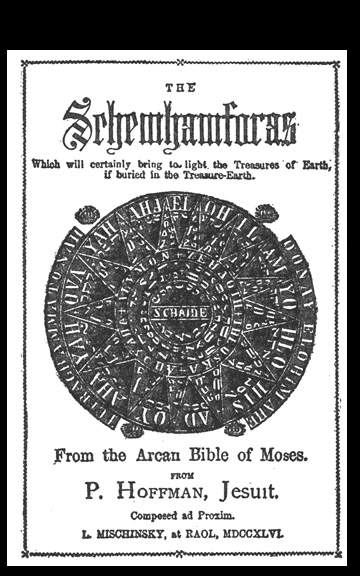
Many of these works are illustrated with diagrams that one uses in invoking spirits of one kind or another. Here’s one such diagram from an English language edition of The Sixth and Seventh Books of Moses. Many American editions of the work, including this one, were illustrated with negatives of the original images. (Peterson restored the original versions for his edition.)

Blish had wondered why he had never read a book based on “what real sorcery had to be like if it existed, although all the grimoires are explicit about the matter.” Considering that Blish seems to have done quite a bit of reading, this was a very odd statement for him to make. It doesn’t take reading more than a few grimoires before one realizes that they do not embody one consistent theory of magic. Part of this no doubt reflects the realities of their existence. To become popular, a grimoire had to promise insight into the metaphysical reality, and either deliver real magical powers, or offer the possibility of doing so without actually delivering. Consequently, grimoires often offer elaborate, confusing, and incomplete instructions, dressed up in elaborate explanations.

Unfortunately, the reality of using magic in fiction is that it must provide the means or the metaphysics needed to support the plot and themes. Confusing and elaborate rituals are great for color, but inconvenient for plot. It’s hard to scare up a goat and a planetary conjunction every time you need one. Blish could use a selection of grimoires (mostly various “Keys of Solomon”) because the point of his story was tightly connected to the metaphysics of those grimoires: magicians use the power of God to compel demons to perform evil. However, there are an infinite number of possible uses for magic in fiction that could not possibly use the Western grimoires. Lovecraft needed his Necronomicon not just because he didn’t have access to any real grimoires when he first started writing, but because his stories ultimately depend on a completely different set of metaphysical assumptions than the Christian ones found in the grimoires.

Oddly enough, one of the reasons I ultimately rejected using the grimoires as the basis for my fictional magic is the same as one of the reasons Blish used them. He wanted to show that practicing magic has moral consequences. So do I. But Blish could show those consequences only at a cosmic level, while I want to connect them to every individual act, which is not possible with the grimoires (or, at least, not easy).

The other reason I rejected using the grimoires is that much of their logic is metaphorical or alchemical. That’s interesting in its own right. However, it’s not what I wanted for this story. The logic of magic in The Dragon Lady of Stockbridge is essentially scientific. Not that in 1886 practitioners know much about that scientific logic. In that respect, they are still on the frontier, knowing just a few of the broad rules. As with physics, chemistry, and biology, it will take years of work by a community of magicians to sketch out the logic of scientific magic.

Posted in Dragon Lady, Writing fiction | Tagged , , , | 3 Comments