Review: Women ghost story writers of the Victorian Age

Ever since the Women’s Lib movement of the 1960s, editors have produced endless anthologies of stories written exclusively by women to prove that women can write as well as men, and to bring undeservedly obscure female authors to our attention. It must be said that by now we all agree women can write as well as men. And as badly, as it turns out, for sometimes in their enthusiasm, these editors resurrected authors who might best have remained obscure.

And so it is with the ghost story. The best-known masters of the field are men: Poe, Sheridan LeFanu, M. R. James, and toss in your favorite contemporary author. Yet there have been some great ghost stories written by women. Therefore it was with some interest that I picked up a volume edited by Richard Dalby entitled Victorian Ghost Stories: By Eminent Women Writers (New York: Carroll & Graf Publishers, Inc., 1988).

Surely Elizabeth Gaskell is too young and pretty to write horror stories!

Surely Elizabeth Gaskell is too young and pretty to write horror stories!

Editors of retrospective anthologies such as this one have a tough job. There are a small number of stories that are considered classics, and have already appeared in many other anthologies. Does the editor include them, and bore the connoisseur, or leave them out, and frustrate the reader looking for a definitive collection? Dalby includes two classics, Mrs. Gaskell’s “The Old Nurse’s Story” and Mrs. Oliphant’s “The Open Door,” but chose to bypass classic tales from Amelia B. Edwards and Mary Wilkins Freeman for some of their lesser-known stories that are good, but not their best. Word of warning to readers: that single story you read in an anthology may not be representative of the author’s work.

Again, an anthology is expected to contain a certain number of well-known authors. But the best women writers of ghost stories by and large are an unfamiliar lot to anyone who doesn’t already read ghost stories. So we get a pedestrian story from Willa Cather and a selection out of Charlotte Brontë’s juvenilia which does not do that author justice. At least the workhorses of the Victorian ghost story are well represented, including Mary Elizabeth Braddon, Vernon Lee, Mrs. J. H. Riddell, and Violet Hunt.
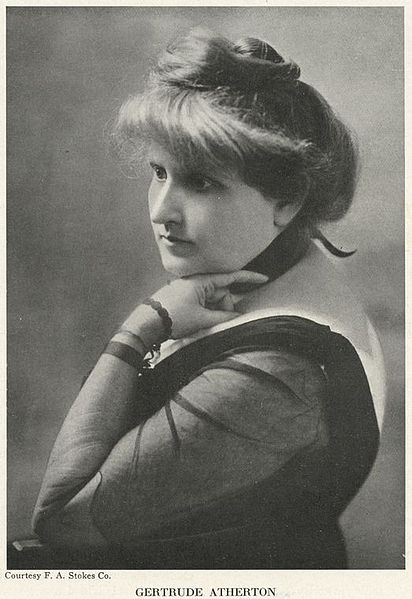
Gertrude Atherton, probably thinking how nice you'd look as a corpse

Gertrude Atherton, probably thinking how nice you’d look as a corpse

I must give the editor full credit for finding obscure authors, for I did not recognize eleven out of the twenty-one authors in this collection. And that was surprising, since some were very well-connected. Rosa Mulholland worked with Charles Dickens, Rhoda Broughton was J. Sheridan LeFanu’s niece, Gertrude Atherton was a friend of Ambrose Bierce, and Louisa Baldwin was related by marriage to Rudyard Kipling and Edward Burne-Jones, besides being the mother of a Prime Minister! And while none of these obscure authors rises to the first rank, based on the stories here, several of them are not far behind: Dinah Mulock Craik, Rosa Mulholland (Lady Gilbert), Mary Cholomondeley, and Gertrude Atherton.

Besides the two classic stories, my favorites here include Mary Elizabeth Braddon’s “The Cold Embrace,” which ought to be a classic; Vernon Lee’s “Winthrop’s Adventure,” which showcases that adventuresome author’s knowledge of Italian music; and Violet Hunt’s “The Prayer,” which lives up to the title of her collection of stories, Tales of the Uneasy. Why do I like them? Because each is distinguished by good writing, intriguing situations, and a good, hearty interest in mortals and ghosts alike. All are also mildly horrific, with Violet Hunt’s being the most disturbing the more you think about it.

C'mon, after that description you want to know what Vernon Lee looked like, and this is how John Singer Sargent saw her

C’mon, after that description you want to know what Vernon Lee looked like, and this is how John Singer Sargent saw her

In reviewing this anthology, I also looked up biographical information on these women. By and large, they seem to have taken to the pen to support themselves, because they were single, widowed, or had a husband who could not hold a steady job. Making their way by their pens, in an era when women were expected to be active only in the domestic sphere, must have been very tough for these women. Many made their reputation with escapist “sensational” novels or serious “social” novels, with ghost stories as a sideline. A few even achieved fame in more than one field. Amelia B. Edwards was not just a writer of “sensational” novels, but a noted Egyptologist. And Vernon Lee (real name: Violet Paget) was an expert on 18th century Italian music and an essayist, as well as being a cross-dressing lesbian expatriate!

I went hunting for more supernatural stories from these authors. Many of the obscure authors are long out of print, and even some of the better-known ones only have print-on-demand or electronic reprints of old editions to represent them. Still, there have been recent paperback collections for Gertrude Atherton, Amelia B. Edwards, Mrs. Gaskell, Vernon Lee, and Mary Wilkins Freeman, and you might find collections for Mrs. J. H. (Charlotte) Riddell or Mrs. (Margaret) Oliphant in your library. Otherwise, since these authors’ works are long out of copyright, there are probably online copies available. I’ll likely read one of these collections for my annual “moldy oldy” Halloween reading. So you’ll be seeing a follow-up from me around the 30th.
Posted in Reading fiction, Reviews | Tagged , , , , , , , , , , | 9 Comments

Chapter 34 of Prophecies and Penalties

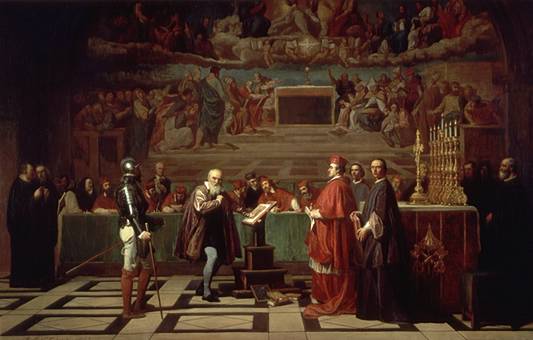
Galileo renounced the heliocentric theory, too. Look what good that did.

Galileo renounced the heliocentric theory, too. Look what good that did.

Alex Bancroft was supposed to be the Prophesied One. Everyone said so but him. Now he’s told Emily Fisher she’s the Prophesied One, and she’s no more happy about it than Alex was. Which adds a certain tension when Emily Fisher poses the $64 question to Alex: if he can see the future, did he know that Stephen Nash would be murdered? Seems like everyone is taking a tumble in “Renunciations,” chapter 34 of Prophecies and Penalties, available now for your reading pleasure.

Posted in Prophecies and Penalties, Writing fiction | Tagged , , , , , | 2 Comments

Wishes for a birthday

May you stand at your ease,
a creature to behold;
the sun on your face,
lit by a smile from within;
the land spread out before you,
its beauty matching your own.

May a trove of good wishes
fall upon your shoulders
and lighten your spirits.
May the day reward your good deeds,
the evening bring warm hopes for the future,
and the night a sound rest.

"On the Hudson River Near Irvington" - Albert Bierstadt (1830-1902) c. 1866-70

“On the Hudson River Near Irvington” – Albert Bierstadt (1830-1902) c. 1866-70

Posted in Uncategorized | Tagged , , , , | 7 Comments

Chapter 33 of Prophecies and Penalties

Nothing personal, Alex, but I have a few questions for you . . . and this time, I want ANSWERS!

Nothing personal, Alex, but I have a few questions for you . . . and this time, I want ANSWERS!

The showdown on top of Sacred Mountain is over. Emily is herself again (or at least she thinks so). But what exactly happened up there and why? And what has happened to the others who were up there? Emily gets the opportunity to grill Alex Bancroft, and this time she’s not going to let go. Read what she finds out in “Consequences and questions,” chapter 33 of Prophecies and Penalties, my weekly serial about a murder on a religious commune in Vermont.

Posted in Prophecies and Penalties, Writing fiction | Tagged , , , , , , | 5 Comments

Chapter 32 of Prophecies and Penalties

It's not quite the Battle of White Mountain, but the outcome is equally one-sided

It’s not quite the Battle of White Mountain, but the outcome is equally cataclysmic

Lavinia Priest constructed the plaza atop Sacred Mountain, the spiritual center of the Children of the New Revelation. Lavinia’s ghost controls Emily Fisher, her descendant, who is trying to uncover who has set the Children at odds with each other. And now Lavinia comes to Emily’s defense against the enemies who have seized and drugged her. Or is Emily coming to Lavinia’s defense against those who would oppose Lavinia’s designs? If anyone knows for sure, it’s not Emily! Nevertheless, she is pressed into service in “The Battle of Sacred Mountain,” chapter 32 of Prophecies and Penalties, my weekly serial about a murder investigation at a religious commune in Vermont. If you’re not already reading this story, you can start with chapter 1.

Posted in Prophecies and Penalties, Writing fiction | Tagged , , , , , , , | 2 Comments

Chapter 31 of Prophecies and Penalties, and an intriguing picture

Lavinia didn't actually have to throw Emily into a trance; controlling her dreams was sufficient!

Lavinia didn’t actually have to throw Emily into a trance; controlling her dreams was sufficient!

Emily Fisher has been emotionally conditioned to submit to her ancestress, Lavinia Priest. Bad enough that Lavinia’s been dead over a century. Worse that she was, in Alex Bancroft’s words, “barking mad.” But what does she want? And how can Emily help her? Find out in “Serving Lavinia,” chapter 31 of Prophecies and Penalties, my serial about a murder investigation on a Vermont religious commune. If you’re not already reading this story, you can begin at the beginning.

The image, by the way, is originally from the 1891 volume of Cassell’s Family Magazine Illustrated, a British periodical, for a story called “Tracked: A Mystery of the Sea,” by the Rev. C. N. Barham, illustrated by W. H. Margetson. The story, which purports to be true, explains the fate of a missing ship by using clairvoyance. In typical nineteenth-century fashion, a superior male, the minister-narrator, hypnotizes an inferior female, a servant, to use her clairvoyance to solve the mystery.

Of the Rev. Barham I have been able to learn very little, not even his vital statistics. He was British, presumably a divine in the Anglican Church. He must have traveled to India as a missionary at one time, and retained an interest in propagating the gospel abroad. He later lived in Kent, where circa 1836 he married the daughter of a British esquire who lived in Calcutta. He apparently wrote religious songs in the 1860s, and was contributing to British literary magazines in the 1890s. Several websites confuse him with Richard Harris Barham, who was also a divine and who wrote The Ingoldsby Legends.

W. H. Margetson turns out to be William Henry Margetson (1861 – 1940), best known for painting pictures featuring beautiful women. He must have supplemented his earning as a painter by doing magazine work. I looked at quite a few images of his painting, and I must say he does indeed do a good job with beautiful women. Here are two examples:

"At the Cottage Door" by William Henry Margetson

“At the Cottage Door” by William Henry Margetson

"Poseidon's mistress on the shore" by William Henry Margetson

“Poseidon’s Mistress on the Shore” by William Henry Margetson

Posted in Prophecies and Penalties, Writing fiction | Tagged , , , , , , | 2 Comments

Review: Tim Powers unleashes the Nephilim on 19th century poetry

With my own interest in history and sci-fi/fantasy, it was probably inevitable I’d get around to reading some of novels by Tim Powers. Recently, I bought Hide Me Among the Graves (2012) at a bookstore warehouse sale, and had to pick up its predecessor, The Stress of Her Regard (1989).

It's fitting that Polidori becomes a vampire because in real life he introduced vampires into English literature

It’s fitting that Polidori becomes a vampiric Nephilim because in real life he introduced vampires into English literature

Ominous sounding titles, eh? Well, Powers postulates a race of stone-like beings, identified with the Biblical Nephilim, who have supernatural powers and prey on humans in a sometimes destructive, sometimes symbiotic arrangement. If you’re lucky, you’ll have a long life, write great poetry, and have a truly hypnotic lover. If you’re unlucky, the things will crush your body or mind. And they are jealous, tending to brutally kill off any other loved ones you have.

The Stress of Her Regard treats the relationship of these things to the Romantic poets Byron, Shelley, and Keats, while Hide Me Among the Graves cover subsequent developments among the Rossetti family and their acquaintance, the poet Swinburne, a few decades later. A fictional

Give Powers credit: he recognized that Rossetti had already turned his wife into something supernatural

Give Powers credit: he recognized that Rossetti had already turned his wife into something supernatural

family, the Crawfords, helps unite the two stories. Oh, did I mention that these Nephilim can appear as if they are human? One of them usually appears as Doctor Polidori, the least talented of that gathering of Romantic writers that produced the novel Frankenstein. Another appears as the ill-fated Lizzie Siddal, who married Dante Gabriel Rossetti and died two years later.

Powers did an excellent job of researching the history of the era and his historical figures. He ties the plot to real events in their lives, and even uses their poetry to provide an eerily appropriate atmosphere for these fearsome tales. I should do as much research and get it into my stories.

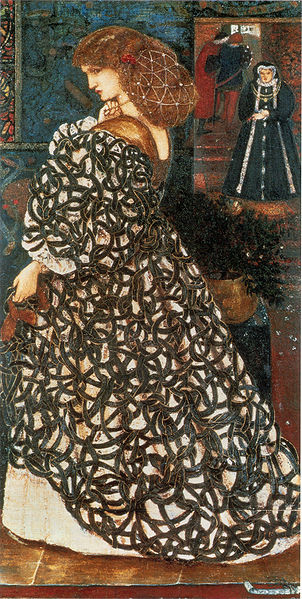
And to complete the loop, the most famous portrait of Sidonia was painted by Edward Burne-Jones, who, like Dante Gabriel Rossetti, was a member of the Pre-Raphaelite Brotherhood

And to complete the loop, the most famous portrait of Sidonia was painted by Edward Burne-Jones, who, like Dante Gabriel Rossetti, was a member of the Pre-Raphaelite Brotherhood

Unfortunately, this creates two problems. The first is what I call the “Sidonia Problem,” after Wilhelm Meinhold’s Sidonia the Sorceress (1847): the difficulty of fitting the motivation of a single fictional individual to fit actual historical events over many years. This is particularly a problem with the earlier The Stress of Her Regard, which strains to explain the many deaths surrounding Byron, Keats, and Shelley by far too many plot twists and far too little explanation of the motivation of the Nephilim. Hide Me Among the Graves is far more successful in this regard, hanging more fiction on fewer specific historical events to produce a more dramatic plot.

Now Powers does something I admire, namely not give us the instruction manual for his Nephilim. Far too often, fantasy fiction assumes that somehow everyone knows exactly how supernatural beings work. (The prologue to the movie Highlander is an obvious offender. Who in blazes told the Immortals about the Gathering?) What people know of the Nephilim is based on experience and folk tradition, and doesn’t always work as planned. However, thanks to Powers’ overwhelming attention on the historical characters and historical detail, the Nephilim are slighted, and appear a bit too obscure and mysterious. Again, Stress is the worse offender, though Graves had me dropping my jaw in the scene where Polidori tries to crush a human’s personality.

I’d known Powers previously only from his early The Drawing of the Dark (1979), a sprightly fantasy about the Turkish siege of Vienna in 1529, which I enjoyed. Stress and Graves show Powers has developed both as a stylist and as a writer of historical fiction. I think the Sidonia problem hurts The Stress of Her Regard too much to recommend it. Hide Me Among the Graves is a more satisfying read. My only reservation in recommending it is that some of the background information for Graves is in Stress, and I’m not sure how easy it would be to follow Graves without reading Stress.

Posted in Reviews | Tagged , , , , , , , , | 5 Comments

An apology for the duplicate posts

Somehow I accidentally put up the most recent post on chapter 30 of  Prophecies and Penalties twice. I regret the error. The proper links to the post and chapter are above.

Posted in Prophecies and Penalties | Leave a comment

Chapter 30 of Prophecies and Penalties, and a notice about posts

Prophecies and Penalties, my serial about a murder on a Vermont religious commune, has hit the thirty chapter mark! Hoorah! Emily Fisher, not-exactly-professional detective of this story, proclaims, “I am a gifted individual” in chapter 30. Oh, but the Trojans could tell her something about gifts, particularly gifts one doesn’t fully understand. Not everyone can vomit up gallons of water on dry land, and one really, really should look into such things before they cause more problems. As they will . . .

If you’re not already reading this story, you can start here.

My policy for some time has been to post twice a week, with a new chapter of the current serial on Fridays and another post, on whatever subject, on Monday or Tuesday. I’ve now missed the “other” post, the Monday/Tuesday post, twice in three weeks. Unfortunately, due to personal circumstances, I can only commit to posting on Fridays for the next few months, and hope I can get out a Monday/Tuesday post now and again. Sorry about that. I’ll return to my old schedule when other demands on my time become less pressing.

Posted in Prophecies and Penalties, Writing fiction | Tagged , , , , , , , , | 2 Comments

Chapter 29 of Prophecies and Penalties

It's that kind of day for Emily, again

It’s that kind of day for Emily, again

After her encounter by moonlight with the spooky Stacia Fletcher, Emily Fisher faces the light of day with new enthusiasm and plans for tracking down Stephen Nash’s killer. She’s going to need that enthusiasm. It’s not just that she’ll have to lie, face death, and be taken for a demon. No, Emily’s real problem is that she must go among “The damned and the demented” in chapter 29 of Prophecies and Penalties, my serial about a murder on a Vermont religious commune.

Posted in Prophecies and Penalties, Writing fiction | Tagged , , , , | 2 Comments