Starting part 2 of Magician’s Misfortune

If you haven’t already, meet Harry Eberhardt. Harry is a magician in the employ of the Office of Occult Affairs, the U.S. Government’s agency charged with dealing with magical threats to the country. Harry has not been a great success in the Office as of late. In fact, he’s stationed in the worst branch of the organization, protecting thousands of square miles of the most desolate parts of the American West.

Harry’s a demon slayer, a damn good one, he’d tell you. So when he got put on a case involving a demonic serial killer traveling the Interstates, he thought of it as his opportunity to make a comeback and get transferred back to D.C.

Part I of Magician’s Misfortune, “Search for the Demon,” covers Harry’s misadventures while trying to track down and kill this demon. Along the way, his life has got tangled up with Persephone Désirée Arabia Nightfeather Sanderson, another magician who somehow is key to this whole affair. At the end of part I, Sanderson was confronting the serial killer demon while Harry was being stomped by other demons.

Several days have passed as part II, “Search for Sanderson,” opens with chapter 16, “Lost.”

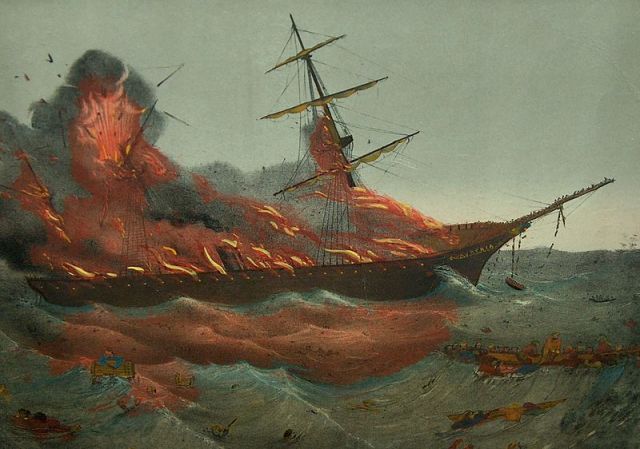
(SS Austria, destroyed by fire at sea, 13 September 1858)

(SS Austria, destroyed by fire at sea, 13 September 1858)

Posted in Magician's Misfortune, Writing fiction | Tagged , , , , , | Leave a comment

Chapter fifteen of Magician’s Misfortune

This may not end well

This may not end well

What has gone wrong with the team searching for their demon-possessed colleague? Why don’t the phones work? Harry Eberhardt is facing the possibility that this demon hunt has turned into a fiasco once again. And then one of his colleagues suggests a course of action that could save them all, or lead to utter disaster! Granted there will be “Questionable choices” in chapter 15 of Magician’s Misfortune, but just what will the consequences be?

Posted in Magician's Misfortune, Writing fiction | Tagged , , , , , | 2 Comments

Harry hits the road in chapter 14 of Magician’s Misfortune

“It’s my way and the highway,” Persephone Désirée Arabia Nightfeather Sanderson tells Harry Eberhardt after deciding not to kill him. Seffie gets pissed off at men turning up in her bed uninvited, especially when they don’t even come in through the door. It doesn’t help that Harry doesn’t have a very good explanation for how he turned up in Sanderson’s motel room. So Harry finds himself pressed into being a chauffeur as Sanderson carries on with her quest to find Deecee Young and expel the demon possessing her. It’s a “Road trip” neither will forget in chapter 14 of Magician’s Misfortune.

Worst road trip? This is a picture of Donner Pass.

Worst road trip? This is a picture of Donner Pass.

Posted in Uncategorized | 2 Comments

Lucky (for Harry) chapter thirteen of Magician’s Misfortune

Harry Eberhardt has crappy luck. He’s now the sex slave of Dr. Candy Knox, who takes “dressing down” to mean dressing ugly or not at all. He needs to communicate with Abigail Lane, who’s been dead for the better part of a century. And he needs to keep Persephone Désirée Arabia Nightfeather Sanderson from her nasty fate . . . if only he knew what that fate is! There’s one thread binding together all these issues, “The morality of magic,” in chapter 13 of Magician’s Misfortune, my weekly serial about a demon-slayer working for the government who is getting in way over his head. If you’ve not been reading it before, you can start at the beginning; chapters are hyperlinked to each other for easy reading.

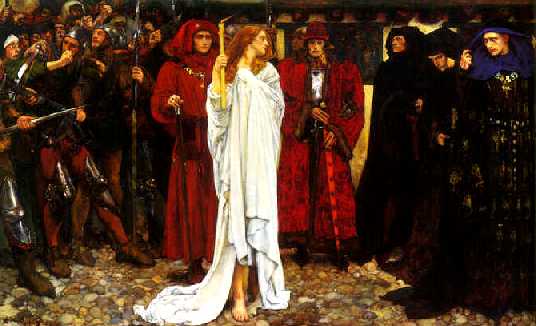
The painting below sums up some of the threads in this chapter, but deserves more of an explanation that I can fit in a caption. Eleanor Cobham (c. 1400 – 1452) was the attractive daughter of a baron who arranged for her to be a lady in waiting to Jacqueline, the Duchess of Gloucester. As sometimes happen, Eleanor attracted the attention of her lady’s husband, Humphrey, who was not only Duke of Gloucester, but uncle to King Henry VI. Humphrey first took Eleanor as his mistress, and then had his marriage to Jacqueline annulled so he could marry Eleanor in 1428.

Eleanor was now Duchess of Gloucester, rich and powerful. But her husband had many political enemies, and they looked for a way to engineer his downfall. Sadly, Eleanor provided them with a pretext: she’d gotten involved with magic. She’d consorted with the Witch of Eye and obtained an astrological forecast of the king’s life, which showed a serious illness in his future. The word got out, and those involved were arrested in 1441. The Witch of Eye was burned at the stake, and while one of the astrologers died in the Tower, the other was hanged, drawn, and quartered. Eleanor was forced to divorce her husband and do penance before being imprisoned for the rest of her life. Her husband retired from politics in disgrace, and died in 1447 before he could be tried for treason.

The painting shows Eleanor doing her penance. It was executed by Edwin Austen Abbey (1852 – 1911), best known for his murals on the Quest for the Holy Grail in the Boston Public Library. Abbey, who did many painting based on Shakespearean scenes, probably knew the story from the inaccurate version in Shakespeare’s Henry IV, Part II.

The_Penance_of_Eleanor_(Abbey)

Posted in Magician's Misfortune, Writing fiction | Tagged , , , , , , , | 7 Comments

The 2015 moldy oldie(s): Midwich Cuckoos of the Damned

Every Halloween I dust off a long-forgotten supernatural horror story to read and review. It’s been a busy November, which is why I’m only getting to writing up my review of 2015’s selection today.  This year’s “moldy oldie” is the most recent I’ve ever tackled: John Wyndham’s The Midwich Cuckoos, first published in 1957.

Doesn’t sound familiar? Well, maybe because the movie adaptations didn’t use the book’s title. And yes, I said adaptations, because there were three, sort of. First up was Village of the Damned, released in 1960. It was remade under the same title in 1995. And then there’s Children of the Damned, an odd 1964 cousin to its 1960 predecessor. I watched them all a few days after reading the book.
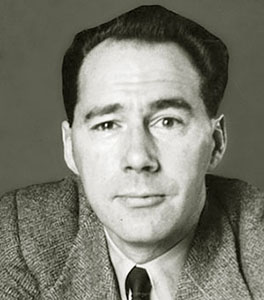
Forget all those other names; just call me John Wyndham

Forget all those other names; just call me John Wyndham

The author behind all these was John Wyndham Parkes Lucas Beynon Harris (1903 – 1969), an Englishman who wrote under various combinations of his names. He first achieved success in the American pulp science fiction market before World War II. After the war, he changed his writing style and his pen name, so it was as John Wyndham that he wrote several major science-fiction novels, beginning with The Day of the Triffids in 1951, which you might know from the movie version released in 1962.

Like several of his novels, The Midwich Cuckoos has its roots in the Cold War and the fear of nuclear annihilation of the human race due to “The Bomb.” While straight treatments of this theme abounded,[i] Wyndham stands the standard treatment on its head. Instead of asking whether humanity would be killed off by the bomb, Wyndham uses evolutionary arguments to demonstrate that humanity will inevitably be killed off by something. And in this novel he proposes an idea of what that something might be: human-like beings superior to us.
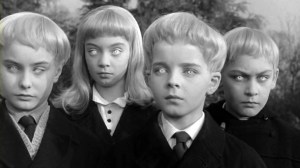
It ain't normal, I tell you!

It ain’t normal, I tell you!

And so the small English town of Midwich is visited in the night by . . . something, and nine months later every fertile woman in Midwich gives birth to unusual-looking children who are genetically not their own. See where the title comes from? Our narrator, one Richard Gayford, serves as our window into the life of the town, its leading intellectual and squire, Gordon Zellaby,[ii] the national security establishment, and the children themselves. Suffice it to say that Zellaby twigs early that there is something most peculiar about the children, while the national security establishment finds itself befuddled by Cold War complications.

This is not an action novel. Most of the exciting events happen off-page. Instead, what we get are Gordon Zellaby’s philosophical musings about what is happening and its significance. This gives the book intellectual depth, though at some cost in pace and tension. Read it for a window into truly speculative science fiction of the 1950s, and reflect on how it might play out today. And the horror? It’s more of a slow intellectual unfolding throughout the novel. No “jump scares” here.
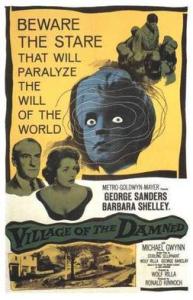
Why does mind control always seem to involve the eyes?

Why does mind control always seem to involve the eyes?

Philosophical musings translate poorly onto the silver screen. So it’s not surprising that the 1960 movie chose to emphasize the children’s ability to mind-control regular humans, partly by bringing to the screen scenes that took place off-page in the book, and adding a few more. The most visceral scene is of a mother who has to plunge her arm into boiling water because she gave her child food that was too hot.

The 1960 movie looks like a low-budget British job, but for all that it holds up fairly well. If it simplified the book’s plot and dropped a lot of the philosophy, it was ingenious in bringing the children to the foreground and making Gordon Zellaby their worthy antagonist.

The 1995 remake was directed by John Carpenter, so you know it was explicitly a horror film as well as a big budget mainstream American movie. The budget certainly helped the special effects become more impressive. And in covering some issues that the 1960 movie chose to
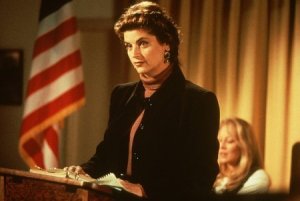
Was making Kirstie Alley play the evil scientist some sort of allusion to her Scientology beliefs?

Was making Kirstie Alley play the evil scientist some sort of allusion to her Scientology beliefs?

overlook, such as the deaths during the “Dayout,” the remake has some truly satisfying moments. Unfortunately, while the 1995 screenplay was adapted directly from the 1960 screenplay, the screenwriters made a number of changes that reduce the coherence of the plot. Dr. Chaffee is a poor substitute for Gordon Zellaby, and the addition of Dr. Verner as the “evil scientist,” while responding to 1990s sensibilities, adds a discordant element that doesn’t do much for the plot.

One of the curious changes between the book and the two movies is the role of women. In the book, women play a significant role between the time they become pregnant and shortly after the birth of the children, but otherwise are background characters. The male characters often interpret women in terms that would seem chauvinistic today. The 1960 movie gave the women even less to do. The 1995 movie, on the other hand, gives much greater play to the women’s roles, especially after they’ve given birth. It’s one of the few major improvements in that version.
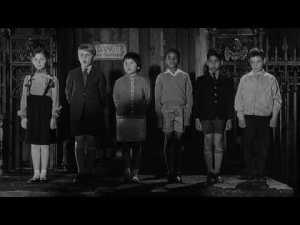
At least Children of the Damned made the evil kids multi-racial. That's progress, sort of.

At least Children of the Damned made the evil kids multi-racial. That’s progress, sort of.

Standing off to the side is the 1964 movie Children of the Damned. In many ways, it’s an inferior retread of the 1960 movie. It’s as if all the philosophical material cut from the first movie made its way into the second one, making it dull and slow-paced. While contemporary reviews say it was meant to show the children in a more positive light, to me it makes the children look worse. True, they demonstrate more emotions than in the 1960 movie and are less likely to strike back at anything other than a deliberate attack.[iii] However, instead of just using their powers to retaliate, they cold-bloodedly take control of a relative to use as their servant and spokesperson, making her into a slave. And they build an engine for large-scale destruction, something they never did in the book or the other films. Sad to say, the Children of the Damned act more like adults than their counterparts in the other versions of the story, and that makes them all the worse.

So which should you watch or read? I’d recommend the original 1960 movie as perhaps the best of the lot, balancing the thoughtfulness of the novel with some genuine action and thrills: a thoughtful horror/sci-fi movie. Go with the novel if you want a deeper experience, the 1995 remake if you need Hollywood pizzazz, but stay away from Children of the Damned, lest you, too, be damned.

[i] Notably Nevil Shute’s 1957 On the Beach and Peter George’s 1958 Red Alert, both of which would be made into movies, though the latter was turned into the black comedy Dr. Strangelove or: How I Learned to Stop Worrying and Love the Bomb.

[ii] Which explains the surname of the “cuckoo” in Seanan McGuire’s Incryptid series, one volume of which I reviewed here.

[iii] When you think about it, those two developments are contradictory. Blame the first movie for making out the children to be unfeeling, a trait not supported by their actions nor the novel.

Posted in Reading fiction, Reviews | Tagged , , , , , | 1 Comment

Chapter twelve of Magician’s Misfortune

Things are not what they appear to be in this chapter

Things are not what they appear to be in this chapter

Harry Eberhardt feels pretty low as he returns to Farnham. His newest colleague is a woman so repellent that even Harry can’t get interested in her. And he finds himself sitting idle and useless while other magicians hunt the demon possessing his colleague Deecee Young. Given a choice between losing himself in his work and chasing women, we know which one Harry will do. But Harry’s in for a surprise . . . no, make that a bunch of surprises. It’s “The world turned upside down” in chapter 12 of Magician’s Misfortune, my weekly serial about a demon slayer whose life just isn’t working out.

Posted in Magician's Misfortune, Writing fiction | Tagged , , , , , , | Leave a comment

Chapter eleven of Magician’s Misfortune

The original woman who could not be a pal: Lady Lillith (painted by Dante Gabriel Rossetti (1828-1882) between 1866 and 1873)

The original woman who could not be a pal: Lady Lillith (painted by Dante Gabriel Rossetti (1828-1882) between 1866 and 1873)

Harry Eberhardt will tell you he has a way with women. Well, with normal, sensible women, i.e., women who see him as charming. Then there are those few women, unnatural creatures, who fail to be impressed with Harry’s sterling character and charming manners. Among those may be numbered the increasingly disturbing Persephone Désirée Arabia Nightfeather Sanderson, who appears to be laboring under some sort of curse, and the redoubtable Valerie Theodora Thompson, Harry’s boss on his current assignment, who’s much more dangerous to Harry than any curse could be. So it’s a pity for Harry that these are the two women he has to spend the day with. As Harry would tell you, “Women are not pals” in chapter 11 of Magician’s Misfortune, my weekly serialized story about a government magician down on his luck in a demon hunt.

Posted in Magician's Misfortune, Writing fiction | Tagged , , , , , , , | 1 Comment

Chapter ten of Magician’s Misfortune

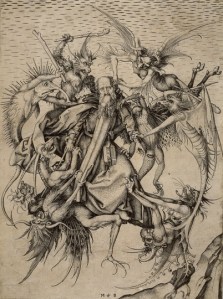
Harry would say this isn't quite as bad as what he's about to go through. (The Temptation of Saint Anthony by Martin Schöngauer (1450-1491)

Harry would say this isn’t quite as bad as what he’s about to go through.
(The Temptation of Saint Anthony by Martin Schöngauer (1450-1491)

Harry Eberhardt may be a crack demon slayer, but having a vortex suck him down to a realm of demons, a hell, is more of a challenge than he’d care to undertake. Unfortunately, he just fell into a vortex. Too bad! And that’s only the start of a journey Harry definitely wishes he was not taking among “The dead and the damned” in chapter 10 of Magician’s Misfortune, my weekly serial about the disasters that befall Harry when he visits the sleepy truck stop of Farnham.

Posted in Magician's Misfortune, Writing fiction | Tagged , , , , , , | 2 Comments

Chapter 9 of Magician’s Misfortune

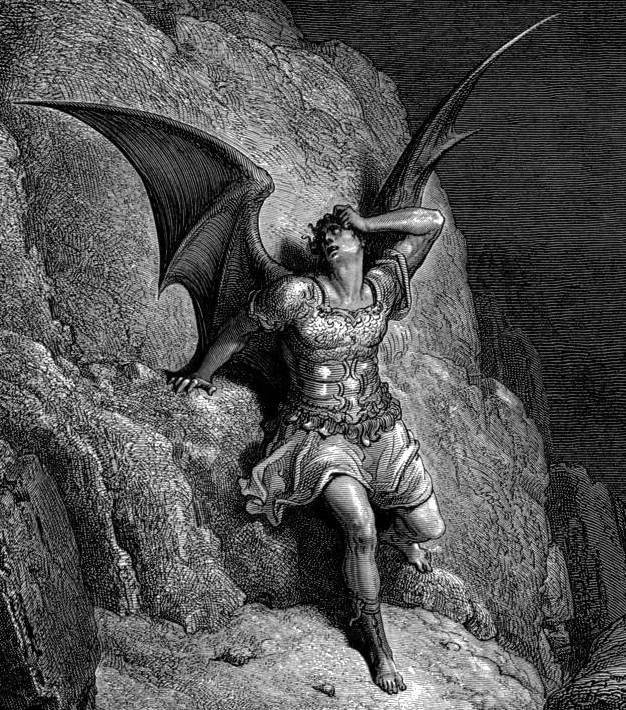
Gustave Dore's depiction of what some call the most sympathetic treatment of the devil, John Milton's "Paradise Lost"

Gustave Dore’s depiction of what some call the most sympathetic serious treatment of the devil, John Milton’s “Paradise Lost”

It’s “Empathy for the devil” in chapter 9 of Magician’s Misfortune as Harry Eberhardt, demon slayer for the Office of Occult Affairs, finds out why having three empaths on the same case is a bad idea. Though he takes a fall for one of them at the end of the chapter!

Magician’s Misfortune is my weekly serial about the misadventures of Harry as he copes with a challenging assignment while trying to navigate his professional and personal troubles. A new chapter comes out every Friday morning. If you’ve not been reading it, you can start at the beginning.

Posted in Magician's Misfortune, Writing fiction | Tagged , , , , , , | Leave a comment

Chapter eight of Magician’s Misfortune

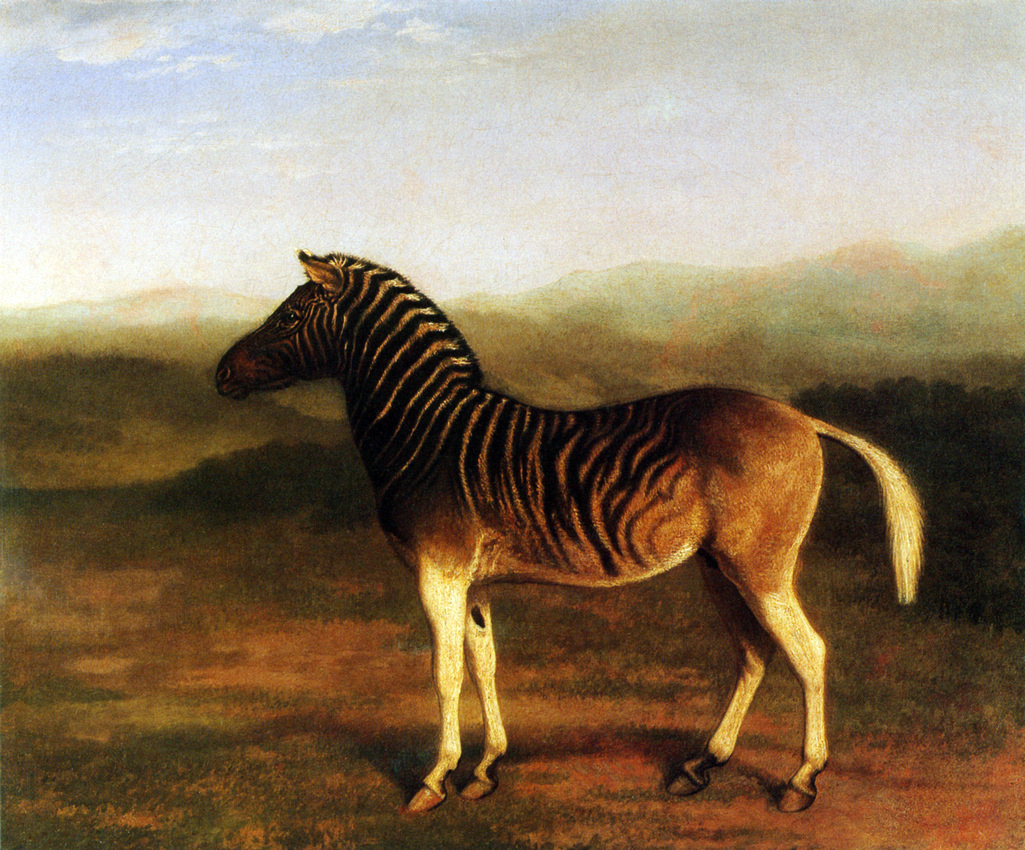
Harry Eberhardt is a busy man. He’s supposed to be helping to catch a homicidal demon which has possessed one of his colleagues. Another of his colleagues has just been stabbed by Harry’s latest love interest. You’d think this would be an action-filled chapter coming up, with Harry taking decisive steps to resolve his problems. You’d be wrong. For the world may demand action, but it runs on conversation. And in chapter 8 of Magician’s Misfortune, everyone is “Chatting with Harry.” Because why not? And yet this chapter has it all, from a drunk doctor to a strip joint parking lot. Though it does not have a quagga. So I’m remedying that deficiency right here.

Quagga painted by Jacques-Laurent Agasse (1767 - 1849)

Quagga painted by Jacques-Laurent Agasse (1767 – 1849)

While millions mourned the demotion of Pluto to a minor planet, hardly a tear was shed when the extinct quagga was demoted from a distinct species to a subspecies of the plains zebra. On the other hand, there’s a project to recreate the quagga, while no one’s suggesting adding mass to Pluto to restore its status as a planet. So there!

Posted in Magician's Misfortune, Writing fiction | Tagged , , , , , | 3 Comments