Chapter 39 of Prophecies and Penalties

There are a few aspects of being the Prophesied One Emily hasn't quite considered

There are a few aspects of being the Prophesied One Emily hasn’t quite considered

The killers have been caught (and killed). Emily Fisher’s job is over. Oh, there’s the little problem that her servant Tanya thinks she’s subconsciously a demon worshiper. And her half-sister Stacia has regressed to childhood, most of the time, something Emily has promised to fix. And there’s one more big problem Emily has been doing her best to ignore. Find out what it is in “The needs of others,” chapter 39 of Prophecies and Penalties, my weekly serial about a murder on a Vermont religious commune. If you’ve not been reading it before, you can start at the beginning.

Posted in Prophecies and Penalties, Writing fiction | Tagged , , , , , | 1 Comment

A Halloween horror story: Death and Professor Appleton

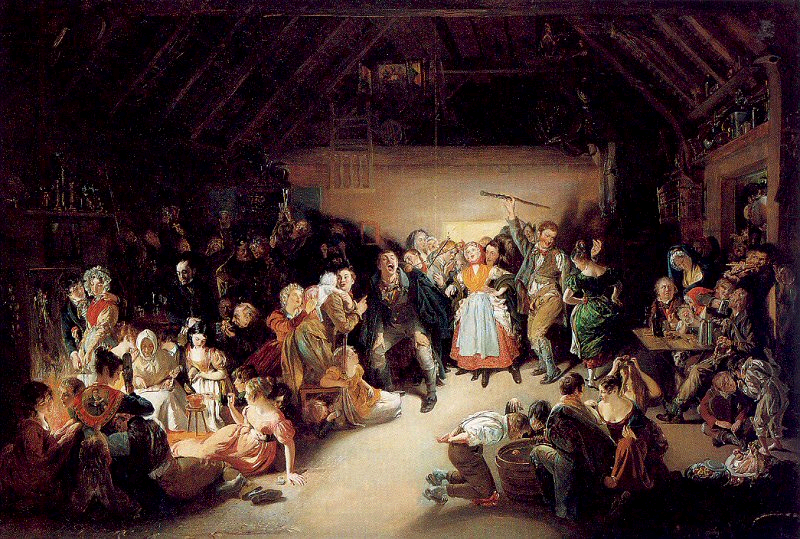
Ah! A good old-fashioned Halloween celebration: dancing, bobbing for apples, telling stories, going home drunk, waking up in the morning with a succubus in your bed . . . "Snap-Apple Night" (1833) by Daniel Maclise (1811-1870)

Ah! A good old-fashioned Halloween celebration: dancing, bobbing for apples, telling stories, going home drunk, waking up in the morning with a succubus in your bed . . .
“Snap-Apple Night” (1833) by Daniel Maclise (1811-1870)

‘Tis the day of innocent trick-or-treaters, candy corn, bobbing for apples, ghosts, witches, and malevolent creatures that will treat your children as hors d’oeuvres before they come to eviscerate you. Yep, it’s Halloween, and time for a short story of the supernatural. This year’s tale, submitted for your approval, is Death and Professor Appleton, and because it starts off in a cemetery, you know it’s going to be a grave tale.

This is the third Halloween horror story to appear on the blog. Its predecessors, On Huckman Causeway (2012) and Dead Cellphone (2013), are still up and available for your reading pleasure, if reading this sort of story is a pleasure to you.

Some Halloween traditions have died out, and it's probably just as well

Some Halloween traditions have died out, and it’s probably just as well

Those of you looking for this week’s chapter of Prophecies and Penalties, my serial about a murder investigation on a rather unusual Vermont religious commune: don’t worry. You’re in the right place, but I posted the chapter a day early. You can go to the chapter directly or via the blog post introducing it.

And, finally, one of my other Halloween traditions is to sit down with a story of supernatural that qualifies as a “moldy oldy:” a long-forgotten story that deserves a second look. This year’s is going to be a collection of short stories, Tales of the Uneasy (1911) by Violet Hunt (1862-1942). I’ll have a post up about it in a few days. If you’re looking for something to read now, then I can refer you to my very recent reviews of two recent collections of short stories by late 19th century/early 20th century authors Vernon Lee and Gertrude Atherton, or past moldy oldy reviews of novels by William Hope Hodgson and F. Marion Crawford.

Posted in Writing fiction | Tagged , , , , , , , , , , , , | 5 Comments

Chapter 38 of Prophecies and Penalties a day early

Circe Invidiosa by John William Waterhouse (1849-1917)

Circe Invidiosa by John William Waterhouse (1849-1917)

Stephen Nash’s killers have been revealed, and they’re now dead. So all Emily has to do is relax, right? If you think “yes,” you’ve read too many mediocre detective novels. The consequences of Emily’s investigation are only beginning to be felt, and Emily is finding out that being involved in people’s lives makes choices much, much more difficult. So she is forced to tell “Lies and things that feel like lies,” in chapter 38 of Prophecies and Penalties, my weekly serial about a murder at a Vermont religious commune.

This chapter is going up a day earlier than scheduled. Tomorrow is Halloween, and Halloween deserves a supernatural horror story. So, instead of a chapter of Prophecies and Penalties, I’ll be posting a horror story, written for the occasion.

Posted in Prophecies and Penalties, Writing fiction | Tagged , , , , , | 3 Comments

Review: Vernon Lee, Hauntings

Vernon Lee wrote in an essay that the supernatural and the arts were diametrically opposed to each other. So, of course, she wrote three collections of supernatural stories over the course of her long (1856 – 1935) life.

Violet Page before she became the androgynous Vernon Lee

Violet Paget before she became the androgynous Vernon Lee

How do we get past such an obvious contradiction? By reading her stories. And there we find the synthesis by which Vernon Lee reconciled her thesis and antithesis. According to Lee, the supernatural thrives on vagueness, suggestiveness, multiple meanings, and connotations, while the arts define and give distinct limits to what they portray. So the resolution is to have the arts suggest, not define. And that is the secret to Vernon Lee’s supernatural stories. Vernon Lee’s ghosts are not some bogeymen out of M. R. James, appearing before mere mortals in frightening form. No, they are stealthy, insidious, all but invisible. It’s hard to tell they are there, let alone what they are.

I mentioned in a recent post that Gertrude Atherton, another writer of supernatural stories, was friends with Henry James. Well, so was Vernon Lee, and Lee shares in James’s subtlety without his ponderousness. Think of James’s The Turn of the Screw, and then wonder that Vernon Lee probably thought that story not quite subtle enough. For Lee’s ghosts are often out of sight altogether, as in “Oke of Okehurst.” Indeed, the ghost of “A Wicked Voice” is but a sound. Even when the supernatural is set directly in front of the narrator, as in “Dionea,” the narrator and the reader are left to wonder, “Did we really see it?”

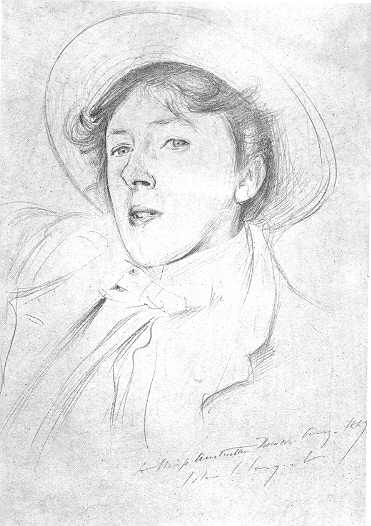
Vernon Lee, eluding the artistry of John Singer Sargent

Vernon Lee, eluding the artistry of John Singer Sargent

Violet Paget, who used the pen name of Vernon Lee, was something of a contradiction herself. She was an immensely erudite woman, recognized as a expert on Italian music of the 18th century, and a popular essayist on learned subjects of the day, yet her works have been mostly forgotten. She was an independent woman who dressed as a man, an English woman who lived most of her life in Italy. She was considered a fascinating, intelligent, and witty conversationalist by many, and yet others found her long-winded, pretentious, and rambling.

If any of this intrigues you, consider tracking down the volume Hauntings and Other Fantastic Tales, edited by Catherine Maxwell and Patricia Pulham (2006), which includes all the stories from Lee’s collection Hauntings: Fantastic Stories (1890), plus three other stories taken from her two later collections. Besides being annotated and more readily available than the original works, this volume also contains Lee’s essay, “Faustus and Helena: Notes on the Supernatural in Art” (1880, 1881) in which Lee explains her views on those two subjects in some detail. Yes, it’s included as an appendix, and no one ever reads those. But read this one first, before you read Lee’s stories. I guarantee you will appreciate her stories all the more.

Posted in Reading fiction, Reviews | Tagged , , , , , | 4 Comments

Chapter 37 of Prophecies and Penalties

The Deserted Village - 1837 Artist: Carl Rakeman (1878-1965)

The Deserted Village – 1837
Artist: Carl Rakeman (1878-1965)

The killer has finally been revealed. Now Emily Fisher finds herself in a life-and-death struggle. Too bad she’s tied up! But this is not a battle that will be won with fists, no. It will be waged over stranger terrain, in ways Emily never could have imagined before she came back to Quasopon. Will she be able to use the lessons she learned in the thrall of Lavinia Priest’s ghost to defeat a  living human opponent? Find out in “The Battle of the Deserted Village,” chapter 37 of Prophecies and Penalties.

Posted in Prophecies and Penalties, Writing fiction | Tagged , , , , , , , | Leave a comment

The parting of ways

I looked for images of "a parting of ways" and kept getting stills from Doctor Who. So here's a fork in the road, instead. (Credit: Jonathan Billinger)

I looked for images of “a parting of ways” and kept getting stills from Doctor Who. So here’s a fork in the road, instead.
(Credit: Jonathan Billinger)

Back a while ago, I mentioned that I was going to be teaching some history courses and set up a blog called Sillyhistory to cover material related to those courses. Well, I’m broadening the scope of Sillyhistory to cover all historical work I’m doing. Hereafter, unless the historical material is related to the fiction I write, it will appear in Sillyhistory, not here.

I know some of you follow this blog for my historical pieces, and it is an inconvenience to switch, or to follow both blogs. However, my work as a historian is cropping up in several other places, and I need one blog to hold them all together. And it has to be Sillyhistory.

Sillyverse will keep going, addressing my own work as a writer of fiction as well as talking about the works of others. So pieces such as the Atherton review that I just posted will continue. And sometimes there will be personal pieces that belong here. That one on caring for a parent and the one about growing up with all sorts of connections to cemeteries belong here, too. But straight history? That’ll be over in Sillyhistory in future.

I hope you’ll join me over at the other blog and follow Sillyhistory, too. Whether or not, I’ll still be talking with you here.

Posted in Uncategorized | Tagged , , | 4 Comments

Review: the supernatural stories of Gertrude Atherton

Atherton's picture from her 1905 collection of short stories, "The Bell in the Fog"

Atherton’s picture from her 1905 collection of short stories, “The Bell in the Fog”

After reading an anthology of Victorian-Era ghost stories by women writers, I decided I would read through a volume of supernatural stories by one of the authors with whom I was less familiar. As it turns out, I’ll be reading three volumes, because I found three I couldn’t resist!

First up is The Caves of Death and Other Stories, a slim volume edited by S. T. Joshi (yes, the Lovecraft scholar) of the supernatural stories of Gertrude Franklin (Horn) Atherton. Atherton (1857-1948) was a native Californian and a distant relation of good old Ben Franklin. From Joshi’s essay and Wikipedia, it sounds as if she made her career writing controversial novels on either sensational or feminist topics, sometimes both. Joshi argues in his afterword to the volume that Atherton deserves to endure as a regional novelist and writer of supernatural tales.

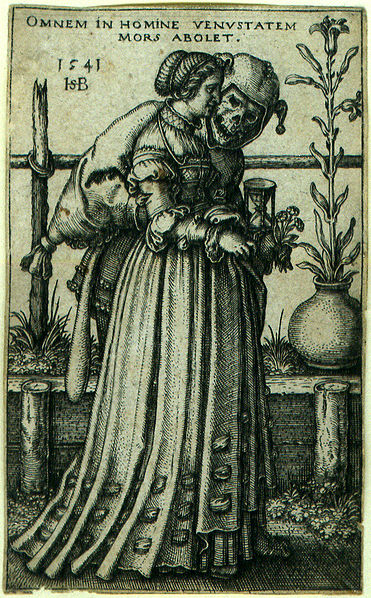
"Death and the Woman" is also a common artistic motif. Sebald Beham (1500-1550) tackled it at least twice, once chastely . . .

“Death and the Woman” is also a common artistic motif. Sebald Beham (1500-1550) tackled it at least twice, once chastely . . .

Caves includes nine short stories. Two Joshi says were previously uncollected; five come from her 1905 collection The Bell in the Fog (which includes five non-supernatural stories as well). Atherton was on friendly terms with both Ambrose Bierce and Henry James (to whom Bell was dedicated), and it shows. A great deal of her supernatural horror is psychological, more akin to Bierce than James in its simplicity. “Death and the Woman,” which features a young wife sitting up alone with her husband on her deathbed, is a prime example; “A Tragedy,” featuring a woman who wakes up after being rejected by a suitor to find that things have changed a great deal, is another.

Despite voicing opinions that would align her with materialists, Atherton was fond of using spiritualism as a starting place for supernatural stories. These can range from simple considerations about the survival of the soul, as in the very effective “The Striding Place,” in which the protagonist tries to save someone from drowning, to the elaborately allegorical, as in the “The Caves of Death,” a description of the afterlife.

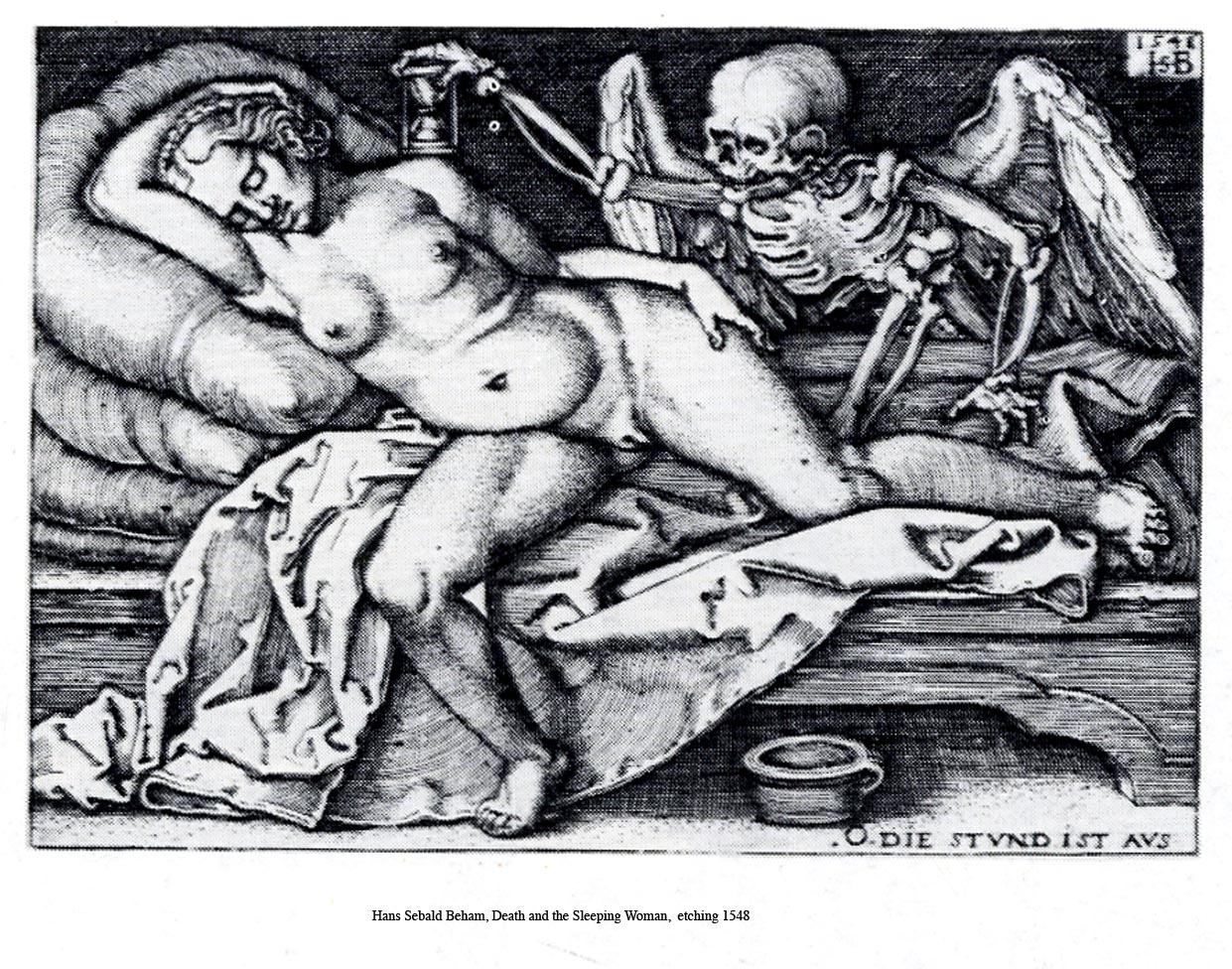
. . . once less chastely. Which one do you think more effective?

. . . once less chastely. Which one do you think more effective?

Despite the conventionality of the spiritual views she offers in these stories, Atherton was both a feminist and social critic. Unfortunately, neither shows up well in Caves. Oh, there are touches of satire in “The Caves of Death” and “When the Devil Was Well,” and “The Dead and the Countess” is primarily a satire on the old Christian view of burial, but none of these are very striking. To see Atherton really take on the shibboleths of her time, you have to turn to the non-supernatural stories in Bell: “A Monarch of Small Survey” makes fun of the self-important rich, while “Crowned With One Crest” disposes of the notion of there being just one and only one person you can ever truly fall in love with. Which makes it perversely funny that another piece in Bell, “A Prologue (To an Unwritten Play)” features every stupid romantic trope of its time.

Overall, I liked Atherton’s work, but it only mildly impresses me. In these stories, she exhibits a narrow range of ideas, and for that, shorter is better, So it’s the shorter short stories that work best, such as “The Striding Place, ” which goes lightly on the metaphysics, and “A Tragedy” and “Death and the Woman,” which don’t run her psychological suspense beyond her abilities. Heavy-handed metaphysics weigh down stories such as “The Caves of Death,” while the psychological horror of “The Greatest Good of the Greatest Number” is carried on longer than Atherton can sustain interest.

The one exception to this is the final story in Caves, “The Bell in the Fog.” Atherton’s protagonist is a complex psychological study, a man who may or may not be dealing with a ghost, or maybe reincarnation. There’s enough here to sustain reader interest in what is in fact the single longest story in the volume. And you’ll come out of the story still wondering exactly what happened. It’s good enough that it makes me wonder if there are any other similar stories by Atherton lurking out there, uncollected. If so, here’s a belated request (Caves was published in 2008) for a follow-up volume.

Posted in Reading fiction, Reviews | Tagged , , , , , , | 3 Comments

Chapter 36 of Prophecies and Penalties

Free of Lavinia’s control, Emily Fisher has to come to terms with how to use her gift while pursuing Stephen Nash’s murderers. Just when is it fair to influence people to say and do things they wouldn’t do otherwise? What is fair use, and what misuse? And how would that apply to someone with a different gift, say like Alex Bancroft’s? This isn’t just a philosophical problem for Emily, as she’s about to encounter a tragic example of misuse, one with deadly consequences. Follow Emily’s quest for the “Abusers and the abused,” chapter 36 of Prophecies and Penalties, my weekly serial about a murder at a very unusual Vermont religious commune. If you’ve not already been reading this story, don’t start with the current chapter whatever you do! Start from the beginning.

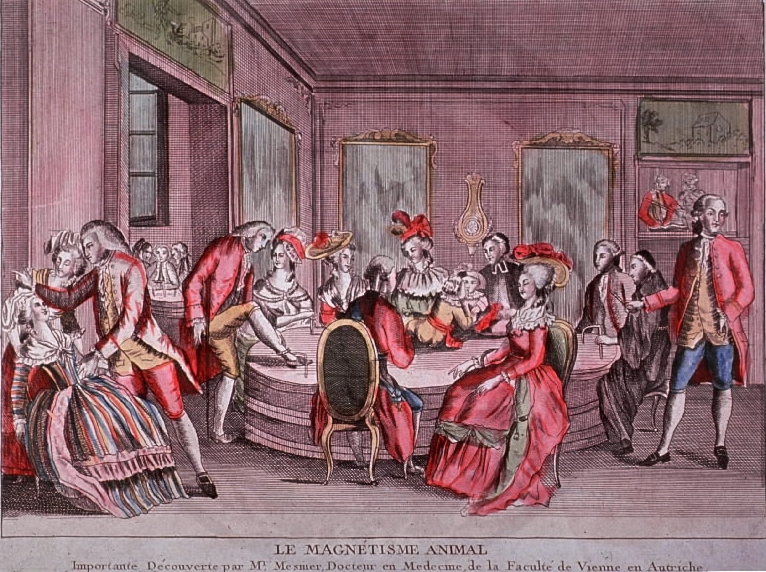
The ethics of Mesmer's treatment of patients with animal magnetism were equally debatable. Was he offering a valuable psychiatric service, or taking advantage of sexual hysteria?

The ethics of Mesmer’s treatment of patients using animal magnetism were equally debatable. Was he offering a valuable psychiatric service, or taking advantage of sexual hysteria?

Posted in Prophecies and Penalties, Writing fiction | Tagged , , , , , | 2 Comments

Bicycle travels: Nashua River Rail Trail

IMG_0646

Harnessing the power of the river

This story begins almost two centuries ago, when the mills came to New England. They built great cities; Waltham and Lowell were but the first. And these cities sat on rivers, for the mills needed water power to run their great machines, and to dump the chemical wastes from their production. And so men made money producing clothing for the many, while the local rivers ran brown and yellow and green from the mills’ wastes.

Next came the railroads, the iron horses that made transportation cheap and reliable. They required routes that neither rose nor fell too steeply, nor took very sharp curves. So the governments granted them rights-of-way by eminent domain, and the railroad construction crews cut through mountains and bridged rivers to blaze a trail for the freight and passenger trains to come. And just as with the factories, towns and cities grew up along the railroads, and those towns bypassed by the rails declined in importance. Truly it was a matter of life or death to a community where the trains should run.

Downtown Ayer today

Downtown Ayer today

Rising in north central Massachusetts, the Nashua River flows north until its waters reach the mighty Merrimack in Nashua, New Hampshire. Mills grew up along its course, making cities out of Fitchburg and Leominster, and scattering smaller mill towns throughout its basin. And the river stank and turned colors with the dyes the mills used. The railroads reached out from Boston, and to service the mills a great rail junction arose in the southern part of the town of Groton. So rich and populous was the new village of South Groton that it overshadowed the old Groton Center to the north, and ultimately broke away and became the town of Ayer in 1871.

All that's left of one mill; I remember when this wall still stood a few stories tall.

All that’s left of one mill; I remember when this wall still stood a few stories tall.

Nothing lasts forever. The automobile ended the heyday of the railroads. Passenger traffic fell off, and even much of the freight was lost to trucks. Worse, the mill owners found cheaper labor in the South, and the mills of New England closed one by one. By the 1960s, many of the mills on the Nashua were gone, some simply closed, others lost to fires and other disasters. Yet the river still stank from over a century of pollution, which had not yet ended. It was one of the ten most polluted rivers in the United States. And the railroads were doing no better. The old line that ran parallel to the Nashua River from Ayer to Nashua no longer carried passengers, and would soon stop even carrying freight.

A view of the river from the rail trail in Pepperell

A view of the river from the rail trail in Pepperell

Then came Marion Stoddart and the Nashua River Watershed Association. Before ecology became trendy, they campaigned to clean up the Nashua, getting laws passed and making the polluters clean up their act. You wouldn’t know to look at it today how bad it once was. I don’t think you can drink from it yet, but at least it looks like a natural river now, not an open sewer. And one of the places you can see it is from the Nashua River Rail Trail. The state took over the old rail line after it shut down, and rebuilt it as an asphalt path for bikers, hikers, horses, and mothers pushing carriages.

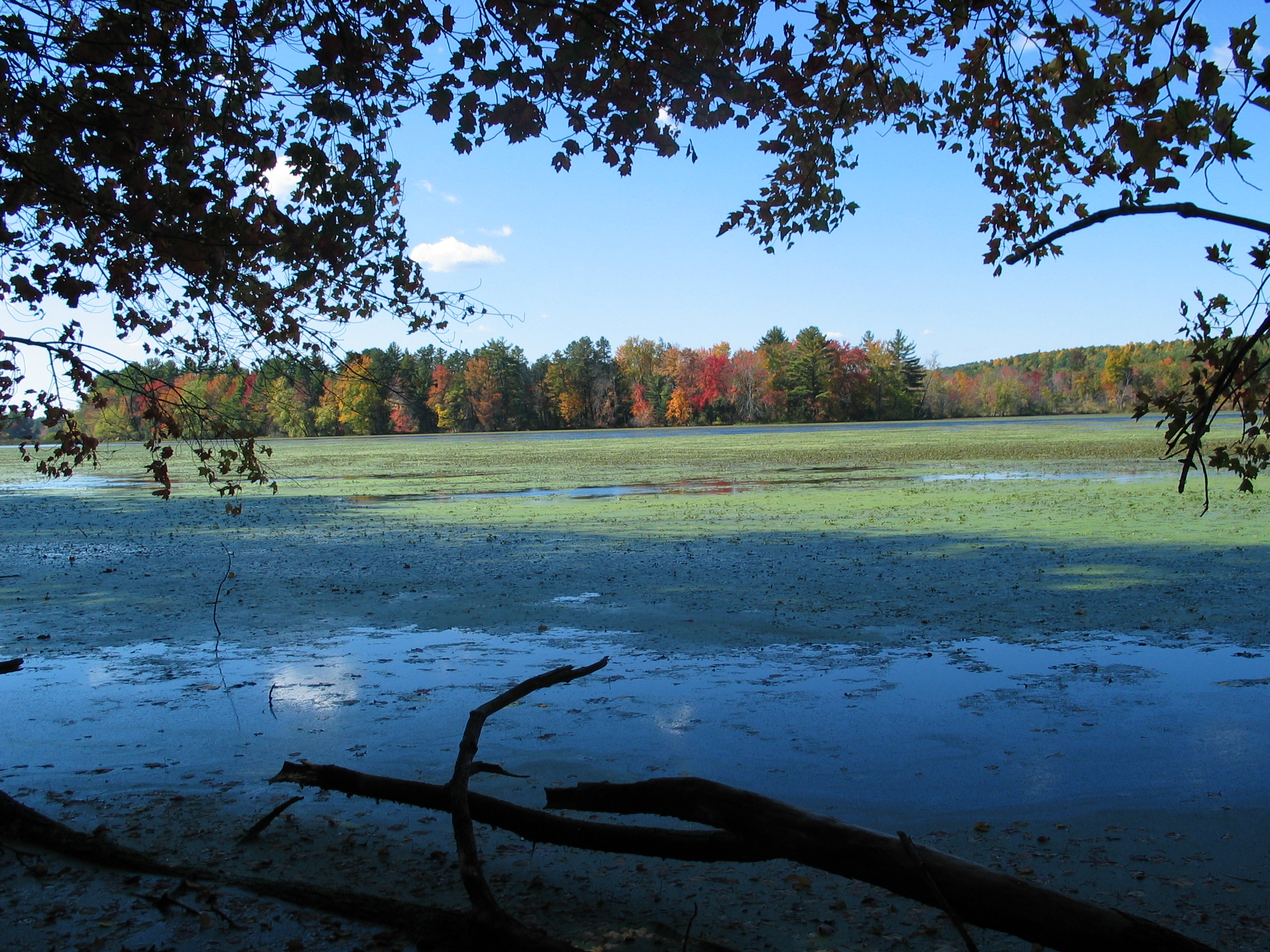
Broadmeadow isn't a meadow anymore: it was once a swamp that was drained in colonial times, and has reverted back to sampland

Broadmeadow isn’t a meadow anymore: it was once a swamp that was drained in colonial times, and has reverted back to swampland

This last Thursday and Friday I rode along the rail trail from its beginning at the old rail junction in Ayer to where it passes by the dam and mills at East Pepperell. It’s not quite peak foliage season, but I did see some nice colors. I also made a side trip into downtown Groton, which is adjacent to the rail trail, for a look around and for two cookies from a local bakery. The Nashua River itself isn’t visible from the trail until the last mile or two upstream from the dam in East Pepperell. But there are other smaller bodies of water, including the Groton School Pond and the pools of Broadmeadow.

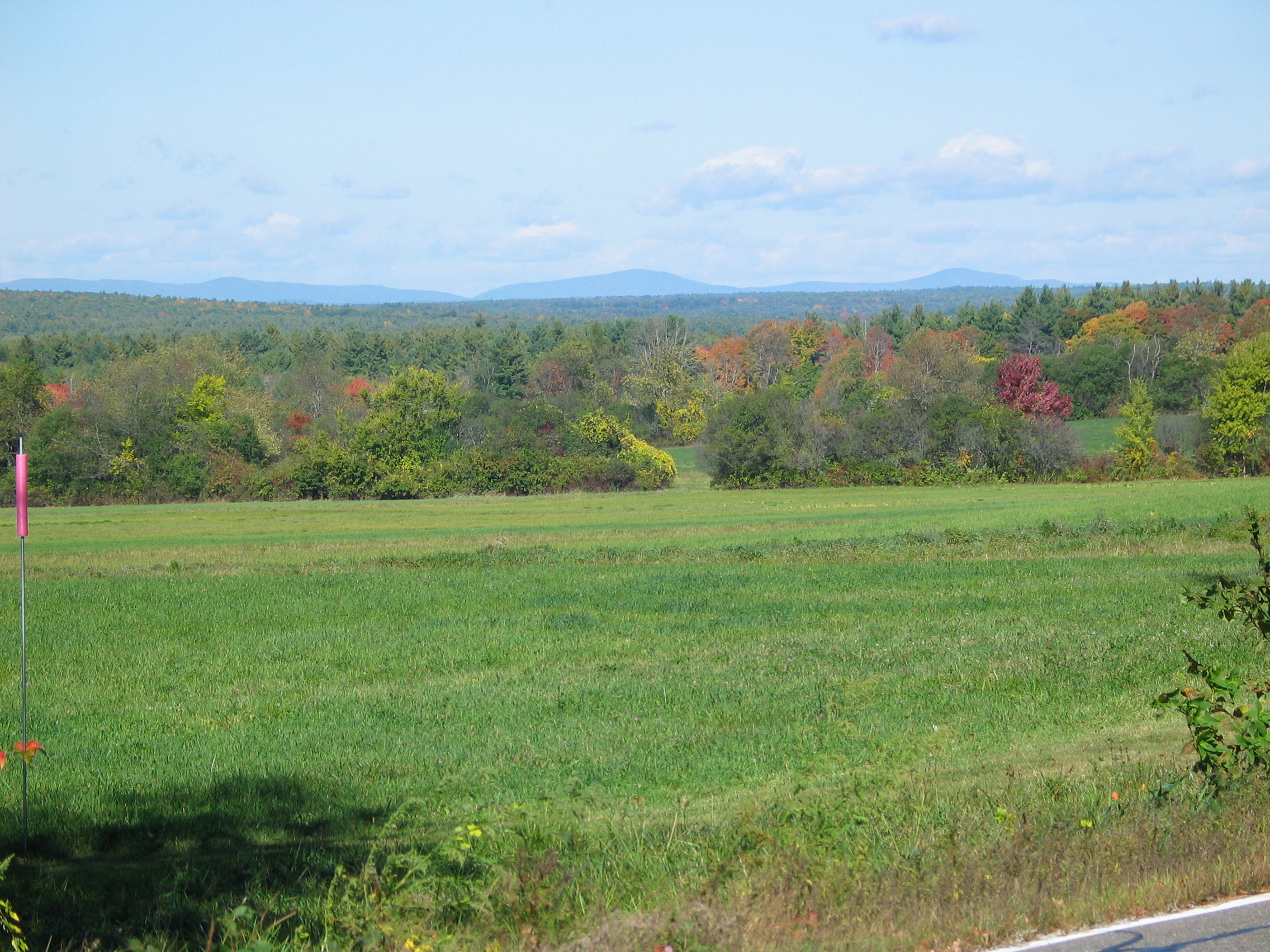
I grew up in the area, and we could always see the distant mountains Monadnock and Wachusett on the horizon

I grew up in the area, and we could always see the distant mountains Monadnock and Wachusett on the horizon

I traveled the trail in late morning. By that time, the hardcore bikers and joggers have already been out for a while, so what wildlife I saw was limited to the birds, gray squirrels, and chipmunks that darted across the path. Oh, and the humans. I was surprised at how many women with carriages or strollers were walking or even jogging along the southern part of the trail in Ayer.

If you’re thinking of duplicating my trip, especially now that the foliage should be reaching its peak, bear in mind it should only take an hour or so to travel the same segment I covered, if you’re on a bicycle. I actually took over two hours, but I stopped often to take pictures. And you can pick up food and drink in Ayer, Groton, or East Pepperell. Just remember: yield to horses!

Posted in History | Tagged , , , , , | 5 Comments

Chapter 35 of Prophecies and Penalties

Especially after her meeting with the injured Sonia and Stacia, Emily needs some downtime away from the Sacred Lands. To borrow a phrase, Emily is “Going off the reservation” in chapter 35 of Prophecies and Penalties. But just as Native Americans sometimes find that to be a challenge, so will Emily. The Children’s affairs are not so easy to escape, and we’re not just talking love affairs, though those figure in, too.

This chapter’s coming out a day in advance as I’ll be away from Internet access tomorrow morning. Enjoy your read, and I’ll be back at the usual time next week.

Posted in Prophecies and Penalties, Writing fiction | Tagged , , , , , | 2 Comments