Chapter 4 of Summer of the Netherfield Witch

We live in an era in which information is exploding. Sometimes literally. I wonder if the exploding heads in the movie Scanners were meant to be a deep commentary on that phenomenon. This notion seems much more reasonable at the tail end of a night of drinking. Even more reasonable the next morning, when my head does feel like it’s exploding.

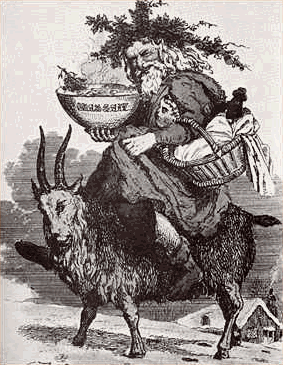
The old version of TMI

The old version of TMI

We’ve even got a name for one kind of information overload: TMI, “too much information,” often used to reply to unnecessarily informative descriptions of the sexual or scatological details of another person’s life. In Hollywood, this is actually a marketable commodity.

So it’s strange that we often don’t think we have enough information. Either we can’t get the information we want, or we have to jump through too many hoops to get it, or it’s buried in an unmanageable amount of useless information.

And wouldn’t you know it, Jane is suffering from all of these problems. I just hope her head doesn’t explode; that would be TMI for me. Yep, for Jane there is “Never the right amount of information” in chapter four of Summer of the Netherfield Witch.

Posted in Netherfield Witch | Tagged , , , , , | 4 Comments

Chapter 3 of Summer of the Netherfield Witch

Jane Harris no doubt misses her life in Boston, but willy-nilly, she finds herself taking up the reins of a life in Netherfield. Time to meet new people, make new plans, maybe even make progress on that new diary, Jane (hint, hint). But you should take Miranda Milan’s book title as a warning, Jane, for you are about to encounter “Strange friends and strangers” in chapter three of Summer of the Netherfield Witch. (For those of you who missed the first two chapters of this weekly serial, you can start here.)

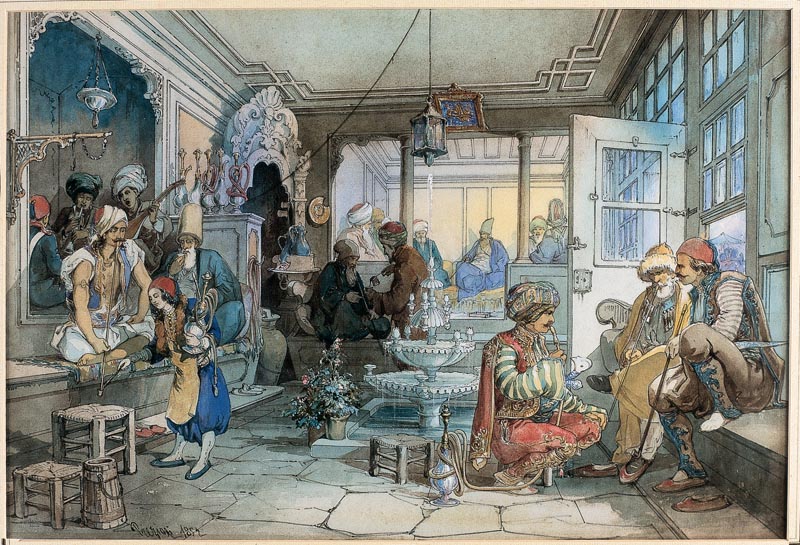
Jane ends up at a coffehouse, but even Netherfield doesn't have coffeehouses as exotic as this one. Painting by Amadeo Preziosi (1816 - 1882), who for many years made his living painting watercolors for tourists in the Near East and Balkans!

Jane ends up at a coffehouse, but even Netherfield doesn’t have coffeehouses as exotic as this one.
Painting by Amadeo Preziosi (1816 – 1882), who for many years made his living painting watercolors for tourists in the Near East and Balkans!

Posted in Netherfield Witch | Tagged , , , , | Leave a comment

Chapter 2 of Summer of the Netherfield Witch

So you’ve met Jane Harris. Come meet her family. They are an ideal family. Mind you, I’m not saying whose ideal. Certainly not Jane’s. Jane probably imagines her ideal family as something closer to the painting below. Still, she must live with hers, and so must we. It’s time for Summer of the Netherfield Witch‘s second chapter, “Charming domestic scenes.”

The Family of Sir William Young (c. 1768) by Johann Zoffany (1733 -1810)

The Family of Sir William Young (c. 1768)
by Johann Zoffany (1733 – 1810)

Posted in Netherfield Witch | Tagged , , , , , | Leave a comment

Snow days, no days, in a daze

The news reports tell me Boston has just set a record for snowfall in 30 days, a bit over 61 inches. This is more than we received in the month of the Blizzard of ’78, which all but shut the state down.

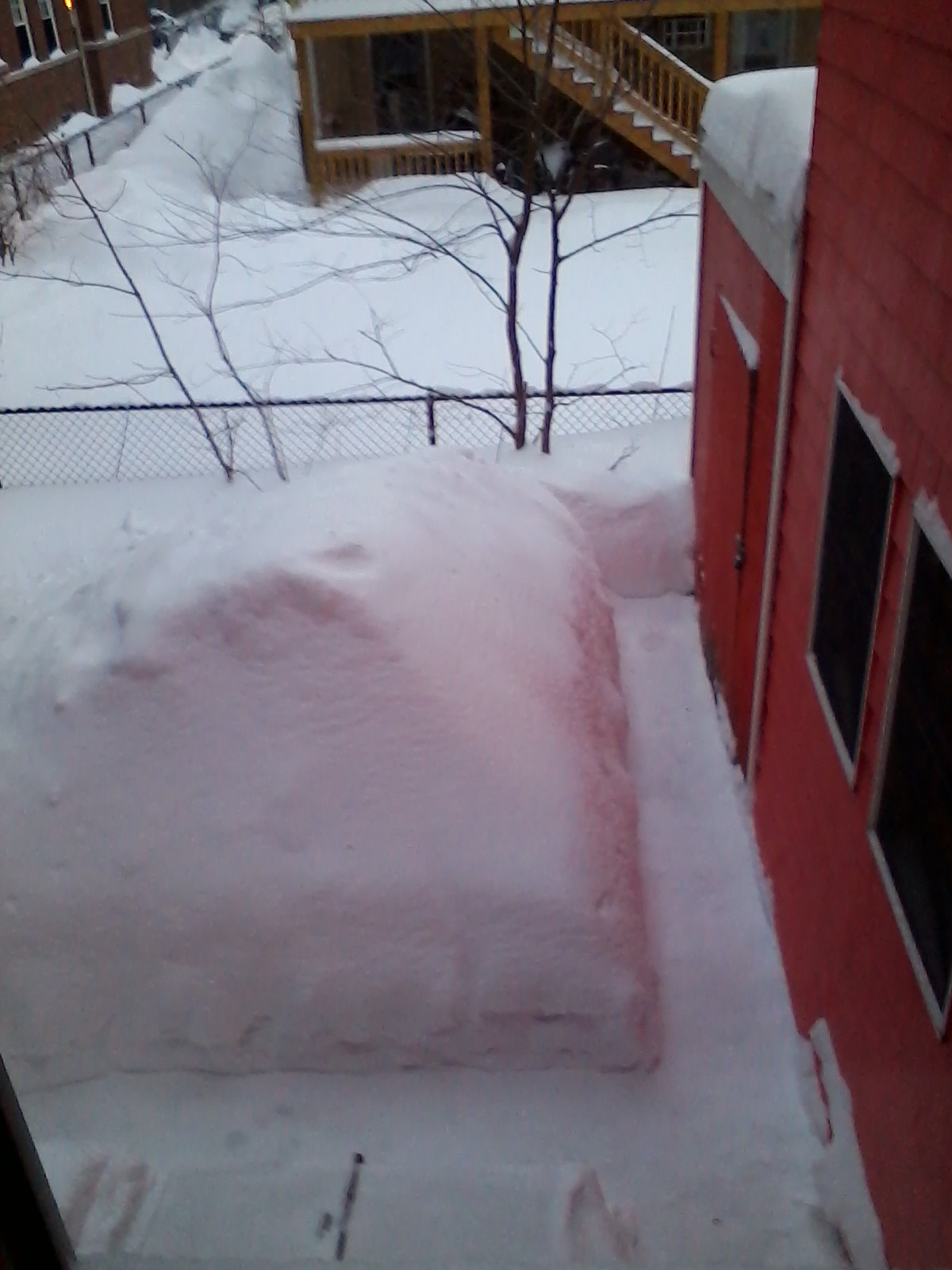
The pile in our back yard

The pile in our back yard

Boston, and Cambridge next door where I live, does get snow. But we’re also by the ocean, and it tends to keep us a bit warmer than much of the state, so that a fair amount of the snow tends to melt between storms. Not this year. I was shoveling out our back door and shed when I realized that the pile in the back yard is now taller than I am. It looks to be about six feet.

This highlights the problem we’re facing in the city. Much of a city’s footprint is roads, sidewalks, houses, and driveways, certainly more than in the suburbs. So we’re running out of places to put the snow. It just get piled higher and higher, which often means broader and broader, too. I think half the on-street parking spaces on our street have been eliminated by snow piles: snow from the street, snow from the sidewalks, snow from clearing out the cars. Cambridge actually has emergency off-street parking for these situations, but I’ll bet it hasn’t faced a situation this bad in decades.

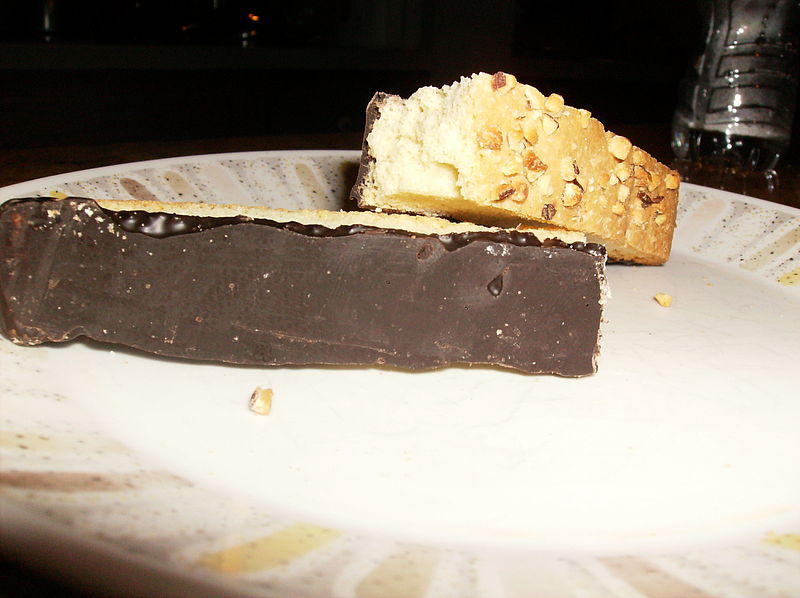
Though, let me say, there is one positive side to this.  When I go out to shovel, I feel I deserve biscotti with my coffee and tea when I come back.

Chocolate-coated biscotti (credit: Wikipedia/Drewboy64)

Chocolate-coated biscotti
(credit: Wikipedia/Drewboy64)

Posted in Uncategorized | Tagged , , , , , | 3 Comments

Beginning a new serial: Summer of the Netherfield Witch

C'mon, folks, it's not Camp Crystal Lake. People have FUN here

C’mon, folks, it’s not Camp Crystal Lake. People have FUN here

Now that I’ve had a month to rest, it’s time to start up a new story. It’s a comedy. How can it not be a comedy? It’s set in a minor vacation resort, where people are happy at their leisure. It has a lake for the children to swim in, the adults to go boating on, and the snapping turtles to wonder what all the fuss is about. It features a teenage girl, and as we know from Shakespeare, they never get into trouble. It’s got romance and sex. Well, the girl is 14, so we’re not going to be able to offer a whole lot of sex. This isn’t Quasopon, you know. Still, besides sex, there are bickering family members, kind-hearted strangers, lovable rogues, all the stock figures you could ask for, and probably more of them than you want.

Although the show only went there a few times, "Bewitched" is remembered in Salem (sigh). E. J. Barnes is trying to figure out which aspect of this is most amusing.

Although the show only went there a few times, “Bewitched” is remembered in Salem (sigh). E. J. Barnes is trying to figure out which aspect of this is most amusing.

And, yeah, there’s a witch. You noticed that in the title, did you? Can’t get much past you, can I, now? But that doesn’t necessarily make it a tragedy. She could be like Samantha Stevens from Bewitched, or the three/four girls from Charmed, or Glinda, the good witch from The Wizard of Oz. Although I have to say that, while she is just as annoying as Glinda, the two don’t really have much in common. I don’t think they’d ever be BFFs, if you know what I mean.

Anyhow, we shouldn’t let a witch spoil the fun, even if she is in the title. I mean, hey, we make comedies with vampires, as if having your throat ripped open and your blood sucked by a dead person is supposed to be funny. Sounds like a bad date I had in college. Teaches me to pick up girls at a bloodmobile.

Anyhow, for your entertainment, I present the first chapter of Summer of the Netherfield Witch, “This is the end of my life.” Remember, it’s a comedy.

Posted in Netherfield Witch, Writing fiction | Tagged , , , , , | 2 Comments

Review: Rachel Urquhart, The Visionist

visionistWriting a novel about the Shakers forces a serious novelist to have to make several choices, some of which will shape the story, others of which can detrimentally affect the story. To her credit, most of Rachel Urquhart’s choices in The Visionist (2014) add emotional and historical depth to the story. If there’s a problem here, it’s in the story telling. Urquhart reaches for depths, and sometimes reaches them, but other times comes up short.

I briefly met Urquhart last year. Her family owns the former Shaker meetinghouse in Tyringham, which the Boston Area Shaker Study Group got to tour during the summer. So I see how she came by her interest in things Shaker. And, to her credit, she did not rely on just absorbing the environment, but read and consulted with scholars in putting together this tale from the Shakers’ era of “Mother Ann’s Work,” the late 1830s and 1840s, when they experienced revived spiritual energy, and visions and other spirit manifestations were common. This is the period of many unusual Shaker songs and of the famous gift drawings. Urquhart deserves credit for using her knowledge to help structure her story, instead of getting bogged down in irrelevant detail. Moreover, she did not limit herself to just Shaker history, but integrated some real historical information about the world outside the Shakers into her story.

One of the more famous gift drawings

One of the more famous gift drawings

Every writer who uses the Shakers must end up addressing a question: did the Shakers have the Truth, or were they at best one path to salvation, or were they frauds? Given the current sentimental view of the Shakers in American culture, this is an easy question to avoid. Although she never says so explicitly, Urquhart makes no bones about the Shakers having only one of many possible paths to salvation. Indeed, it is integral to her design that this be so, most noticeably in the development of the fire investigator Simon Pryor, whose cynicism and defeatism give way to hope and love during the story. Even Sister Charity, who begins and remains with the Shakers, has a spiritual development that implies that, even among the Shakers, there may be more than one path to salvation.

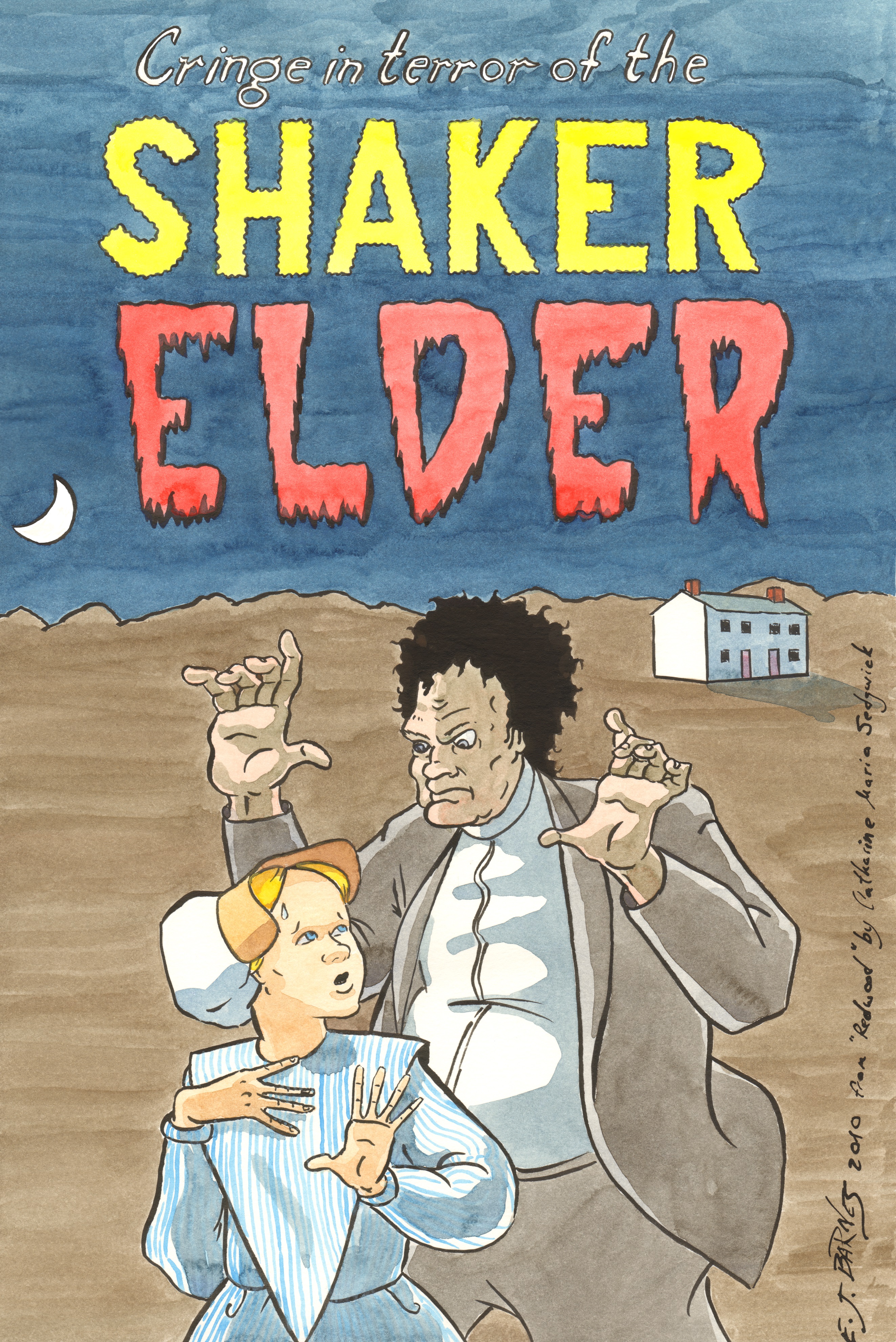
The evil Shaker elder is a stock figure in 19th century Shaker fiction (Image copyright by E.J. Barnes)

The evil Shaker elder is a stock figure in 19th century Shaker fiction
(Image copyright by E.J. Barnes)

Urquhart’s answer to the first question leads to a second question: does one portray the Shakers as an ideal, as practical people, or as villains? Since the very first Shaker story, Catharine Sedgwick’s Redwood (1824), writers have wrestled with this question. For if the Shakers do not have the sole road to the Truth, how can they be virtuous? And if they are villains, how came they to do so much good? Urquhart chose to portray the Shakers as real pragmatists. This will dissatisfy many Shaker fans, for this means the Shakers are not perfect, not purely spiritual creatures, but subject to the same emotions and caprices as anyone else. And this can seem shocking at times, as when Elder Sister Agnes tries to manipulate events to secure the Briggs-Kimball farm for the Shakers. It seems far too worldly and even cynical for a Shaker eldress. My sympathies lie with Ms. Urquhart here. For if one is certain one has the Truth, then all other considerations are secondary. And while Elder Sister Agnes may seem far too worldly when she seeks the farm and encourages Polly to depart quietly, it is that same dedication to Truth, as she sees it, that leads her to grant sympathy and pity to Polly when Polly confesses what to many in the World would be damning faults.

Urquhart’s treatment of the Shakers’ visions follows logically from her answers to the previous questions. At least some of those visions spring from the psychological needs of the individuals. However, their effect on the Shakers depends on their interpretation. As Urquhart shows, the truth of visions is in what people make of them. If one is of the faith, then what believers make of them coincides with the transcendental Truth, as well.

Urquhart had a lot of luggage to carry in writing this story. So how does it do as a story? At its heart, the story is one of the unreliability of expectations and the difficulties of redemption. And where it has trouble is keeping these two horses in step. I’m convinced of Pryor’s redemption, but have trouble understanding why he chose it. I’m convinced of Sister Charity’s errors in thinking Polly what she is not, but I have trouble seeing how she recovers. Only with Polly herself, who does not expect what happens to her among the Shakers and has a tortuous route to salvation, and, note well, with Elder Sister Agnes’s own trials of faith do I feel convinced of how expectations and redemption operated in tandem.

I would not normally advise an author to write a tree-killer, a fat novel no one would read, but that would be my recommendation here. Simon Pryor needs more development at his beginning, and Sister Charity at her end, to make their issues of expectations and redemption fully work out in the novel. The frame is solid, the themes are worthy, the story runs along. Give these two characters the more they are due, and Urquhart would redeem them both, and her novel. But make no mistake: as it stands, there is much value in it, else I would not have bothered to write at such length.

Posted in Reading fiction, Reviews | Tagged , , , , , , , | 16 Comments

Looking ahead and behind, though not both at once

It's E.J. Barnes's turn to shovel out the back yard

It’s E.J. Barnes’s turn to shovel out the back yard

I’m snowed in today, and the class I’m teaching on “Pirates!” is cancelled for tonight, so it’s a good time to reflect. Where had this blog been? Where is it going? If you’re short on time, the most important news is that a new story will start up on Friday, February 6, 2015. There — you can stop reading now, unless you want the details.

In looking over the stories I’ve posted here since the blog’s inception, I’d say they fall into three categories: short stories, long stories with a rapid pace, and long stories with a slower pace. The former two are better suited for the blog. But the latter is where I experiment, and I do so need to experiment.

I’m happy with my progress in writing short stories. I didn’t intend to write any, after the story that led to this blog, “The Troubles of the Farnsworths.” However, I started up with the Halloween annual short story. Personally, I think those have been getting better. “On Huckman Causeway” is serviceable, “Dead Cellphone” has nasty implications, and “Death and Professor Appleton” is a decent adventure. Toss in the recent “When the ghost came in from the cold,” and I’ve started to get suspense, horror, and humor under some control. Good enough.

Remember me?

Remember me?

The long stories with a rapid pace, The Dragon Lady of Stockbridge and Nightfeather: Ghosts have proved to be popular. I think they’re the type of story that is best suited for this blog: a story in which we make dramatic progress every week, while leaving something important hanging in the air. Naturally, my thought is that my next story should be like them. Whether it will be is another question.

The most problematic have been the longer, slower-paced stories, the ones that have frankly been experiments. Martha’s Children was an attempt to juggle multiple viewpoints, handle the psychology of the new vampire, and tell a “prequel” to a story many of you haven’t read! (I’d established in that story that Martha had created the Chicago vampire cops, if only by biting so many of them, but I’d never thought about how that might have happened in any detail before I tackled Martha’s Children.) As I’ve stated before, I was not all that happy with Martha’s Children, both because of pacing and the plot developments at the end. In retrospect, I have to admit that the story was going to have a slower pace, anyhow, and that my concerns there were more about putting it up on the blog than on the story itself. It needs slower pacing.

Emily didn't realize just how much pentagrams meant to her

Emily didn’t realize just how much pentagrams meant to her

The recently completed Prophecies and Penalties was a better story than Martha’s Children. For one thing, it’s more tightly focused, since the entire story is filtered through Emily Fisher. In the end, it’s not a murder mystery, it’s a story about how Emily copes with her extended family among the Children and all their weirdness. Emily has to decide what’s important about her life, and therefore what she is going to do. If you had put that to her at the beginning of the story, the answer would have been, “What, are you nuts? I’ve turned my back on my childhood. What’s important is my life now.” By the end of the story, Emily has changed. Her supernatural twin among the Children, Stacia Fletcher, has changed even more dramatically. Both have become more human, with more ties and concerns affecting their behavior. Neither is really certain what they will do next, but they make decisions and get by. I’m proud of the human complexity of that story, even as I look through it and wonder why I wrote some parts of it the way I did.

Yep, pirates! I wanted to teach a fun history course for a change

Yep, pirates! I wanted to teach a fun history course for a change

I made it to ARISIA this year, and managed to stay for the whole sci-fi/fantasy convention (unlike last year). It was a bit of a working break for me, as I had a story and my pirate course to prepare. (If you’ve not heard about the latter, check out my most recent blog post on the subject, over at sister blog Sillyhistory.) Still, it reminded me that last year was supposed to be the year I made a major push to get some of my writing published. That didn’t happen, for a variety of personal reasons and simple procrastination. This year I’ll see if I can do better.

As for Sillyverse this year, I expect to be running a major story for much of the year on Fridays, as in past years. It will start up in February. I’m still playing around with the ideas for it, which is to say I’ve written pages of episodes for a possible story, which is how Prophecies and Penalties originally began.

I’m also thinking that I have at least one story that needs to be written that would not be suitable for the blog. If I schedule that, if I have the time, if I can do the research, I may come calling on some of you for help by reading the manuscript. You’ve been warned.

And now on with 2015!

Posted in Dragon Lady, Martha's Children, Nightfeather, Prophecies and Penalties, Writing fiction | Tagged , , | 3 Comments

On the third (or fourth) day of Christmas

Santa after three days of spiked eggnog

Santa after three days of spiked eggnog

It was the third or fourth day of Christmas. Santa wasn’t sure which. He’d been mixing a lot of brandy with his eggnog; got to do something to appear fat and jolly, you know. And he got to thinking about his job.

“365 days in the year, and all I do is spend one day going around the world delivering presents. It used to be two days, one for the servants, but there are so few of those that I can finish my Boxing Day run in under an hour.” Santa was feeling a bit maudlin, and was remembering his second run with a romantic glow, forgetting just how wretched servants’ living quarters often were.

Thinking of servants reminded him of his other job. “All the rest of the year, I’m supposed to be toting up who’s naughty and nice, but, hey, I’ve subcontracted that job to the American NSA.” It bothered him that the NSA thought he was an interstellar alien. Maybe making Dinky the Elf his liaison had been a bad idea.

Santa on the First Day of Christmas

Santa on the First Day of Christmas

But the big guy’s heart was in the right place, and he shucked the self-pity and got down to brass tacks. “There are supposed to be twelve days of Christmas, and I’m only busy on one, two at most. I should be doing something on the other ten days.” He scratched his head, thinking of what else he might do. To tell the truth, Santa hadn’t gotten the position based on his intellect or creativity. And what little he had of the latter quality had been swamped by the toy companies and their mass-marketing campaigns.

But there’s one thing Santa knew for sure, and that was how to make out a list. So he got out a pencil and a sheet of paper, left-over wrapping paper to be sure, and sat down to make out a list.

“Let’s see. Christmas: presents.”

“Boxing Day: Presents for servants. Hardly any of those. Let’s branch out, add in slaves. Thought they’d gone extinct after the Brazilians had abolished the practice, but there are always people trying to take control of the lives of others.”

Poor people need Santa, too! (Source: DN-0001069, Chicago Daily News negatives collection, Chicago Historical Society via Wikipedia)

Poor people need Santa, too!
(Source: DN-0001069, Chicago Daily News negatives collection, Chicago Historical Society via Wikipedia)

“The third day of Christmas. Crud, this is hard. Wait, I’ve got it. Time-and-a-half for everyone who worked on Christmas and Boxing Day. No, double wages. Give the poor working stiffs a lift.”

“The fourth day. Well, what do I do after Christmas? No, besides get drunk. Sleep. That’s it, sleep! Three extra hours for every parent, and anyone else that works two or more jobs.”

“Fifth day. Oh, I’ve got one. Everyone gets to be sweet-tempered and like it for a day. None of that fake Christmas cheeriness, people will actually want to be good for a day. And because they don’t think the fifth day is all that special, won’t it be a surprise!”

“The sixth day of Christmas. Well, after what happened on the fifth, they’ll be in a bad mood. Sorry, but that’s human nature. So drop them off a list of all their good points. It’ll make some of them happy, a few thoughtful when they see how few there are, and the ones with no good points? Hah, they need to know it!”

Just thinking about day 7 is bringing Santa back to his old self

Just thinking about day 7 is bringing Santa back to his old self

“Goin’ on seven. Well, I’m going to go out on a limb here, because I don’t know if I have the authority or power for this one. Make every person sit down and talk with someone they dislike, not because of what that other person is, because because of what they imagine about that other person. That may be a violation of free will, and I may not have the authority for it, but hey, wouldn’t it be great for toleration and open-mindedness?”

“Eight. Again, human nature means they’ll be upset after yesterday, if I can pull it off. So how about a day spent with their loved ones. I mean the ones they really love, of course. And people who don’t have loved ones should be able to find one on this day.”

“Ho boy, the ninth day of Christmas. Well . . .” And there Santa fell asleep. Too much eggnog, if you ask me. But don’t be too hard on Santa. He just proposed more than nine-tenths of all the prophets and politicians have ever done. And that though he was a few sheets to the wind and isn’t much of a thinking man.

Still, he did make up the list. And it’s there on the table in front of him. He’ll wake up in a day or two. Maybe he’ll have forgotten all about this, and just crumple up the wrapping paper and toss it in the wastebasket (which, at the North Pole, is shaped like a squat polar bear). Or maybe, just maybe, he’ll remember, and go about trying to do something about it next year. We can hope.

Posted in Uncategorized | Tagged , , , , | 6 Comments

The final chapter of Prophecies and Penalties

It’s been a long road for Emily Fisher since she came to Quasopon to solve the murder of Stephen Nash, a member of the High Council of the Children of the New Revelation. She met the Prophesied One and became the Prophesied One. She solved a murder, and the resolution everyone knows is wrong. She had the joy of meeting family members whom she never knew before, and all the complications that came with them. And now she’s almost ready to leave. Still, it’s time for “A party before I go,” the epilog of Prophecies and Penalties.

"My name is Gabriel Fisher, and these are the mothers of some of my children."

“My name is Gabriel Fisher, and these are the mothers of some of my children.”

That’s it for this year. If you missed it, I did indeed post a Christmas ghost story, “When the ghost came in from the cold.” I don’t expect any new story will go up on this blog until February. Though I hope to post something on the sci-fi/fantasy convention ARISIA and a review of the writing of Prophecies and Penalties, and possibly some other things, during the month of January. Meanwhile, you can catch my sister blog, Sillyhistory, as I explore the world of pirates for an upcoming course I’m teaching.

And a happy new year of 2015 to all you readers!

Posted in Prophecies and Penalties, Writing fiction | Tagged , , , , , | Leave a comment

This year’s Christmas ghost story: When the ghost came in from the cold

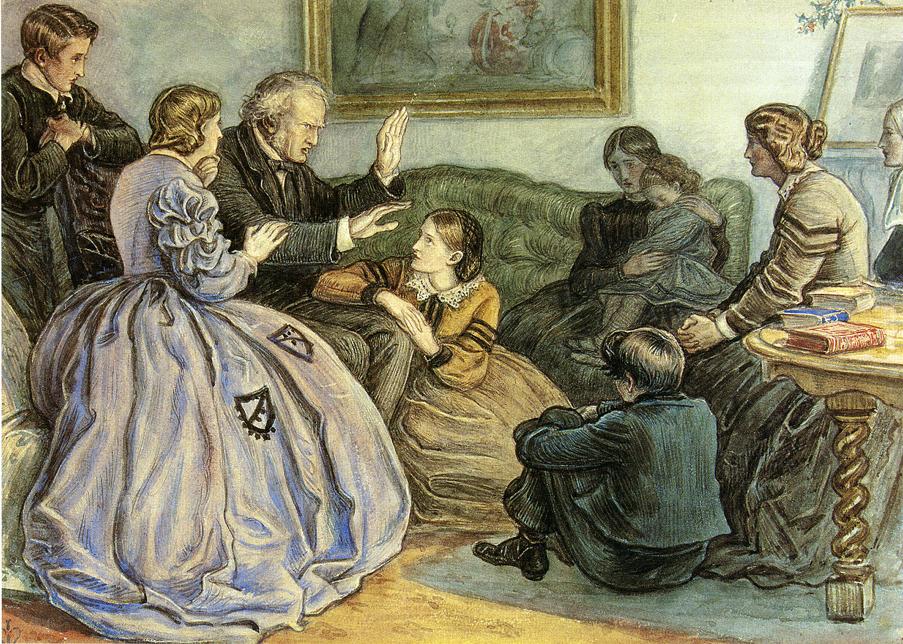
Tell us a story, please! (John Everett Millais, A Winter's Tale)

Tell us a story, please!
(John Everett Millais, A Winter’s Tale)

You all know about Charles Dickens’s A Christmas Carol: Scrooge and Tiny Tim, the Ghosts of Christmas Past, Present, and Future, and all that. Whether he started it or not, Dickens supported the tradition of ghost stories at Christmas time for many years thereafter. And other writers took up the tradition, notably M. R. James.

I did a long ghost story last year, Nightfeather: Ghosts. This year I didn’t think I’d get to a story, because I’d injured my left arm. However, I had an inspiration this morning, and so, fresh out of my brain, let me present to you, “When the ghost came in from the cold,” this year’s Christmas story.

Posted in Writing fiction | Tagged , , , , | 8 Comments