Prophecies and Penalties Chapter 18, and a short vacation

Emily Fisher’s investigation of the murder of High Council member Stephen Nash has taken a giant leap forward, which makes her happy. On the other hand, that leap implicates her sister Elsie, and Elsie’s lover, the so-called Prophesied One, Alex Bancroft, and that makes Emily decidedly less happy.

So when the two sisters sit down to lunch after Elsie’s interrogation by Quasopon’s police chief, Emily’s expecting some nice quiet time with her sister, a chance to recover after the strains of the last 24 hours. And that’s what she gets . . . until Elsie throws her a curve that upsets the entire investigation again. Join Emily as she discovers one of the mysteries of the Children’s lands in “All things rest connected by hidden knots,” chapter 18 of Prophecies and Penalties.

The title for this week’s chapter is taken from an alchemical drawing featured in Principe’s book The Secrets of Alchemy. It seemed particularly apropos.

By the time you read this, I should have returned from a brief vacation in upstate New York and southern Vermont. We’ve been staying with friends who have two dogs the size of small bears, and three cats of distinctly different breeds and characters, one of which is trying to rival the dogs in size. (He’s thought to be part Maine Coon Cat.) The trip included an excursion with literary connections to previous posts in this blog. One of our hosts looked over the blog, and the next day dropped three hardcover books by Russell Kirk (two of ghost stories, one the novel about Manfred Arcane) into my lap. While yet another person who finds Kirk’s politics intrusive, he did express an admiration for the man’s stories, specifically including “The Reflex-Man in Whinnymuir Close” as one of his better ones.
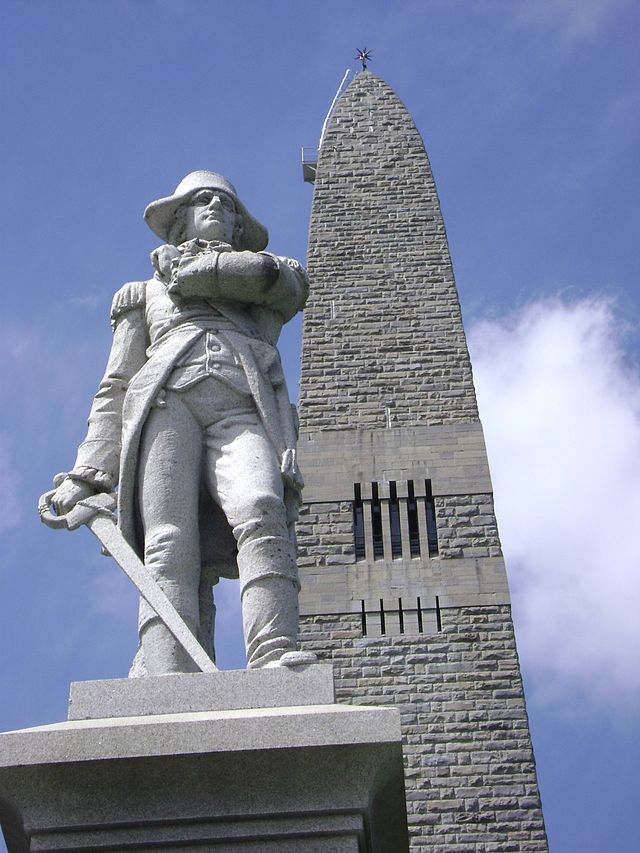
That's a statue of Vermont military leader Seth Warner erected in front of the Bennington obelisk (Credit: Wikipedia)

That’s a statue of Vermont military leader Seth Warner erected in front of the Bennington obelisk
(Credit: Wikipedia)

One the same day, we traveled through Bennington, Vermont. Bennington is probably best known for the Revolutionary War battle that helped doom an invading British army, commemorated by a particularly phallic-looking obelisk. Part of our quest was to go see Bennington College, which probably does not wish to be remembered as the model for the campus figuring in Shirley Jackson’s Hangsaman. And along the way we stopped to see the place where she lived for a while nearby, and the small green in front which we are told served as the model for the infamous setting of her short story, “The Lottery.”

The Quasopon of Prophecies and Penalties is on the eastern side of the Green Mountains, so we did not travel to its (fictional) location. Still, as always, the sight of the mountains and the small villages of the region help support my vision of the town and its setting.
Posted in History, Prophecies and Penalties, Writing fiction | Tagged , , , , , | 10 Comments

Visiting where Shakers conducted businesses sacred and secular

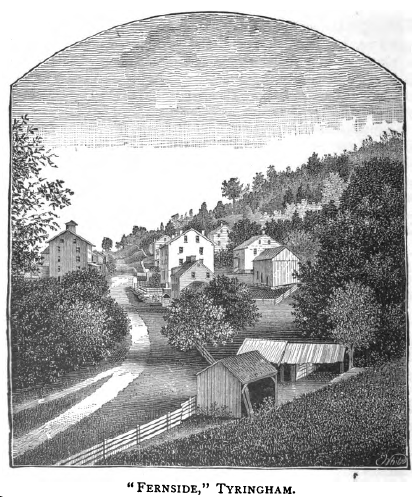
The former Shaker Village of Tyringham as it appeared circa 1886

The former Shaker Village of Tyringham as it appeared circa 1886

Those of you who have been following this blog for a while know about my interest in the Shakers, a religious group that worshiped a godhead with male and female aspects, and practiced celibacy and communal living while awaiting the End Times. This last weekend, I was on a trip visiting some buildings that were once part of the Shaker village in Tyringham, Massachusetts.

The Shakers founded about twenty communities, of which only one survives. Tyringham was one of their smallest communities, barely reaching 100 people at its height. After 1850, the Shakers went into a decline, and began closing villages and selling them. Tyringham was the first to go, in 1875.

There are a lot fewer Shaker buildings than there once were. As they declined in numbers, the Shakers began pulling down buildings as they ceased to need them, to reduce their property taxes. Once they closed a community and sold it, the people who took over altered or demolished the buildings as they saw fit. And not a few perished in fires or by simple neglect. So there aren’t that many Shaker buildings left.

Some Shaker buildings are part of museums and are open to the public on a regular basis. Others are in government or private hands, and Shaker scholars and fans can visit them only when the owners are willing to receive visitors. So there’s a certain prestige in Shaker circles to be able to say you had the chance to visit a building that has rarely been opened to visitors.

My own favorite such experience was my first trip to the former Shaker village of Shirley, Massachusetts. To visit, I had to reserve a place in one of the trips organized by the Shirley Historical Society. On the day of the trip, we were picked up at the Historical Society by a prison van! You see, these Shaker buildings were on the grounds of a maximum security state prison, and prison officials did not want a bunch of antiquarians running loose on the grounds.

Anyhow, back to Tyringham. All of the surviving buildings are in private hands. So it was fortunate that the owners of two buildings both agreed to let the Boston Area Shaker Study Group visit on the same day. Indeed, they were enthusiastic hosts, and let us wander freely around both buildings and their grounds.

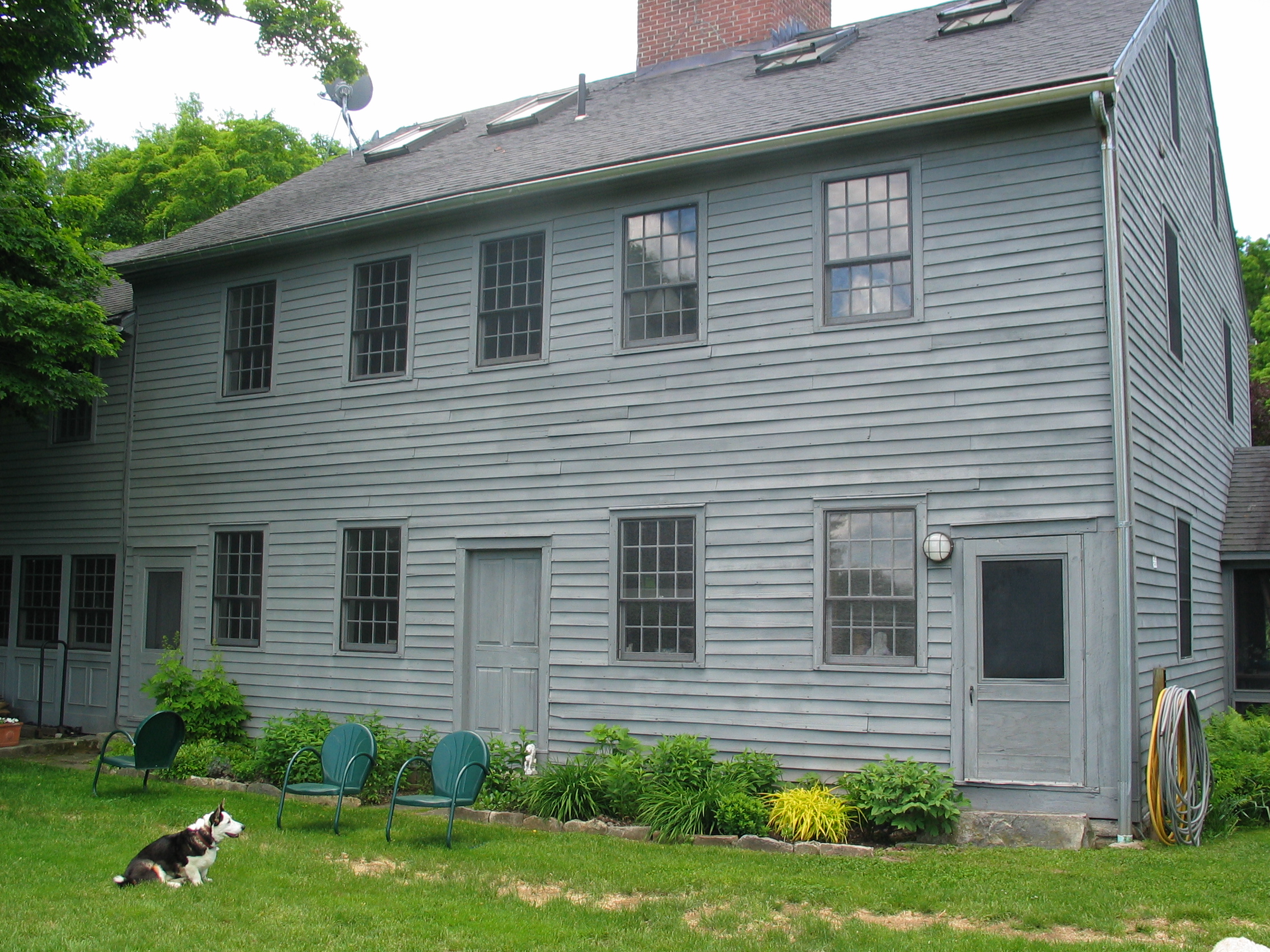
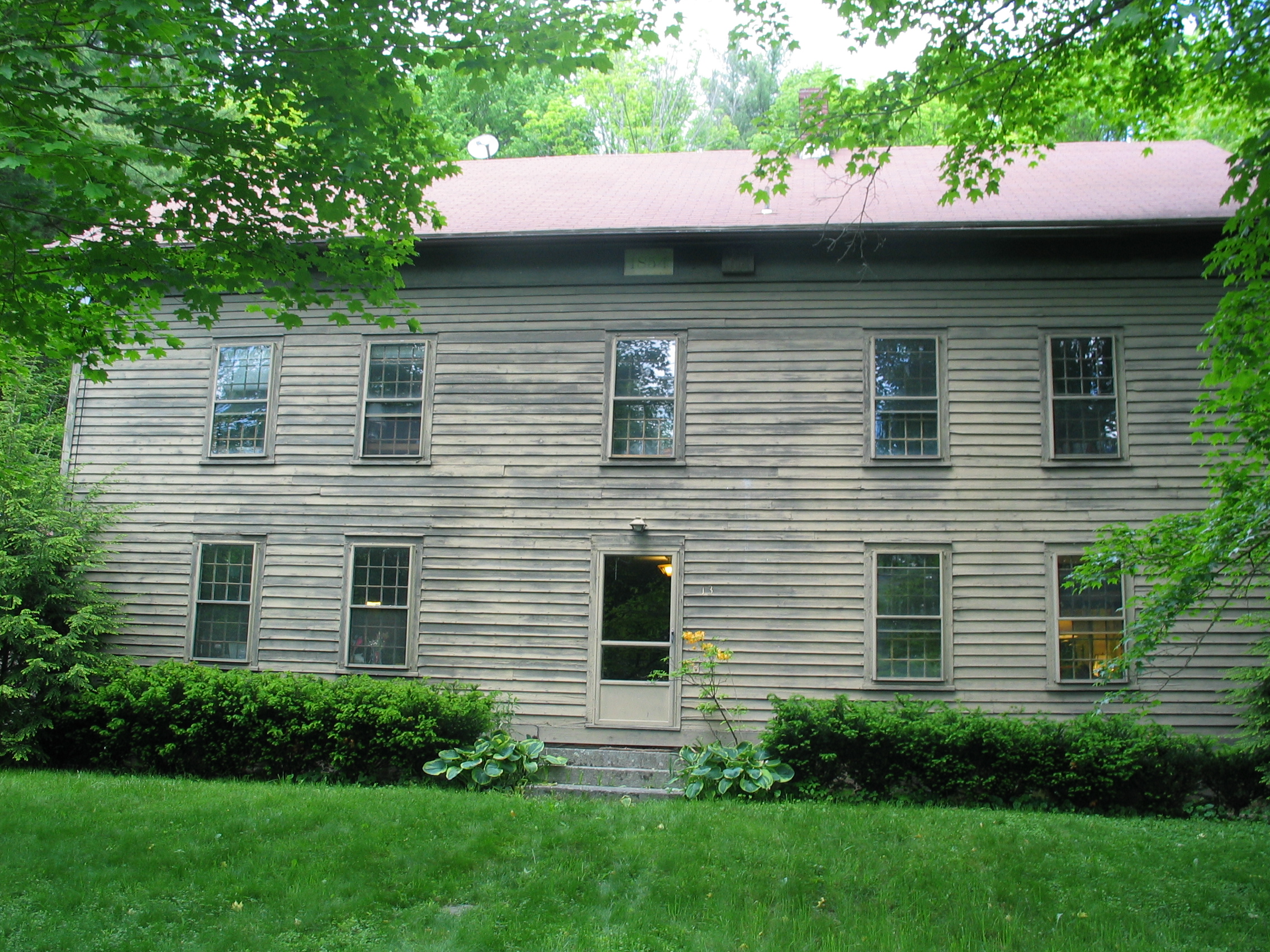
The Seed House as it appears today

The Seed House as it appears today

Prior to the Civil War, the Shakers conducted a major trade in seeds. Indeed, they were the first to package seeds in envelopes and sell them. Tyringham was one of the villages with a large business in seeds, so they had a large Seed House to store and prepare the seeds for sale. This Seed House would be even larger, but it was moved off its original foundation and downhill to a new site, losing a floor in the process. Later, in the 1950s to 1980s, the building was the residence of Jean Brown, who amassed one of the largest collections of  Fluxus and Mail Art in the world, which was of particular interest to E.J. So we both had things to talk about with the current owners.

The meetinghouse as it appears today

The meetinghouse as it appears today

One of the most important buildings in every Shaker village was the meetinghouse, where the Shakers in their heyday conducted a worship service open to the public every Sunday. It was there that the Shakers engaged in their famous group dances, in which the male and female Shakers would dance together in intricate patterns, without coming into contact with each other. Like the Seed House, the Tyringham meetinghouse has also been moved from its original site. The current owners of the building are proud enough of its Shaker heritage; indeed, their daughter has written a novel set among the Tyringham Shakers during the period of intense spiritualist activity of the late 1830s and 1840s.

Many Shakers villages, like Tyringham, are located in beautiful locations; this is a view from the meetinghouse's current site

Many Shakers villages, like Tyringham, are located in beautiful locations; this is a view from the meetinghouse’s current site

Besides seeing Shaker buildings, we also had dinner and ice cream with an old friend of mine from graduate school whom I hadn’t seen for some time. And on our way home, we spotted a doe and her fawn together on the grassy strip between the highway and the woods. Combine that with perfect weather, warm and dry, and it was a good day’s trip!

Posted in History | Tagged , , , , , | 12 Comments

Chapter 17 of Prophecies and Penalties

Finally, Emily Fisher feels she’s making progress. She’s going to get the real story of how High Council member Stephen Nash’s body was found, and maybe even some clues about the murder itself. But first she has to deal with her family. Oh, and her sister’s the one who found the body. And the other person implicated is the apparently helpful but often perplexing Alex Bancroft, the Prophesied One (maybe), and a suspect himself. Read what Emily finds out in “Confusing confessions,” chapter 17 of Prophecies and Penalties.

Prophecies and Penalties is my weekly serial tale about a data analyst for a detective agency reluctantly dragged back to her home town to investigate a murder at a religious commune where she grew up. A new chapter goes up every Friday morning. If you’re not already reading the story, you can start here.

Posted in Prophecies and Penalties, Writing fiction | Tagged , , , , | Leave a comment

Is it the birthday of Cagliostro, definitely a man of mystery?

Eliminate the round belly, and Cagliostro looks impressive

Eliminate the round belly, and Cagliostro looks impressive

Wikipedia claims today is the anniversary of the 1743 birthday of Count Allesandro di Cagliostro, and who would disagree with Wikipedia? Well, actually I have, several times, but that’s irrelevant, because Cagliostro’s birthday is only the MacGuffin for this post about my own encounter with the man. Well, with his footsteps; I’m not old enough to have met him, since he died in 1795.

Cagliostro was many things: alchemist, doctor, seer, political intriguer, schemer, social climber, and scoundrel. He wasn’t an immortal, or the ruler of a country, and he wasn’t very tall. I mention the latter because he is so often portrayed in films as this tall, impressive fellow (see 1949’s Black Magic with Orson Welles or 2001’s The Affair of the Necklace with Christopher Walken as examples of Cagliostro being played by six-footers), when in fact he was at best of medium height and rather stout. And he had a beautiful wife, Seraphina, whose charms were, shall we say, sometimes lent out.

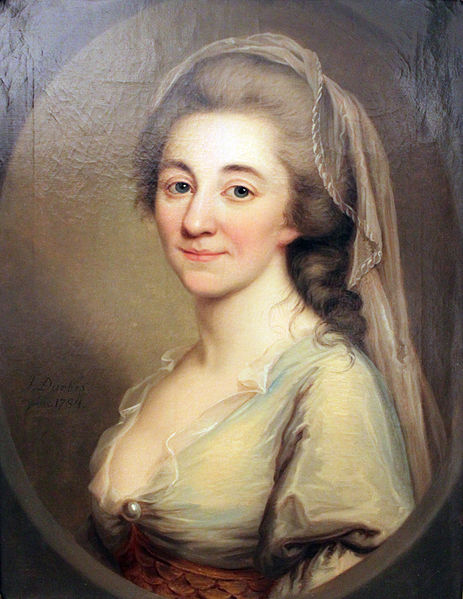
Cagliostro's target for seduction, Elisa von der Recke, as she appeared in 1784

Cagliostro’s target for seduction, Elisa von der Recke, as she appeared in 1784

In 1779, Cagliostro was traveling about Europe, trying to interest wealthy patrons to join his “Egyptian” Freemasonry lodge, which unlike most forms of Freemasonry admitted women as well as men. He paid a visit to the Duchy of Courland, a semi-independent state in what is now Latvia, and tried to convince the leading members of the German-speaking nobility to join. While there, he apparently tried to seduce a young divorced noblewoman, Elisa von der Recke, who happened to be sister to the future duchess!

(The rest of the family was less chaste than Elisa. Her sister Dorothea and two of Dorothea’s daughters were notorious for their affairs.)

Well, in 2003, my girlfriend and I spent several days staying in Riga. Now Riga is an interesting city in its own right. But we were hunting for places Cagiostro had visited. In this, we were helped by historian Iain McCalman, who in a kind gesture sent us some information from his biography of Cagliostro which was just then about to be published. The Dukes of Courland had two large palaces constructed by famed Italian architect Francesco Bartolomeo Rastrelli (1700 – 1771), who also designed several palaces in and around St. Petersburg, Russia. So we visited those two palaces, of course.

To this day, I am still amused by the reception we got at the museum in what was once the ducal palace in Mitau (now Jelgava). When we explained we were tracking down Cagliostro, the staff member exclaimed, “Caglisotro? But aren’t you Americans? Shouldn’t you be looking for Casanova?” Apparently Americans are supposed to be obsessed with sex, not the occult.

The former manor house of the von Medems, now a school in Vilce

The former manor house of the von Medems, now a school in Vilce

Our greatest triumph was tracking down the Wilzen manor of the von Medem family, where Cagliostro had conducted seances and claimed there was a buried treasure. We went to the present-day town of Vilce, Latvia, and began asking around. This was not easy, as between us we (that is, E.J.) spoke very little Russian and even less Latvian. We stopped in the first grocery store we saw, and tried to ask using the Latvian terms for “big old country house.” This did not work. In fact the people seemed to be telling us that there were no old buildings around, that the community was mostly a post-World War II Soviet factory town. Still, we persevered. Our attempt at the other grocery store in town also began as a failure. However, E. J. had an inspiration, and asked whether there was a “pils,” meaning palace or castle, in town. An elderly woman lit up at that, and informed us that there was such a place, which turned out to be the local school building. She tried to tell us a great deal more, but she knew no English, even though she managed to tell us she had relatives in Colorado Springs, Colorado!

Two years ago, E. J. got back to Latvia for a month’s stay on an artist’s residency. Thanks to the Latvijas Piļu un muižu asociācija (roughly the Latvian Palaces and Manors Association, to keep the initials the same), she received a tour of the old manor house in Vilce, with a guide explaining how the building had been laid out and used in Cagliostro’s time. Neat. All this will eventually be material for her graphic novel about Cagliostro’s schemes in Courland.

There’s just something about knowing the history of a place and going to see it. It makes me feel more connected to the history. Thanks to that trip, I have an enduring affection for that scoundrel Cagliostro, and a fond memory of an elderly woman trying to do her best to help out some American visitors who had strayed far away from the normal haunts of tourists and into her home town.

Posted in History | Tagged , , , | 6 Comments

Chapter 16 of Prophecies and Penalties, and a new banner

Emily Fisher has had a long day. She’s had to confront Sonia, walk into town during a rain storm, get shot at, and meet yet another half-sister. What Emily needs is down time, a chance to recuperate. She’s not going to get it. For earlier events, whether from hours ago or years ago, have consequences that come raining down on her head in “Alex Bancroft’s women,” chapter 16 of Prophecies and Penalties. It’s a long chapter, folks, so be prepared to spend some time reading it.

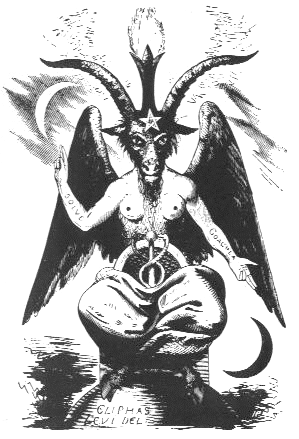
While popularly associated with the idea of the Devil, Levi's Baphmet has a more complex symbolic meaning

While popularly associated with the idea of the Devil, Levi’s Baphomet actually has a morally complex symbolic meaning

After so many weeks on this story, it seemed time to redesign the banner. I’d been holding off for so long because no compelling image seemed to be emerging out of the story. Well, you might remember that Emily put pentagrams on things as a teenager as part of her pretense of being evil. Turns out there’s more to the pentagrams than that, as this chapter demonstrates. So I’ve borrowed a pentagram design from the noted occultist Eliphas Levi (real name Alphonse Louis Constant, 1810 – 1875). Despite being long-winded and not as brilliant as he thought he was, Levi’s synthesis of magic has been very influential in the history of the occult. You probably recognize the picture on the right, another one of Levi’s creations. His pentagram design is by no means so sinister. In Transcendental Magic: Its Doctrine and Rituals (1854-56, translated by A. E. Waite in 1896), Levi explains it thus:

The Pentagram signifies the domination of the mind over the elements, and by this sign are enchained the demons of the air, the spirits of fire, the phantoms of the water, and ghosts of earth. Equipped with this sign, and suitably disposed, you may behold the infinite through the medium of that faculty which is like the soul’s eye, and you will be ministered unto by legions of angels and hosts of fiends.

In other words, whether you use this sign for good or evil depends on you. That’s the way magic ought to work, if you ask me.


Posted in Prophecies and Penalties, Writing fiction | Tagged , , , , , | 8 Comments

Memorial Day and the shifting grounds of commemoration

Yesterday was Memorial Day in the United States. For those of you who don’t live here, it’s the day we honor our military veterans, as opposed to Veterans’ Day, which is the day we honor our military veterans. Confused? So are most Americans.

This early 20th century cartoon captures the essence of Memorial Day's original meanings

This early 20th century cartoon captures the essence of Memorial Day’s original meanings

Memorial Day is a child of the Civil War and mid-19th century death rituals, combining the spring ritual of cleaning and beautifying the family cemetery plot with honoring the far too many soldiers who had died during the Civil War (1861 – 1865). Ironically, the combination seems to have begun in the South to honor the rebel dead, but the May 30 date for the holiday (before it shifted to a Monday holiday) was that adopted in the North to honor the Union dead. The holiday was also long known as Decoration Day, reflecting its composite nature. Over time, the connection to the Civil War has been mostly forgotten, and the rituals of cleaning the family cemetery lots have been reduced to having government authorities plant flags on veterans’ graves, whether they died in combat or not. The connection to the Civil War hasn’t been entirely forgotten in the South, however, where eleven states still celebrate a separate Confederate Memorial Day (under various names).

This famous photo was taken on V-J Day in 1945. Wouldn't kissing (between consenting adults) be a great way to celebrate the end of wars?

This famous photo was taken on V-J Day in 1945. Wouldn’t kissing (between consenting adults) be a great way to celebrate the end of wars?

One would have thought that a date to commemorate fallen soldiers would be directly connected to a war, but May 30 had no such connection. For that, we turn to Veterans Day, which is celebrated on November 11. This used to be called Armistice Day, because it celebrated the end of fighting in the “war to end all wars,” the First World War, in 1918. (Ignore the fact that American soldiers kept on fighting in Russia for months afterwards.) World War Two had a bigger impact on Americans, but Congress decided that it did not want to start celebrating the end of every war as a holiday, so Armistice Day became Veterans Day and was stripped of its specific history. Oddly enough, officially the United States did celebrate the end of World War Two, Victory (over Japan) Day, for almost thirty years, but the holiday got little attention. It is still celebrated in Rhode Island, much to the embarrassment of state officials when hosting a Japanese trade delegation in the 1990s.

This curious state of affairs, two holidays celebrating veterans, has been rationalized by claiming that Memorial Day specifically honors soldiers who died in our wars (although not necessarily in battle) , while Veterans Day honors all those who served in the military. Making the situation even odder, while both holidays were converted to Monday holidays in 1971 (thanks to lobbying by the tourism industry), Veterans Day was converted back to the historically significant date of November 11 in 1978, even though that date is irrelevant to what is now the holiday’s official meaning. Admittedly, the reason for the shift probably had less to do with history, and more to do with the uncomfortable closeness of the Monday-holiday version of Veterans Day to Halloween, an association that displeased veterans’ organizations.

Memorial Day was always the bigger holiday when I was growing up in New England, both for our town and for me personally. It’s a tradition in many communities for the veterans to march in a parade on Memorial Day, and in the 1960s that was a big event in my home town. There were a lot of veterans of World War II, including my father, and they had big families, so there would always be a large turnout. Other civic groups and organizations would also take part in the parade, so it was a big deal.

Before the Federal Gov't supplied flag-holding grave markers for veterans, groups such as the Sons of the American Revolution provided them. I remember planting flags in many of these. (Source: Wikipedia/Timothy Valentine)

Before the Federal Gov’t supplied flag-holding grave markers for veterans, groups such as the Sons of the American Revolution provided them. I remember planting flags in many of these.
(Source: Wikipedia/Timothy Valentine)

On top of that, my father was the town’s veterans’ agent in those days, which meant he was the part-time town employee helping veterans get their state and Federal benefits. One of his jobs was to put small American flags in the markers by every veteran’s grave in both town cemeteries. This was a task he delegated to us kids (though under his supervision), and my brother and sister and I would spend a wonderful spring day running through both cemeteries, trying to find all the markers and place flags in them. To this day, when I think of Memorial Day, the memory of planting flags in the cemetery is what comes to mind first and foremost.

Posted in History | Tagged , , , | 12 Comments

Follow up on chapter 15 of Prophecies and Penalties

In my previous post, I managed to forget the link to chapter 15 of Prophecies and Penalties, my serial story about a murder in a Vermont religious commune. So here’s the link to chapter 15, “Lost in translation.”

Posted in Prophecies and Penalties, Writing fiction | Tagged , , , , | Leave a comment

Chapter 15 of Prophecies and Penalties

Things begin to heat up in Prophecies and Penalties with chapter 15, “Lost in translation.” As Emily Fisher is about to find out, all sorts of things can be lost in translation: names, places, even herself. Yet somehow she’s stumbling closer to whoever murdered High Councilor Stephen Nash. Or is she?

Prophecies and Penalties is my weekly serial about a not-quite-detective dispatched to solve a murder at the religion commune in Vermont where she began her life. She’s run into a “man of the prophecy” who doesn’t believe he is, a previously unknown half-sister who likes beating people, and an incest survivor married to the town’s police chief. Such is life in Quasopon and among the Children of the New Revelation. To read more, start here!

Posted in Prophecies and Penalties, Writing fiction | Tagged , , , , , | 6 Comments

Working at a comics convention: MeCAF

You might recall that E. J. Barnes did the dragon-headed cane and Vampire Bureau badge illustrations for this blog. Well, she also writes and draws comics, and as henchman / “art enabler” I sometimes accompany her to comic book conventions to provide support.

So we went up to Portland, Maine this weekend for MeCAF, the Maine Comics Art Festival. It’s a one-day show, mostly of small independent comics creators, with a reputation of being kid-friendly. (Keep the X-rated stuff under the table!) For E.J., that meant such items as her minicomic on astronomer Caroline Herschel (1750-1848) and her animated film Leatherwing Bat, based on an old Appalachian folk song, with her minicomic on astrologer and occultist John Dee (1527-1608/09) being the one “adult” comic on hand.

E. J. Barnes and me (photo: Keith O'Brien)

E. J. Barnes and me
(photo: Keith O’Brien)

Me? As you can see, I help tend the table when things get busy, or when E.J. has to take care of various necessities. And as you can also see, I advertise her art and my blog by wearing my The Dragon Lady of Stockbridge t-shirt.

Oh, and I indulged a hobby of mine while I was there. I like beer, and there are several breweries and brewpubs in downtown Portland. Indeed, the convention party the night before was held at the tasting room of Shipyard Brewery, while I had lunch on the day of the con at a brewpub farther up the street. These days I’m into barrel-aged beers, so I tried a barrel-aged IPA at lunch, and brought home a bottle of a barrel-aged imperial stout to try with friends.

It was a nice low-key way to spend a weekend. Although the forecast was for rain, the wet weather cleared out Saturday morning and didn’t return until late Sunday evening after we got home. So I had a splendid stroll through sunny downtown Portland to get my morning coffee and and my lunch on Sunday. It’s the one advantage to being the henchman: I get to leave the convention building and enjoy the nice weather if I want!

Posted in Uncategorized | Tagged , , , | 5 Comments

Prophecies and Penalties Chapter 14 is now up

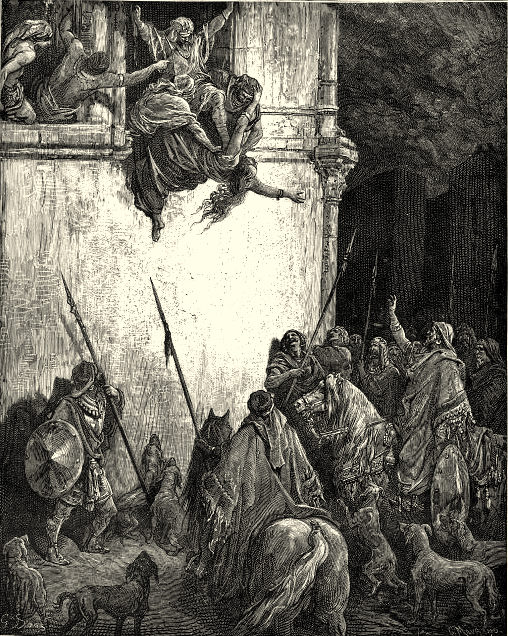
So Alex Bancroft, the Prophesied One, has been using an apartment up at Hilltop. But as Emily Fisher realizes, that doesn’t make him the only suspect. Not that she gets much time to consider the matter. For there are all sorts of “Sinners” in chapter 14 of Prophecies and Penalties, and Emily has to cope with a girl named for sin: Jezebel Johnson.

Fortunately for Jezebel Johnson, certain forms of punishment have been discarded by the Children

Fortunately for Jezebel Johnson, certain forms of punishment have been discarded by the Children

Posted in Prophecies and Penalties, Writing fiction | Tagged , , , | Leave a comment