Chapter 11 of Martha’s Children, and vampire lust in “The Hunger” (1983)

“The gentle art of persuasion,” chapter 11 of Martha’s Children, is now up and available. Ned and the sorceress Love try to remove the diminutive vampire Martha from Chicago before she gets out of hand. Maybe they’re a bit too late? If you’re not already reading this serial of vampires and cops, and sorcerers, too, set in 1969, you can start here.

The blood lust of vampires and its relation to sexual lust has been an enduring theme in the literature and visual media. After exploring it myself in chapter 9 of Martha’s ChildrenI was motivated to look up and watch one of the more unusual films portraying this relationship, 1983’s The Hunger (see trailer), based on the Whitley Streiber novel of the same name that came out two years previously.
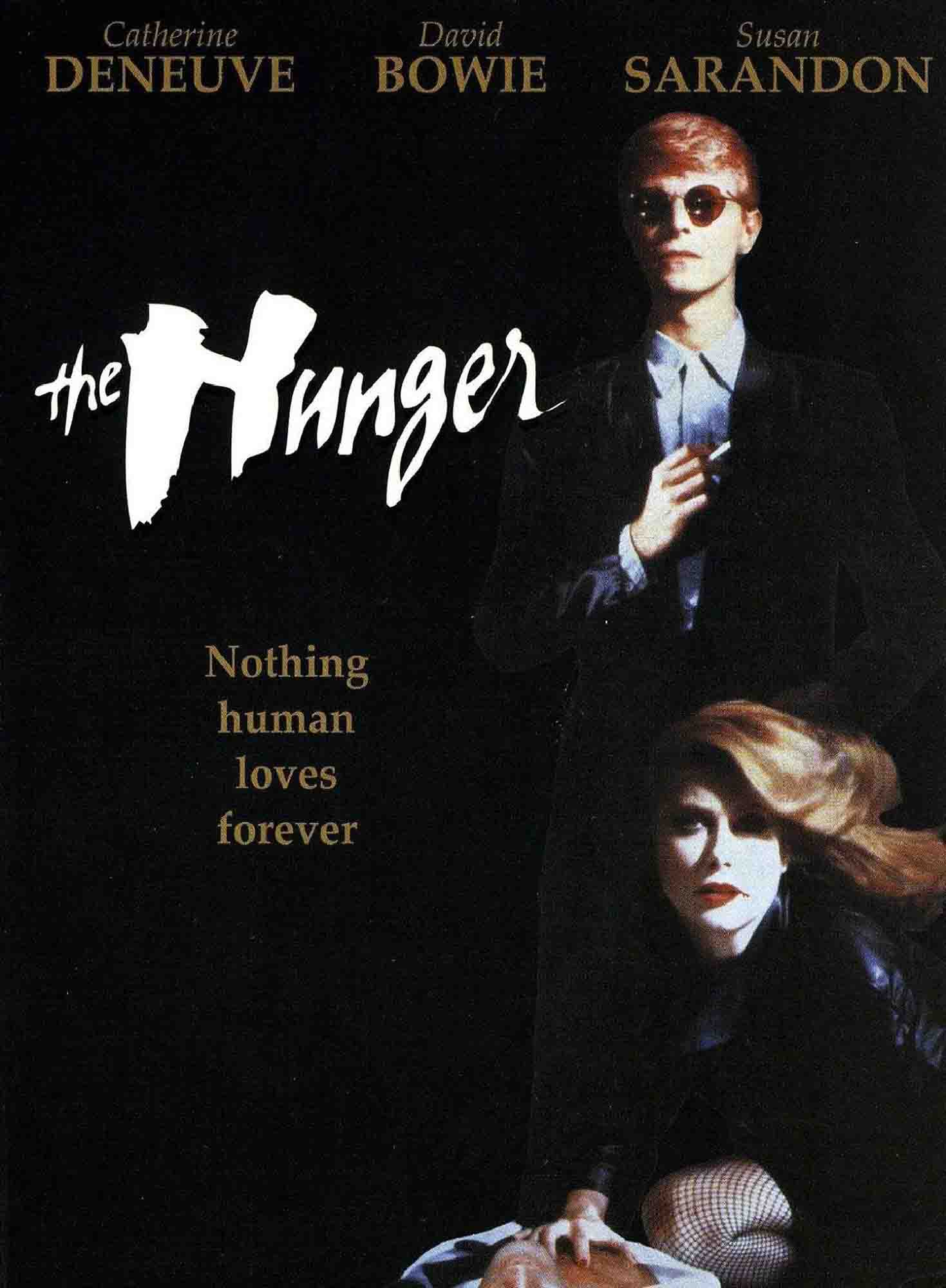
One of the posters gives a sense of the movie's style

One of the posters gives a sense of the movie’s style

The Hunger is famous for its lesbian sexual scene between vampire Catherine Deneuve and victim Susan Sarandon. But there’s more here to sink your teeth into. Deneuve’s Miriam Blaylock is a vampire that looks human but is of another species. In the movie, she seems capable of seducing just about any human she chooses into submitting to her. She can kill them, or she can make them into her partners by giving them some of her blood, which turns them into human vampires. Giving her partners the blood lust is psychologically her way of ensuring their sexual fidelity to her, if for no other reason than that any other potential sexual partner ends up dead to feed the blood lust. Provided they don’t mind sacrificing another human victim every week, Miriam’s partners seem to have the best of both worlds, sexual lust and blood lust, for several centuries . . . until they suddenly grow old and helpless, yet still immortal.

That’s the price Miriam’s human partners pay in the world of The Hunger, a variation of Tithonus’s bargain: after a few centuries of youth and fun, they become old and withered, but cannot die. David Bowie gets to see this happen to himself at the beginning of the film. Once he ages, Miriam just places him in a box, to stay there for all eternity, along with her other lovers.

Most reviewers have focused on the familiar trade-off between immortality and killing others that Susan Sarandon’s character faces when she is turned into a vampire. However, to me, the really interesting moral issue is the behavior of the inhuman vampire Miriam. Although she knows her chosen partners will eventually age and have to spend the rest of eternity as withered wrecks in a box, aware but incapable of action, Miriam continues to create new partners, simply because she is lonely without one. Far from being an act of kindness, Miriam curses her partners with untold millennia of suffering just to enjoy their company for a few centuries. She offers no real choice: she will destroy you now by taking your blood and killing you, or she will destroy you in a few centuries when you wither and become helpless, shut up in a box.

And that helps explain why The Hunger was not popular when it was released, and has obtained only a cult following since. Despite its truly glamorous style, The Hunger is ultimately an unglamorous depiction of the vampire as a destructive force. Miriam the vampire is surrounded by great beauty, is herself beautiful on the outside, but she truly has no soul. She is hollow.

I’ve wrestled with some of the same issues in writing Martha’s Children. However much they differ from Miriam Blaylock, the vampires of Martha’s Children face a similar problem. In becoming vampires, they have sacrificed the sexual lust for the blood lust, and yet they can’t seem to leave sexuality behind. In fact, they can’t even leave humans behind: they live among them while preying on them. Every vampire in Martha’s Children faces the problem of deciding what to live for, and how to live with people. They don’t all solve the problem the same way.

Posted in Martha's Children, Writing fiction | Tagged , , , , , , , | 2 Comments

Spring Witches (a reblog)

I haven’t reblogged someone else’s piece here before, so this is a first. The author, a Salem State University history professor, has a blog in which she offers a wide variety of images to illustrate historical topics. Found out about it when one of her articles was “Freshly Pressed.” This article of hers is on witchcraft, certainly a topic relevant to this blog:

Spring Witches

Posted in History | 2 Comments

In pursuit of a history of spiritual shaking

Shaker rocking chair (credit: Carl Wycoff/Pleasant Hill)

Shaker rocking chair (credit: Carl Wycoff/Pleasant Hill)

After being sick for a month, I decided to get out of the house and go visit the former site of a Shaker village. Most Americans these days, if they think of the Shakers at all, think of their finely crafted furniture, especially their chairs. But in their heyday, the Shakers had a reputation as religious radicals, and they claim to have been the first spiritualists in the United States.

The Shakers began in England, but they flourished after coming to America in 1774. Over the next eighty years, they would spread from Maine to Kentucky, with perhaps 5,000 members living in their communal villages. As a matter of faith, Shakers were celibate, yet they worked together, lived together, and prayed together, all the while trying to keep the two sexes from having private time with each other. Their villages were organized into one or more “families,” each of which owned and managed all their property in common.

The Sister's Shop (all Harvard photos by Peter Van Demark)

The Sister’s Shop (photo: Peter Van Demark)

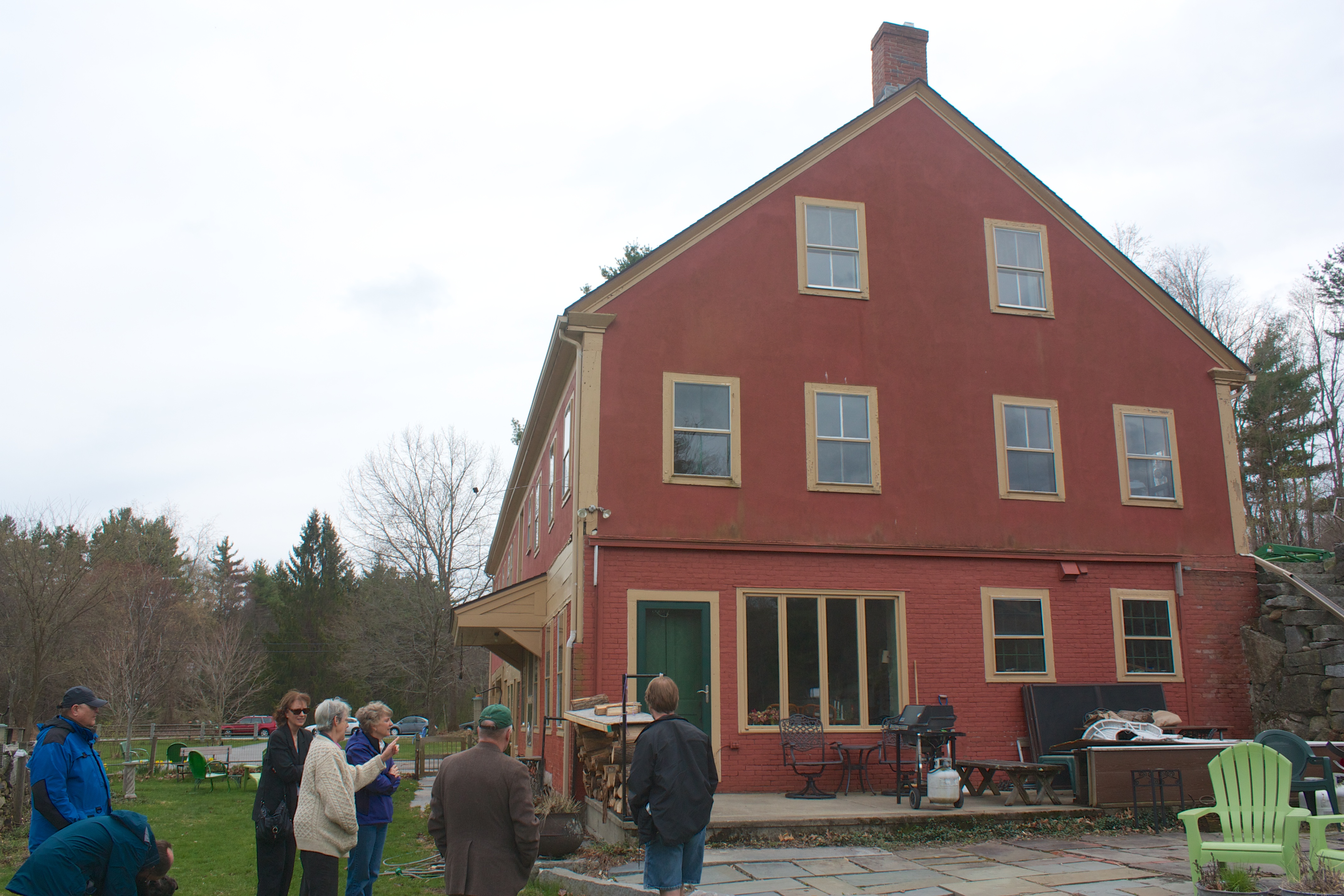
I rode my bicycle over the hills of Harvard, Massachusetts to visit three buildings erected and used by the South Family of Harvard’s Shakers. The Shakers lived at Harvard from the 1780s to the beginning of the twentieth century. By then, there were so few Shakers in Harvard that they sold the buildings and relocated the remaining members to other villages.

The ruins of the great barn (photo: Peter Van Demark)

The ruins of the great barn (photo: Peter Van Demark)

Preservationists know that the chances of an old building surviving are much greater if the building is being used. Two of the buildings I visited have remained in use, one as a home, the other, for much of its history, as a chicken coop. They’ve suffered some damage and had alterations, but they are still mostly what the Shakers built. The third building, the great barn, was not so fortunate. It was partially destroyed by fire some decades ago, and what is left is at the mercy of the weather.

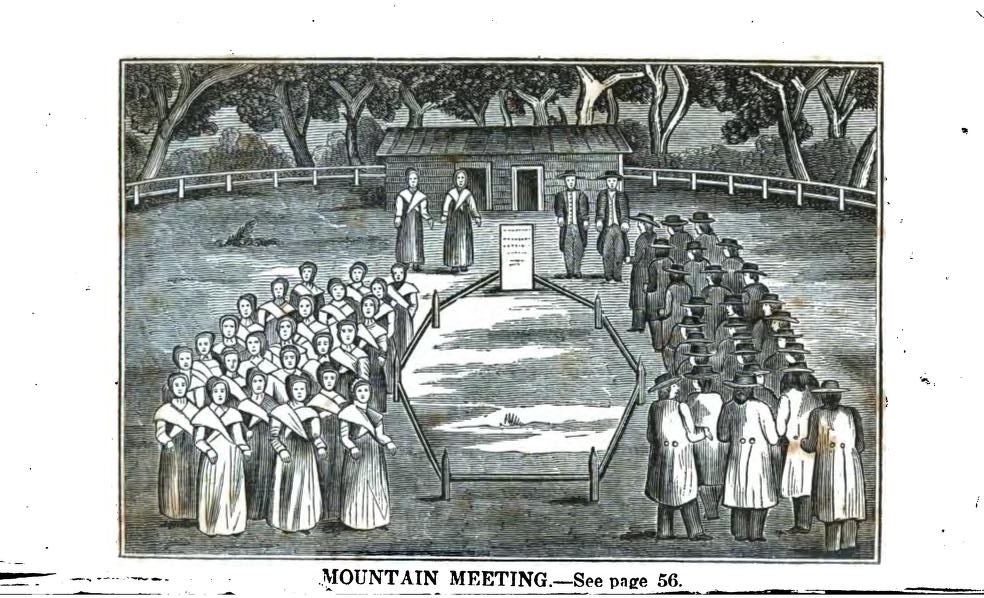
A depiction of one of the outdoor spiritual ceremonies

A depiction of one of the outdoor spiritual ceremonies

If you read a textbook on American religion, it will probably tell you that “spiritualism” began in 1848 with the Fox sisters in upstate New York. The Shakers would tell you differently. They were talking with the dead almost from the day they arrived in America. And in 1837 began their Era of Manifestations, when the spirits communicated regularly with the Shakers through selected “instruments” (as the spirit mediums were called). The instruments gave voice to dead Shaker leaders of the past, and great historical figures such as Ben Franklin, who admitted to seeing the error of his ways and becoming a Shaker in the afterlife. The instruments would relay spiritual guidance from beyond, and lead the faithful in elaborate outdoor ceremonies in the early 1840s. Members would receive spiritual “gifts,” which ranged from feeling the need to clean and sweep to engaging in ecstatic dancing and whirling.

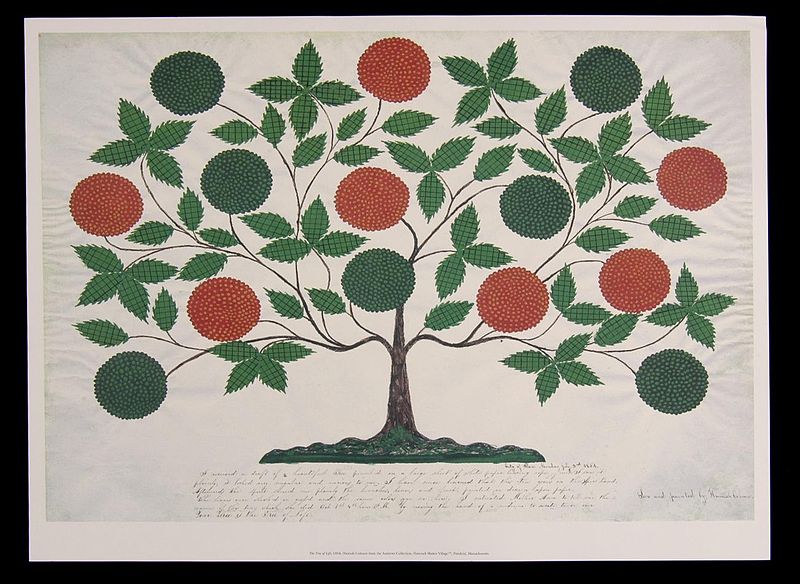
The enthusiasm of the Era of Manifestations gradually died out, and by the 1850s the Shakers seemed more embarrassed than proud of what had happened. It didn’t help that several of the prominent instruments had left the Shakers, which raised a question about how real their spiritual gifts had been. It’s not that the Shakers lost interest altogether in communicating with the spiritual world after the 1850s. What seems to have happened is that they gradually abandoned the unique practices of the Era of Manifestations and adopted the more common forms of spiritualism abroad in America. The distinctive spiritual works that survived were put aside and forgotten or even lost. So it wasn’t until the middle of the twentieth century that outsiders became aware of the spirit drawings that some Shaker sisters had made during the Era. These have since attracted a great deal of scholarly and popular interest.

The famous Tree of Life by Sister Hannah Cohoon

The famous Tree of Life by Sister Hannah Cohoon

The Shakers gradually declined in numbers after the Era of Manifestations. Starting in 1875, they began closing their villages and selling them off. Today, only a few Shakers remain in their one village in Sabbathday Lake, Maine.

The Shaker buildings in Harvard are in private hands, and you will need to speak to their owners to visit them. (I went as part of a group of Shaker enthusiasts and scholars that made arrangements beforehand.) There are other Shaker villages that are open to the public. If you’re interested, a good starting place is the National Park Service “Shaker History Trail” web site that lists the major Shaker villages and provides information on how to visit them.

Posted in History | Tagged , , , , | 2 Comments

Chapter 10 of Martha’s Children

“The blood brotherhood of vampires,” chapter 10 of Martha’s Children, is now available. “Scratch” Wilson didn’t get to be the leader of the Bronzeville vampires by being stupid or hasty. And he’s no great fan of white cops, even if they are vampire ex-cops. So when Ned lies to Scratch’s people, he sets in motion a confrontation with Scratch that will surprise both of them! If you’re not already reading Martha’s Children, my weekly serial about vampires and cops in 1969 Chicago, you can start here.

Along with posting a link to the newest chapter, I usually write on a related topic in these posts. My topic for this Friday isn’t really connected to Martha’s Children, so I’ll be putting it up as a separate post in the next few hours.

Posted in Martha's Children, Writing fiction | Tagged , , , , , | Leave a comment

Two birthdays related to magic and Hollywood on April 23

It’s time to celebrate the complexities of America’s Madonna/whore complex about women with the birthdays of Marjorie Cameron (1922-1995) and Sandra Dee (1942-2005). It would be easy to categorize Dee as the Madonna and Cameron as the whore. But things are rarely so simple.

In 1959, Dee was a rising young star

In 1959, Dee was a rising young star

Sandra Dee (born Alexandra Cymboliak Zuck) was one of those young actresses Hollywood quickly typecasts as a sweet young innocent girl. It helped that she was actually a teenager when she was acting as one. Marriage to clean-cut heartthrob Bobby Darin cemented her image. But as many young actresses have found out, it is hard to break away from being the ingenue. Americans didn’t want to think of her as anything else, and were disappointed when she and Darin divorced. In 1960s America, divorce still carried enough of a stigma that it ended Dee’s Hollywood career as a wholesome youngster without giving her entrance to more sophisticated roles.

So where does magic creep in? As Dee’s movie career was ending, she snagged the leading female role in the 1970 screen adaptation of H. P. Lovecraft’s The Dunwich Horror. In this movie, she get to talk about sex, cavort with naked people, and even be seduced or raped on an altar as part of a black magic ceremony. Wow! Quite a departure from her “good girl” image. Except it wasn’t. She was playing a college co-ed, a virgin who falls into her dire situation through a combination of drugs and being clueless. At least she does better than her best friend in the movie, who seems to be a bit more frank about sex, and therefore by Hollywood logic gets to be devoured (and possibly raped) by the monstrous offspring of Yog-Sothoth.

I have to admit to a certain fondness for the movie version of The Dunwich Horror. (You can take a look at the trailer here.) The opening animated credits and some of the scenes convey a genuinely creepy atmosphere. It got me interested in reading Lovecraft. That said, it was a bad choice for Dee. She looks too old for the role, and stumbles through the movie as if she’s on sedatives. The movie gets to debase her from the Madonna to the whore, but she doesn’t effectively come across as either.

Dee’s career was just about over after The Dunwich Horror. She made some appearances, mostly on TV. But she was mostly forgotten, and in ill health for most of the rest of her life. If she’s remembered at all anymore, it’s for the movies she made as the young innocent actress who wasn’t even twenty years old.

The reputation of Marjorie Cameron, on the other hand, seems to be firmly on the “whore” side. She was the second wife of rocket pioneer and occult magician Jack Parsons, his “Scarlet Woman,” who participated with him in his “Babalon Working” ritual in 1946 to create a spiritual child. And she turned up as the Scarlet Woman, literally and figuratively, in Kenneth Anger’s 1954 film, Inauguration of the Pleasure Dome. Having bright red hair helped.

Cameron's colors are much more vibrant in the actual film

Cameron’s colors are much more vibrant in the actual film

I first saw Inauguration of the Pleasure Dome only a few years ago. It might best be described as a personal and symbolic vision, done up as an experimental film. The movie is packed with references to mythology and magic, especially Aleister Crowley’s magic. I suspect most viewers either see it as a marvelous achievement or boring and pretentious nonsense. Either way, Cameron’s Scarlet Woman is the most striking image in the film. (This film is included in a DVD packaged as Films of Kenneth Anger I or The Complete Magick Lantern Cycle, which is how I saw it. There are stills all over the net, but I suspect posting them constitutes copyright violation, which I usually avoid on this blog.)

However, Cameron’s career as the Scarlet Woman lasted only about a decade. She lived for more than seven decades. What was she doing the rest of the time? Online sources reveal surprisingly little. She served in the military in World War II, was an artist, hung out with other figures in Hollywood’s occult and underground circles, and married at least one more time. But one gets little idea of what her life was actually like, or, for that matter, what she lived on. There’s a biography that I’ll have to track down to see if it will tell me more.

Polar opposites though they may seem, there is a link between Cameron and Dee. Among the people Cameron knew in occult circles in Hollywood was a young actor named Dean Stockwell. And Stockwell used some of his occult background when he was cast as the nefarious magician Wilbur Whately . . . the man who seduces Sandra Dee in The Dunwich Horror!

Posted in History | Tagged , , , , , , , , | Leave a comment

Chapter 9 of Martha’s Children, and the ongoing Boston bombing story

“Can’t get enough of you, Love,” chapter 9 of Martha’s Children, is now available. Martha warned Ned to stay away from sorcerers. By reputation, they are dangerous, devious, and capricious. All of which describe the sorceress named Make Love Not War quite well. So why is Ned asking for her help? And how is she going to treat the request of a mere vampire, let alone one who’s on the outs with her friend Martha? The answers to those questions surprise them both!

If you’re not been following Martha’s Children, my serialized story of cops and vampires in 1969 Chicago, you can start reading here. A new chapter goes up every Friday.

I’d planned an essay on “new age” spirituality, but my head’s a bit rattled this morning. Much of the region is shut down while they hunt for the surviving suspect from the Boston Marathon bombing. So we’re relying on news feeds, laden with uninformative fragmentary facts, rumors, and falsehoods, to figure out what’s going on. Turns out one of the suspects was living and going to school within a fifteen-minute walk from where I live in Cambridge. So much for the violence being only across the river in Boston.

Still, this is the second time in five days we’ve been going through crisis reaction in the area. I’ve read how people subjected to repeated crises become blasé about them, with London during the Blitz being a famous example. I’m seeing the same thing happening to myself. Monday was a horror. Today, we’ll just live through it.

I’d carefully considered Ned’s psychology, waking up to find himself a vampire, and wondered if I had got it right. I can still wonder, but I know that what I’ve portrayed is possible. People do adapt to horrors. Whether that’s good or bad is worth thinking about.

Posted in Martha's Children, Writing fiction | Tagged , , , , , , , | 17 Comments

Tragedy and uncertainty in Boston

This is a blog about mysteries and magic. Well, today we have had a real-life mystery unfold through the magic of explosives technology: the multiple bombings at the Boston Marathon, just across the river. As death tolls from explosions go, it’s likely to be small potatoes: fewer than five, though probably around 100 injured. Of course, to everyone who was hurt or killed, and their friends and relatives, the bombings are of surpassing importance.

From my safe home across the river, the whole story unfolded like a mystery. I got a phone text asking me if I was OK. From what? And then I saw the first postings on Facebook about one or more bombs going off near the finish line of the Boston Marathon.

The major local newspaper’s site went down immediately, and did not come up again for at least half an hour. The cell phone network was rapidly overloaded, and even shut down in downtown Boston by the authorities. So, just as much as anyone in San Francisco or Fiji, I had to rely on Internet connections to find out what was going on. It was very disconcerting to know the story was unfolding only a few miles away, and yet knowing my news sources were all coming from places such as suburban news stations or even New York.

There’s a river between Cambridge, where I live, and Boston. But we’re in Boston often enough. So I had to field phone calls, text messages, Facebook queries, and whatever else from people concerned about our welfare, with the cell phone network usually non-functional . . . and send out my own queries to people I know who live or work nearby, not to mention the runners. And all the time, I’m getting the news on what feels like an interminable delay.

I’m happy to say that no one I know seems to have been hurt or killed. Someone I do know was actually in the JFK Library when that explosion went off, and another was a runner who was about half a mile from the finish line when those explosions went off, but neither was hurt.

Still, people were killed, people were hurt, people that other people care about. And there are no answers yet, no solutions, not yet. It’s a mystery. Already, claims about the identity of the perpetrators are flying, often with a political agenda behind them.

We read about these events when they happen. They sound bad enough. But to be near them adds another layer of chaos and uncertainty. It’s a lot easier for me to appreciate why people have trouble figuring out what is going on when major tragedies strike, when I have trouble doing so for one only a few miles away. And what the situation is like for those who are at the scene must yet reach a higher level of confusion.

Right now, we don’t have an exact count on how many were injured. We don’t know who the perpetrators are. We don’t know if we’ll ever find out, or if they will be brought to justice. It is as profound and serious a mystery as any one confronts in life.

As a civilized people, it is our duty to help those who were hurt, comfort those who suffered. It is our duty to investigate this crime, to try to uncover the perpetrators, and if possible to see them judged guilty and sentenced in a court of law after a fair trial. And it is our duty to take steps to prevent future tragedies without compromising the virtues of a civilized society.

A civilized society is not built on guarantees, nor on vengeance. It is built on the hope that we can live peaceably and happily most of the time by being kind to one another, and on the efforts of citizens to put in place the laws and practices to make it so. We know our hopes will be blasted sometimes, that we will be disappointed, that we will be hurt. Without becoming uncivilized ourselves, we must act to fix things after such disappointments, after such tragedies. Because ultimately, human civilization is an experiment, built on the hope we can live peaceably together, that civilized behavior must in the long run triumph over savagery.

Posted in History | Tagged , , , | 17 Comments

The land of the dead

I grew up among the dead. My local landscape was inhabited by stories about ancestors who had lived and died in nearby places for centuries. My mental landscape was haunted by ghost stories. I had relatives who ran a funeral parlor only a few minutes’ walk away. But more than these, the dead came into my life through the two cemeteries in town.

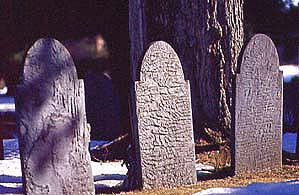
Weather-eroded slate stones in the old burial ground

Weather-eroded slate stones in the old burial ground

There was the old cemetery. Appropriately, it was only a minute’s walk away from the funeral parlor. Not that anyone from the funeral parlor was buried there, because the old cemetery had been closed since the end of the nineteenth century. It had been a churchyard cemetery originally. The meeting house (church) had moved away in 1714, but the cemetery remained. It had once contained open tombs, but these had been sealed and covered over, some indeed sealed up by the wall erected around the cemetery in the 1870s. As kids, we saw names and dates inscribed on the granite capstones of that wall, and wondered why people were buried underneath the wall.

Inside, slate headstones from 1704 onward predominated, many with the grim death’s head at the top, some with the mellower urn-and-willow design. There were historical markers by some graves, to identify the fellow who rowed Paul Revere across the Charles River on the night of his famous ride in 1775, the woman who led a group who captured a Tory spy during the Revolution, and several of the town’s original founders. There were also metal flag-holders in front of the graves of every veteran. My father had the job of putting American flags on all of their graves just before Memorial Day (which commemorates the nation’s war dead), but he made it a game with his children, and we all rushed about the cemetery trying to place as many flags as possible.

That task led to me writing my first supernatural story, when I was in fifth grade. For years, there had been one veteran’s grave we could never find, even by reading the headstones. So I composed what I considered a creepy story about how the gravestone appeared and disappeared on Halloween, a Brigadoon of the dead. One year a plane was flying overhead when the gravestone disappeared, and the airplane was lost, too! I thought it was impressive, then. And it did give one of my classmates the creeps.

Oh, the missing grave? We did eventually find it. There was a slate stone with a very long inscription, which turned out to mark two graves, that of a mother and her son, the veteran. His name only appeared halfway through the inscription. So much for the mystery. But I don’t set foot in that cemetery on Halloween.

The “new” cemetery had been around since 1847. It was about a ten minute walk from my home, but in a direction we rarely went on foot, so it was less familiar. Garden cemeteries were all the fashion after Mount Auburn Cemetery had been founded in Cambridge, Massachusetts in 1831, so the new cemetery was planned as another garden cemetery. But the people of my home town were not as rich as the founders of Mt. Auburn, so the new cemetery was a weak imitation. You walked in through the impressive stone gate, saw a grassy lot directly in front of you, and the grounds swept up the hill, with a winding path to take you to the top. But any attempt to cultivate a garden had long been abandoned, and the fence around the cemetery consisted of granite posts joined by rotting (or missing) wooden timbers.

Bridget's gravestone

Bridget’s gravestone

Still, this was where my family was buried. My great-grandmother, Bridget Lee Bixby, whom I mentioned in an earlier post? That’s where her grave is. Along with her husband and many of her descendants, which since 2001 have included my father. And there were more metal flag-holders there, with different designs for each war, and a unique one for the only sailor from the War of 1812 buried in the cemetery. That war was unpopular in New England, and my home town wasn’t on the coast, so it’s not surprising there was only one such marker. And it was a fancy one, too. I often wanted to take it away with me!

This is an example of that fancy marker

This is an example of that fancy Naval War of 1812 marker

As I got older, I became more curious about burial and memorial customs. I even squeezed several books on the subject into my doctoral research. Turns out there is a lot one can learn from visiting cemeteries. The slate graves of early New England were locally produced, while the marble stones only came into fashion as status symbols in the mid-nineteenth century. Death’s heads represented mortality, while the urn-and-willow demonstrated a shift to a more sentimental and hopeful view about death. Elaborate inscriptions or pictures all but disappear off granite stones for much of the twentieth century due to the cost of inscriptions, but declining costs have led to a resurgence in memorial art on stones in recent decades. The (U.S.) Association for Gravestone Studies holds an annual conference each year to discuss research.

The rest of the Midian cemetery was equally impressive

The rest of the Midian cemetery was equally impressive

Even though I’m become more scholarly about cemeteries, I still can shudder when they crop up in horror stories. Clive Barker wrote a horror story called “Cabal” (circa 1988) about revenants, subsequently turned into a movie called Nightbreed, that features an enormous cemetery called Midian. It looked so fascinating in the movie version that I wanted to go visit . . . in the daytime.

Posted in Uncategorized | Tagged , , , , , , , , , , | 8 Comments

Chapter 8 of Martha’s Children, and the logic of enthrallment

“It’s not that I don’t like you, I just want to kill you,” chapter 8 of Martha’s Children, is now up on my blog. Cops are loyal to their partners. But what happens when your partner turns up as a vampire? Ned’s about to find out! If you’re not already reading Martha’s Children, you can start here.

In the world of Martha’s Children, vampires have the ability to enthrall their prey. This is hardly a new notion in literature. Vampires have been enthralling their victims since Varney the Vampire (1845-47). Which is not to say they’ve all done it the same way, and some don’t do it at all.

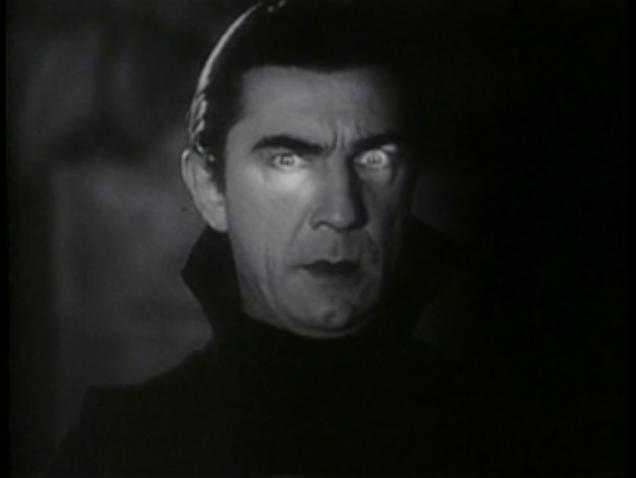
Don't look at the eyes!

Don’t look at the eyes!

Enthrallment is usually depicted as being similar to the popular conception of hypnotism. The vampire stares at you with his eyes, and you can’t look away. Your attention has been captured. Your will weakens, and the next thing you know, you are doing whatever the vampire wants you to do. You’ve lost control. The similarity to sexual attraction is obvious, and indeed it has often been portrayed that way in the literature, starting at least as early as Le Fanu’s Carmilla. The vampire is almost always the aggressor, the prey almost always passive. That explains at the sexual level how Fifty Shades of Gray could evolve out of Twilight.

If the vampire’s attack ends in the death of the victim every time, that’s that. But what if the vampire takes several attacks to kill its victims, as in Dracula? Typically, the victims are unable and unwilling to escape the vampire. Somehow, the vampire has altered the victim’s psychology. In the literature, the alterations range from sapping the will of the victim, to confusing the victim’s understanding and memories of what has been happening, to making the victim fall in love with the vampire, to the point of wanting to be killed and becoming a vampire in turn.

In Martha’s Children, I’ve given my vampires the full range of enthrallment. Vampires being predators, enthrallment is their way of luring and capturing their prey. They can use their voices and their touch as well as their eyes to enthrall prey. But just as sexual attraction only reaches its peak with the stimulation of the sexual organs, vampiric enthrallment is at its most powerful when vampires bare their fangs.

There are more parallels to sexual attraction. We humans have developed the ability to decouple our sexuality from reproduction. So, too, vampires in the world of Martha’s Children have learned how to decouple enthrallment from feeding. They can enthrall to various levels without feeding, show their fangs without enthralling. Of course, if they’re hungry and have trapped their prey otherwise, they are still quite prepared to dispense with enthralling their prey, and just simply biting into them and drinking their blood. That they don’t do that very often testifies to how much vampires enjoy enthrallment as their version of sexual foreplay.

Love is a many-splendored thing

Love is a many-splendored thing

To conclude today’s post on a personal note, I mentioned last week I was ill, and might skip Monday’s post, which in the event I did. Unlike victims of vampirism, I’m not enthralled with the virus that’s been preying on me. Between getting better, and getting sick and tired of being sick and tired, I believe I’ve recovered enough that the blog will be back on its regular schedule again.

Posted in Martha's Children, Writing fiction | Tagged , , , , , , , | 4 Comments

Chapter 7 of Martha’s Children, and not much else

In “Home is where the bleeding heart is,” chapter 7 of Martha’s Children, Ned finds himself  without Martha to instruct him in living as a vampire. So what does he do now? If you’re not reading Martha’s Children, my tale of cops and vampires in 1969 Chicago, you can start at the beginning here.

I normally write an essay on a related topic in these posts. However, I’ve been suffering from a viral infection this week, and haven’t had the energy to write one. My apologies. I may end up skipping Monday’s post, too, while this infection abates, but should be back as usual next Friday. I’ve already written chapter 8 of Martha’s Children, so it is not at risk of being interrupted because of my temporary indisposition.

Posted in Martha's Children, Writing fiction | Tagged , , , , , , | 8 Comments