
Writers have an almost unlimited opportunity to offend their readers: sex, violence, race, religion, politics, profanity, gender, class, and so on. Americans in particular live in a society that officially encourages freedom of speech, and at the same time says that people who are offended, in certain ways, have a right to demand an apology from you. And we condone certain types of censorship: explicitly sexual material is labeled “pornography” and sent off to its own little ghetto.
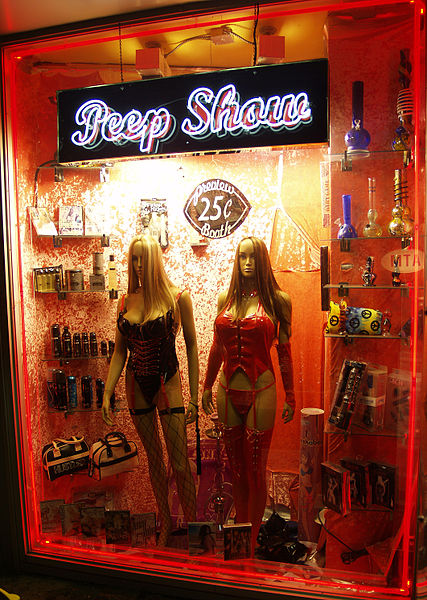
It can seem like a very attractive ghetto (photo: David Shankbone)
All this presents an author with problems. Including some of this material will alienate readers, and in the case of certain sexual or racial terms can easily get one’s work removed from the public eye and one’s own reputation destroyed. And yet this material, by its very controversial nature, can be a fruitful source of material for an author.
Although it’s less commonly recognized, this tendency to not want to discuss certain subjects in certain ways also causes problems for the readers. The problem is less apparent, and therefore more dangerous, when reading contemporary fiction. For example, we don’t want to deal with the contradictions of a culture that relentlessly exploits sexuality as “sexiness,” yet would prefer that actual sex not be presented, or be presented in forms artificial and stylistic, or banished to the “pornography” classification, where they will be read and seen frequently with a dollop of guilt.

When Capt. Picard (Patrick Stewart) can portray Shylock, what does that tell us about us?
The problem for readers becomes more obvious when dealing with the literature of the past. The tragic history of antisemitism, particularly in the 20th century, makes it almost impossible for contemporary readers to think about Shakespeare’s attitude toward the Jew Shylock in The Merchant of Venice. And our greater sexual openness (greater in imagination than reality, I am afraid) no doubt is responsible for the current mania in pop culture to extend the story of Pride and Prejudice. We know Lizzie Bennett and Mr. Darcy have a happy marriage, yet inquiring just how Mr. Darcy went about boinking Lizzie Bennett on their wedding night somehow seems tawdry. Instead, we have stories about zombies and murder mysteries to somehow assure us that Lizzie and Darcy really are happily married. And this, somehow, is dignified and delightful.
There are literary traditions that insist that all literature be uplifting, convey a positive message, uphold the moral values of society. If you hold to these theories, then your treatment of potentially offensive subjects, as a writer or reader, will be simple and straightforward. Somethings must not be discussed, and others should always be treated in line with those principles. The Hays Code, Hollywood’s self-censorship system from the 1930s until it collapsed in the 1960s, should be your model. And it must be acknowledged that the Hays Code did provide a generation of film-goers with movies that could be seen by the whole family.
But defenders of such a system should also acknowledge that the Hays Code was often at variance with actual social norms. Daphne du Maurier’s novel Rebecca was a best-seller, which implies that readers accepted its plot as one worthy of public discussion, but it had to be altered to suit the Hays Code, because a person who committed a criminal act was depicted in positive terms in the novel. That was unacceptable under the Hays Code, so the criminal act had to be changed into an accident, thus robbing the story of its moral tensions. Then, too, Hollywood worked long and hard to circumvent the Hays Code by implying what could not be explicitly shown.

You mean you didn’t realize that Bogie and Bergman had a past relationship in “Casablanca?”
I’m not a defender of the principle that literature must be uplifting. Indeed, I think an author should have and use license to portray any aspect of humanity to make the intended point in any given work. Yet at the same time, I have to deal with my readers, and with the structures of our society. There are some things I feel uncomfortable saying, and when I think of my readers, my problems grow greater. I will never forget the shock I had when a friend of mine told me that she had passed along a copy of one of my works to her parents. Said work describes a borderline-psychotic personality, bisexuality, promiscuity, dominance, psychological torture, alcoholism, and bad taste in decorating hotel rest rooms. I could easily imagine the trouble I was about to get into.
Well, fortunately I was wrong with my idiotic thinking. I ended up with two appreciate readers, instead of a legislative act banning me from the state. And that was a heartening result. It told me that if I had a solid purpose in writing as I did, if it was clear to my readers that I was writing to make a point, and not just to shock and offend, I could for the most part write as I felt necessary. I will lose some readers that way. But, hey, I’m writing sci-fi/fantasy. By writing in that ghetto, I’ve already accepted up front that there are a lot of people who won’t read what I write. I’m writing for the ones that will.











 Sillyverse