I get by with a little help from my friends in chapter 7 of As the Wyrm Tyrns

Geoffrey MacAlpine prepares to confront the wyrm with his unexpected partner, the American photographer Jacintha Lowell, while Calpurnia Kingsley fumes back at home with her diminished role as a researcher. They almost all got killed last time. But Geoff has a little surprise of his own, to Jacintha’s delight. And Calpurnia finds out that the benefits of having children are not always obvious. It’s all in chapter 7, “Unexpected help,” of As the Wyrm Tyrns, my weekly serial of a band of magicians trying to tackle a fire-breathing monster before it contributes to global warming by burning down a city.

Is this what the wyrm looks like? No, it's actually a sketch from 1832 of the common or weedy seadragon, which inhabits waters off Australia and reaches the whole of 18 inches in length!

Is this what the wyrm looks like? No, it’s actually a sketch from 1832 of the common or weedy seadragon, which inhabits waters off Australia and reaches the whole of 18 inches in length!

Posted in As the Wyrm Tyrns, Writing fiction | Tagged , , , , , , | 2 Comments

It’s all talk in chapter six of As the Wyrm Tyrns

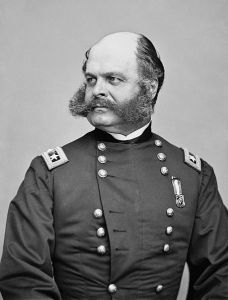
Burnside, sideburns, get it? Real U.S. Civil War general. Led his troops to disaster at Antietam, Fredricksburg, and "The Crater." His home state of Rhode Island rewarded his military incompetence by electing him as Governor and as a U.S. Senator. Americans sometimes do strange things like that.

Burnside, sideburns, get it? Real U.S. Civil War general. Led his troops to disaster at Antietam, Fredricksburg, and “The Crater.” His home state of Rhode Island rewarded his military incompetence by electing him as Governor and as a U.S. Senator. Americans sometimes do strange things like that.

Our intrepid band of magicians didn’t come out so well in their first encounter with the wyrm. Jacintha went brain-dead, Calpurnia got a hot foot, and Geoff is contending for the Ambrose Burnside Award for least competent leader. So it’s time for them to take stock and make plans for the future. Oh, and there’s an ominous development. Just in case you were wondering. It’s all in “Conversations,” chapter six of As the Wyrm Tyrns, my serialized story of magic and a dangerous undomesticated animal.

Posted in As the Wyrm Tyrns, Writing fiction | Tagged , , , , , , | Leave a comment

Hunka hunka burnin’ somethin’ in chapter 5 of As the Wyrm Tyrns

It's not quite a dragon breathing fire on a woman, but it's William Blake, and I say it's close enough!

It’s not quite a dragon breathing fire on a woman, but it’s William Blake, and I say it’s close enough!

Looks like Jacintha and Calpurnia have both lost their first confrontations with the wyrm. And with wyrms, losing confrontations is usually fatal. So what can Geoff do? Get more help, of course! And some help he gets without even asking! Read what the wyrm’s devastation left behind in “New fires and old flames,’ chapter five of As the Wyrm Tyrns, my weekly serial about an oversized fire-breathing creature loose near an English beach resort. And if you’re new to the story, start with chapter one!

Posted in As the Wyrm Tyrns, Writing fiction | Tagged , , , , , , | 4 Comments

My 2016 horror moldy oldie: Edward Page Mitchell, The Crystal Man

It’s time for the annual “moldy oldie” reading, when I dig up some generally forgotten writer’s horror stories to read for Halloween. This year, Paula Cappa,  an award-winning writer and blogger, introduced me to the stories of Edward Page Mitchell, so I read the groundbreaking 1973 collection of his stories by Sam Moskowitz, The Crystal Man. I thank her for doing so. For, while the collection is short on horrors, it’s a fascinating look at the nebulous borderline between fake news and fiction.

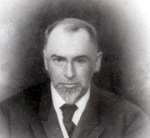
Edward Page Mitchell

Edward Page Mitchell

So who was Edward Page Mitchell (1852-1927)? According to Moskowitz, who must be given credit for rediscovering him, Mitchell was the missing link in American science fiction, the man who bridged the gap between Verne and Wells, and probably influenced the latter. Alas, while Moskowitz was a noted researcher of the roots of American science fiction, he let his enthusiasm run away with him at times. For example, crediting Mitchell’s “The Tachypomp” as the first story of faster-than-light travel overlooks the fact that it does not take into account relativistic effects, no surprise since the theory of special relativity wouldn’t be invented for another 31 years.

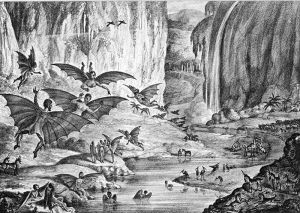
In 1835, the Moon was not a harsh mistress!

In 1835, the Moon was not a harsh mistress!

A better way of understanding Mitchell is to see him as a newspaper editor and writer of the late nineteenth century. Mitchell spent most of his life (1874-1926) at the New York Sun, the first successful penny newspaper in America when it was founded in 1833. In those days, newspapers had to entertain as well as inform. And one of the ways they entertained was to create what appeared to be news stories about strange events. Perhaps they were true, perhaps they weren’t. In fact, one of the Sun’s greatest successes was the famous Moon-man hoax of 1835, in which the real astronomer John Herschel was purported to have seen flying man-like creatures on the moon.

One can see this influence directly in some of Mitchell’s tales. “The Story of the Deluge” begins just like a genuine news story, only to switch to humor and political satire along the way. “The Soul Spectroscope” begins likewise, though the use of “Prof. Dummkopf” as its subject tips off the readers immediately. Not surprisingly, several of his stories develop an idea just a little bit and end abruptly, convenient to fill in some space in a newspaper, but unsatisfying as a tale. “The Tachypomp” is passed off as a dream, while “The Soul Spectroscope” implies at the end that its protagonist is a madman. And a few bits are didactic essays that remind me of Mark Twain, another journalist-turned-writer. I could imagine him writing “The Devil’s Funeral” instead of Mitchell.

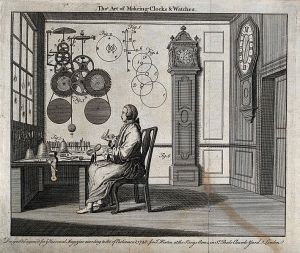
Can't have a time-traveling clock without a clock-maker! (Source: Wikipedia/Wellcome Images)

Can’t have a time-traveling clock without a clock-maker!
(Source: Wikipedia/Wellcome Images)

And yet, Mitchell wrote some pieces that qualify as genuine, well-developed stories, and deserve much of Sam Moskowitz’s praise. “The Clock That Went Backward” really is an elegant story about time-travel paradoxes, even if the “science” behind it is left unexplained. And “The Crystal Man” is a decent invisible man story, in which an innovative technology leads to human tragedy. Better yet, while Mitchell was prone to using many of the hackneyed romantic tropes of his era, to the detriment of his stories, in “The Crystal Man,” he gives one of them a sharp twist that brings it to a startling conclusion.

So what of horror stories? To judge from this collection, Mitchell preferred his horror with a leavening of humor. “The Cave of the Spurgles” and “The Flying Weathercock” are stories which in other hands could have been good horror stories, but Mitchell’s design in the first case and his exposition in the second deprive either story of any frights. And appearances of Judas Iscariot are not as shocking to 21st century sensibilities as they were to the 19th, which lessens the impact of such stories as “The Devilish Rat.”

Yet there are stories which can give one the shivers. Mitchell tackled the subject of conjoined souls twice, and while his story of the Dow twins is marred at the end by his humor, that and the story of the Fancher twins are both eerie considerations of human nature. “The Facts in the Ratcliffe Case” begins innocently enough, and is slow to build up, but pays off in its concluding pages by revealing a human monster. And while “An Uncommon Sort of Spectre” is, despite its name, a common enough ghost story, I appreciate the twist Mitchell gives it.

What is more intriguing to me is that some of Mitchell’s stories have horrific implications that may not have been obvious to his readers, or even to himself. “The Ablest Man in the World” is meant to be a story about advanced technology and human nature, but on second thought can be read as a lesson on how human fears can frustrate noble goals. And “The Senator’s Daughter” has an awful lesson about race prejudice (expected) and sexism (unintentional) at its conclusion.

While it was short on horrors, The Crystal Man was an entertaining read. The British magazine The Fortean Times has been covering these borderline “news” stories for years as curiosities in journalism. It was illuminating to get another angle on late 19th century newspaper journalism, to see how “fake news” could so easily slide into science fiction and fantasy. So thanks, Paula!

Posted in Reading fiction, Reviews | Tagged , , , , , , | 13 Comments

The wyrm takes center stage in chapter 4 of As the Wyrm Tyrns

It would be a pity if a story called As the Wyrm Tyrns did not have an appearance by the wyrm. And so, this week, the wyrm raises its head over Breydon Water. This bodes ill for our intrepid magicians: the scholarly Geoffrey MacAlpine, the recently rehabilitated Calpurnia Kingsley, and the American photographer Jacintha Lowell. And it’s not as if they don’t have other problems of their own! Check out “Enter the wyrm,” chapter four of As the Wyrm Tyrns, my weekly serialized story.

dobrynaNice image, eh? No, it’s not Calpurnia and Geoff looking over the dead wyrm. They wish! No, one of the fascinating things about writing this blog is finding out things I never knew before. This is an image of the legendary Russian knight, Dobrynya Nikitich, rescuing the princess Zabava Putyatishna from the three-headed dragon Gorynych, as drawn by Ivan Bilibin (1876 – 1942). It’s so gorgeous, I couldn’t help but include it here.

Posted in As the Wyrm Tyrns, Writing fiction | Tagged , , , , , , | 8 Comments

Questions about relationships in chapter 3 of As the Wyrm Tyrns

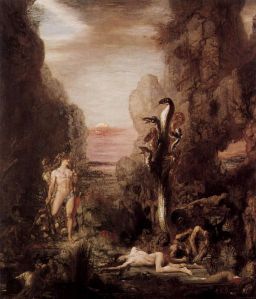
Calpurnia's second husband. No, the one on the right. (By Gustave Moreau, 1876)

Calpurnia’s second husband. No, the one on the right.
(By Gustave Moreau, 1876)

What’s a wyrm to do? It just wants to smash through Great Yarmouth and go north to mate with others of its species. Surely the humans should understand that? Well, the humans have relationships of their own to deal with, and Calpurnia finds herself having to tell the tale of her least successful marriage. “It’s complicated” in chapter three of As the Wyrm Tyrns, my weekly serial about dragons, magicians, photographers, and maternity wards. If you haven’t been reading it, you can start here.

Posted in As the Wyrm Tyrns, Writing fiction | Tagged , , , , , , , , , , | Leave a comment

Intrigue raises its head in As the Wyrm Tyrns Chapter Two

Is this barista trying to draw a wyrm on the latte? Is it a clue? (Credit: Wikipedia/

Is this barista trying to draw a wyrm on the latte? Is it a clue?
(Credit: Wikipedia/”Takeaway”)

So far, it’s all been fun and games for magicians Geoffrey MacAlpine, down from Scotland, and Calpurnia Kingsley, in her home town of Great Yarmouth, England. But there’s a wyrm to put down, and other dangers lurk among the coffee shop tables.

Hmm, wait, that doesn’t sound right. The wyrm isn’t in the coffee shop. Unless it’s hiding. Where can one hide a wyrm in a coffee shop? Maybe dress it up as a barista?

In any case, turn to chapter two to pick up the story. If you’re new to the story, begin here. I put up a new chapter every Friday until the story is done.

Posted in As the Wyrm Tyrns, Writing fiction | Tagged , , , , | 4 Comments

A new serial – As the Wyrm Tyrns

Sillyverse was begun to tell long stories in serial form over many weeks. For much of this year, the blog has been all but suspended while I attended to family and personal issues. Between some timely important decisions and being rested from my trip to France last month (including this episode), it seemed like a good time to get the blog going again.

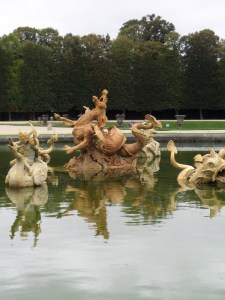
You do not want a wyrm loose in the Water! (Photo; E. J. Barnes)

You do not want a wyrm loose in the Water!
(Photo; E. J. Barnes)

So this week begins a new story: As the Wyrm Tyrns.  “What’s it about?” you ask. Wyrms. Well, a wyrm. (I’m using the word over and over again so you realize it’s not just a typo.) A wyrm is a dangerous creature, all the more so for being poorly understood. Geoffrey MacAlpine, a professor who has studied many things strange and magical, would suggest arm wrestling polar bears as safer than confronting a wyrm. Pity, then, he has to go confront one himself. To find out just what’s going on, start reading Chapter One: Two uncomfortable people, to learn more. (And if you want a bit of background on Geoff, he has appeared in one earlier short story on this blog.)

As with previous serials, a new chapter of As the Wyrm Tyrns will go up every Friday morning until the story is done. Each chapter will be hyperlinked forward and backward, to make it easier to read. And there is a parent page with links to all the chapters as they go up.

Now, I must emphasize that As the Wyrm Tyrns is a work of fiction. Any resemblance between characters in the story and real people, living or dead, is strictly coincidental, except when it isn’t because I begged for permission to smuggle thinly disguised versions of people into my story. But the real people are not the same as my fictional characters. For one thing, the real people are nicer. (I’m required to say that.) And the fictional characters think and do things their real-life counterparts would never do, I think. So don’t confuse them.

Posted in As the Wyrm Tyrns, Writing fiction | Tagged , , , , , , , , | Leave a comment

Death of a hat

Where we stayed in Normandy

Where we stayed in Normandy

Besides visiting a fellow blogger, my partner E.J. and I spent several days last month in Normandy. Neither of us had been there before. Friends of ours own a pre-Revolutionary farmhouse that has come down through their family. Considering that in my family an heirloom is something my parents bought, I was impressed. The cat at the farmhouse was not impressed by me, though. I had to wonder if he’d come down through the family, too. (He sort of did.)

There’s an old saying that fish and house guests stink after three days. So E.J. and I decided we’d spend the fourth day on our own, and give our hosts a chance to catch up on their own lives. There was a nearby historical site, an old ruined castle at Gratot, that was only 7 km away. We decided to walk there. There wasn’t much chance we’d get lost. All we had to do was follow the highway signs. And we had the map app on a mobile phone as backup.

See: cows. And Gratot's church in the background. The ruined castle is barely visible to its left.

See: cows. And Gratot’s church in the background. The ruined castle is barely visible to its left.

It was supposed to be a cool, cloudy day with a chance of rain. But the rain held off, so we had excellent walking weather in the morning. The road was a minor highway with very little traffic, and ran through mostly rural countryside. As we walked, we saw hedgerows and working farms on either side of the road most of the way. They were raising everything from cattle to corn. (Probably the corn was meant for the cattle; humans don’t seem to eat corn in Normandy). It was a quite enjoyable walk. Making it just that much better, there were sometimes ripe blackberries on the bushes at the edge of the roads. We helped ourselves.

As we approached our destination, we walked on the road up a ridge, and there were the ruins of the castle and its church off to the left and in front of us.  Now I’ve studied the history of European warfare a bit, and I could tell that this was definitely a medieval fortification, built before the age of gunpowder and cannons. It had tall round towers connected by high but thin walls. It’s a good way to protect the castle against pikemen and cavalry, but cannons would level those walls with ease.

Inside the perimeter wall of the ruined castle

Inside the perimeter wall of the ruined castle

One of the reasons the castle had survived was that it wasn’t in a strategic location. Oh, you could see out to the coast from the towers, which meant you could see Vikings or an invading English army coming. But it didn’t command any important routes and wasn’t that important by itself. So it stayed in the hands of Norman nobility for most of its existence, instead of being seized by the Crown. After the Revolution, the castle passed through many hands, became dilapidated, was all but abandoned, and began falling into ruin. Only a local effort began the restoration of the castle in the last few decades. So most of what’s been left has been stabilized, and some repairs and restoration have taken place. But there’s no money to pay a staff, so you can go where you will, though you are advised not to go past points which are marked as dangerous. A few laminated guide pamphlets, which you are supposed to use and return, provide information about the castle’s features.

There was a moat around the Castle. Unlike the moat we’d seen at Pirou Castle a few days earlier, this one’s water was mostly clear, not scum-covered, which indicated there was some source of running water in the moat, although there was almost no current. The drawbridge had been replaced a long time ago by a permanent stone bridge.
The gray guardian of the castle

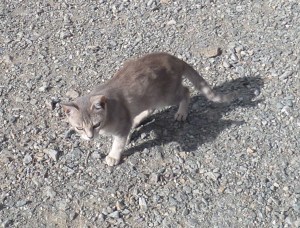
The gray guardian of the castle

Which is not to say the castle was unguarded. It was guarded. By cats. (I should have figured this after the farmhouse.) At least three cats, as it turned out, all feral. We first saw two small kittens holding the mainland side of the bridge, eyeing us suspiciously. The gray kitten was very skittish, but the white one was aggressive enough to approach us and let us pet her, if we were careful. They both looked cute, the white one especially so because it was being friendly. They decided to form our honor guard across the bridge. There we met the captain of the guard, the mother cat, who was as white as her favored offspring, the one she played with more. All three cats had scarring on their ears.

Leaving the cats behind, we walked the three levels of buildings open to us, including climbing up as far as we could all three of the remaining standing towers. There was also a display indoors in one of the buildings, going into the history of the castle and the noble family that once owned it. It filled out the story in the printed guides.

It's a ruddy shelduck, E.J.! Don't go for your camera!

It’s a ruddy shelduck, E.J.! Don’t go for your camera!

Cats were not the only inhabitants of the castle grounds. As we prepared to leave the castle, we saw ducks in the moat, swimming near the bridge. And one was a very odd looking duck, of a species E. J. was sure she’d never seen before. So she quickly reached for her camera to get it out of its pouch and to take a picture before the duck did something horrible, like swim away.

Now E. J. likes hats. They are part of her signature style. This day, she was wearing a broad-brimmed “Shaker hat” (made in China but sold at Canterbury Shaker Village), because it was lightweight (a good thing when it is hot, which it was becoming) and it keeps the sun out of her eyes and off much of her face.
Nooooooooooooooo!

Nooooooooooooooo!

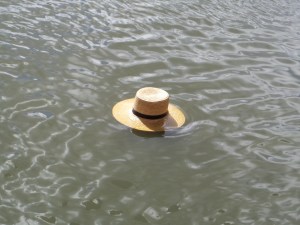
But such hats have one undesirable feature: they pick up the wind. Or, rather, the wind picks them up! E. J. had inadvertently demonstrated this during the English part of our trip, when a wind snatched that same hat off her head and blew it into a street intersection . . . where we recovered it before a car ran it over. And now, with both hands busy getting the camera out of its case, Eleanor was not prepared for a sudden gust of wind that picked up, picking up her hat, off her head, and carrying it over the parapet! And then the gust died. Hats, no less than cannon balls, are subject to gravity, and with the dying of the gust, E.J.’s hat began its slow descent . . . down, down, down, until it landed brim-first flat on the waters of the moat.

And there it sat! The lack of current in the moat meant the hat wasn’t moving much, and in no definite direction. Since it landed brim first, the crown of the hat was above water, and the air trapped underneath it ensured it would stay afloat for some time. Yet there was nothing we could do to recover it! We couldn’t fish it out, it was out of our reach, and there was no staff on hand to appeal to for help. And neither of us felt like jumping into the moat and swimming over to the hat. E.J. stood on the bridge, disconsolate, looking down over the parapet at her hat, itching for some way to get it back! But, in the end, she had to settle for taking a picture of her forlorn-looking hat, and then walking away.

We ended up taking a roundabout route back, via the nearby coastal resort town. The sun had come out from behind the clouds, making it a warm and sunny day. I didn’t know it, but my nose was acquiring a sunburn. E.J., of course, missed her hat, so the sun afflicted her, too. When we finally arrived at the shore, I made a beeline for a local bar to get an orange-flavored Picon beer, while E.J.’s feet turned to the ice cream parlor across the square. Each to his or her own preferred form of relief!

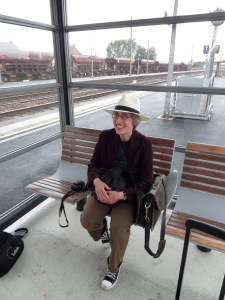
E.J. sorely missed her hat. Our hosts lent her one the next day, but that’s not the same. She needed a hat, her hat. The second day after, we went to an open-air market, and she bought a hat. It looked somewhat similar to the one she had lost, though it was whiter and had a smaller brim. It had one ironic similarity: it, too, had been made in China.
E.J. is smiling because she has her new hat

E.J. is smiling because she has her new hat

What was more amusing was that the label also told her that the hat was made of paper! This made it so light and airy that E.J. was initially uncomfortable with it. As she told me, she didn’t expect to feel the wind on the top of her head when she had a hat on, but with this hat, she did. Despite being so insubstantial, and even being rained on at least once, the hat has made it back to the United States intact.

Posted in Uncategorized | Tagged , , , , , , , | 9 Comments

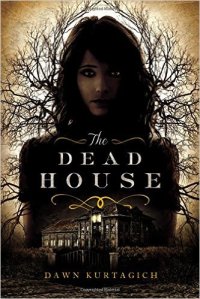
Review: Dawn Kurtagich, The Dead House

It was the cover, and the tag line “the girl of nowhere,” that snagged me when I was looking for something light to read, because as we all know, Young Adult horror novels are light reading. Well, Dawn Kurtagich’s debut novel, The Dead House, really is light reading, a horror tale with an intriguing twist that will have you wondering for at least a while.

the-dead-houseNow I rarely venture into Young Adult territory, partly because I don’t know what can and can’t be included in it, and partly because my own reading habits didn’t develop that way. But The Dead House was just among the new releases at my local store, so I picked it up, only to see its category afterward. What does it mean in this case? It’s about teens in their last year of high school. It does talk about sex, a bit. And its take on identity issues probably would be more appealing to teens than any other group.

The back cover has R.L. Stine calling it “original.” Well, don’t get too worked up about that. The problem of the protagonist who’s not certain if she’s crazy or really dealing with magic has been around almost since the gothic novel was invented, and the use of documents, including newfangled technology, to tell the story can be traced back to Dracula and even before that to the epistolary novel.

Where Kurtagich deserves credit is in her treatment of her protagonist’s mental condition and in her use of magic. Carly Johnson is a split personality, with her alter ego named Kaitlyn. The relationship between these two is intriguing, especially as we get most of it from Kaitlyn. And then Kurtagich throws in a twist halfway through the novel which confuses even our protagonist as to just what she is. Kurtagich tends to rely on withholding information to build suspense, a technique I greatly dislike, but Carly/Kaitlyn’s odyssey is the real driver of suspense in the novel, and the reason I kept reading.

And then there’s the magic. Some people make a big deal of demanding that one have a full and novel system of magic behind one’s stories. That’s not here. Kurtagich deserves the credit for putting together a type of magic and backstory for it that combines Scotland with what looks to me to be voodoo. It’s not a fully fleshed out system, but then for the story it doesn’t have to be, and given what our characters know, it shouldn’t be shown as a complete system. Let’s be clear: the purpose of magic in a fantasy story is to allow the writer to bend reality in ways to further the story’s plot and themes without seeming arbitrary. And this Kurtagich does.

The Dead House wasn’t quite what I was expecting. But it’s an entertaining bit of horror. I found the psychological elements much more horrifying than the magic, but  that’s me. And the conclusion, while finally a bit predictable, does take a satisfying route to get there. So here’s hoping Kurtagich’s next novel, which should have come out about now, builds on the more successful elements of this one.

Posted in Reading fiction, Reviews | Tagged , , , , , , , | 1 Comment