Chapter 16 of Martha’s Children, and hierarchies

In chapter 16 of Martha’s Children, “The shadowed livery of the burnished sun,” ex-cop and vampire Sherlock Kammen gets down to the business of helping to build what will become Chicago’s vampire police, if all goes well. There’s no blueprint; Ned O’Donnell, Kammen, and their colleagues have to make up the rules themselves. Meanwhile Kammen continues on his quest to find out what happened to Martha Fokker.

If you’re not reading Martha’s Children, my serial set in 1969 Chicago, you can start here. A new chapter goes up every Friday before noon.

Weber is considered one of the founders of Sociology

Weber is considered one of the founders of Sociology

A lot of Kammen’s problems in this chapter stem from the tensions created by an organization. Humans, like vampires, are hierarchical. We tend to look for leaders. At the same time, we often resent following leaders. A century ago, the sociologist Max Weber (1864-1920) argued that there were two types of leaders: charismatic leaders, who inspire and lead people by their own personal gifts, and bureaucratic leaders, who hold their position because they satisfied some sort of standard process for selecting leaders for defined positions. The founders of religious groups are often charismatic leaders. Sadly, their successors typically become bureaucratic leaders. Many of the Founding Fathers rose to their positions in the American Revolutionary leadership thanks to their own talents, making them charismatic leaders. Far too many American Presidents took office because they were the beneficiaries of a well-defined process, making them bureaucratic ones. (Weber actually put democratically elected leaders in a third category, for reasons not relevant to this exposition. Still, I don’t want to misrepresent his thinking.)

The vampires are trying to build a brand new organization, but one which is modeled on an existing bureaucracy, the  Chicago Police Department, so they really need both types of leadership at once. This is putting enormous strain on Ned, particularly because, like most people in the modern world, he’s much more used to bureaucratic leadership than the charismatic type. You hold a rank and position in the Chicago Police Department, you know pretty much what you can do. Just as importantly, you know how much you have to defer to higher-ups, and how much respect you should be able to get simply by virtue of your position from people below you. In other words, leadership is about manners as much as power. Ned doesn’t have that sort of well-defined social structure to support him as yet, but that’s what he’s used to and that’s what he’s aiming for.

All this reminds me of a time in my own life when I worked as a low-level manager for a large corporation. The corporation was going through hard times that would eventually destroy it. No one’s job seemed safe anymore. The managers in my part of the company had taken to hoarding information as one of their tools to control their staffs.

One day we had an all-managers meeting, in which the two senior managers tried to understand why they were having so many problems with the junior managers. They did the logical thing: they asked the junior managers to tell them. The junior managers conferred and came up with a list of reasons. And, wouldn’t you know it, they selected me to be one of their spokespeople. I think I was selected because some of the explanations the junior managers offered were dynamite, and they picked the youngest manager in the group, me, to be the sacrificial lamb.

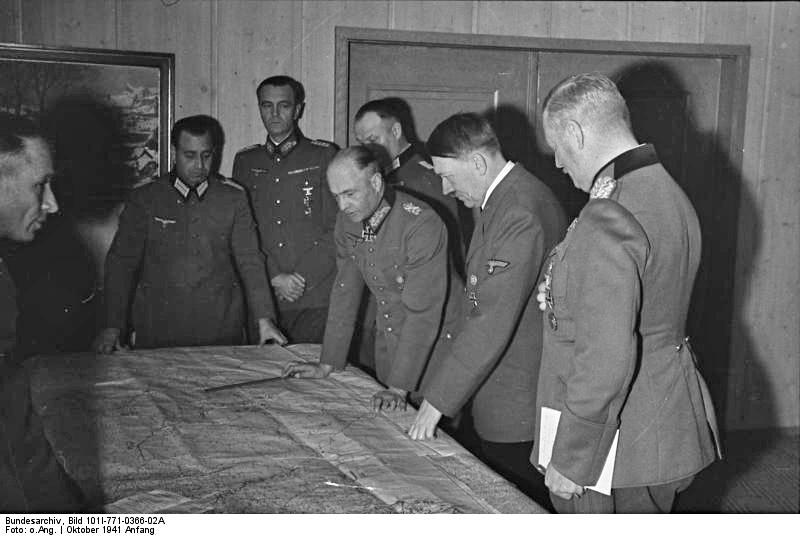
I took their dynamite and added a touch of nitroglycerin. One of their complaints was the communication problem between the two layers of management, which was not limited to information hoarding. When I brought this up, the senior managers looked puzzled, so I tried to think of a way to crystallize what we junior managers meant. Well, even then I was a historically-minded individual, so I reached into my memory, and explained to the senior managers that the communication problem was similar to that between Hitler and his generals.

It is probably a bad idea to compare your boss and your colleagues to Hitler and his generals (attr: Bundesarchiv, Bild 101I-771-0366-02A / CC-BY-SA)

It is probably a bad idea to compare your boss and your colleagues to Hitler and his generals
(attr: Bundesarchiv, Bild 101I-771-0366-02A / CC-BY-SA)

Dead silence.

Prolonged dead silence. My colleagues who knew me could scarcely believe what I had said, and were horrified. They were horrified by the comparison. They were also horrified by the way I had violated several social norms in addressing our senior managers. My colleagues who did not know me well were all that, and confused, to boot.

It was worse. As I said, there were two senior managers. One knew me fairly well. The other did not. He was of German ancestry. He wore a small mustache.

A nervous titter went round the room. Bright boy that I was, I realized something had gone wrong, and managed to get out some words glossing what I had just said into more appropriate management jargon, and then plowed on to the next point. The rest of the day went along, and while I got a few bemused glances, no one said anything to me.

About two weeks later, I ran into the senior manager I knew. He laughed about the incident (then!), saying that I was sometimes a bit too honest, not quite diplomatic enough. Then a few months later, we had a reorganization and a layoff. The senior manager of German ancestry became the sole senior manager. And I got laid off.

In truth, there were no doubt many other reasons why I was let go. Even so, I’d learned a lesson about violating unwritten but well-understood social norms about manners between different levels in a hierarchy. Why, I would go an entire decade before doing it again!

Posted in Martha's Children, Writing fiction | Tagged , , , , , , , , | 14 Comments

Becoming a fan: Doubleday Science Fiction Book Club

The resemblance to Mr. Spock is uncanny, isn't it?

The resemblance to Mr. Spock is uncanny, isn’t it?

Oh, I’d watched Twilight Zone and Outer Limits on television when I was a kid. That isn’t to say I always understood them; some of the stories went over my head. And I identified far too much with Will Robinson when watching Lost in Space. Oddly enough, I missed Star Trek until midway through its second season. My classmates were playing Star Trek on the jungle gym, and they told me I was Mr. Spock. (That tells you about my reputation as a kid.) So of course I had to find out who Mr. Spock was.

But I didn’t think of this stuff as being part of a category of stories until, somehow, I joined the Doubleday Science Fiction Book Club in third grade. Do people even know what that was? Doubleday was a publishing house that would take new and noteworthy science fiction and fantasy books, reprint them in one standard size hardcover format, and ship you one every month.[i] It was a “negative option” deal, so beloved of mail-order companies, where you got their monthly selection by default unless you sent them back a card saying you didn’t want it. Great way to increase sales. How I ever got my mother to co-sign for this (she wrote the checks that paid for the books) I don’t know. But for two years, I got a book every few months, a trip into worlds I’d never thought of before.

The cover was as creepy as the story.

The cover was as creepy as the story.

Was I a prescient reader, picking the hit books that would remain memorable for all time? Bah. I was, what, eight or nine when I started. I might have been reading way above my grade level, but that didn’t mean I had great taste or understanding. And deciding on a book from the one- or two-paragraph blurbs was a hit-or-miss affair anyhow. But that was beside the point. I read books that stretched my understanding and imagination. Lloyd Biggle Jr.’s detective Jan Darzek tackled an intergalactic conspiracy and offered an interesting take on the role of lying in Watchers of the Dark.[ii] James Blish and Norman L. Knight offered a view of an Earth with a trillion(!) people in A Torrent of Faces, and tossed in satire, romance, and social analysis, including a world government run by corporations. Probably the most fantastic story I read was L. P. Davies’ Psychogeist, which crossed the boundary between psychological thriller, occult fantasy, and space opera pulp by having a comic book story come to life by taking over a dead drifter.

The only book I remember reading that still has a reputation is Colossus, by D. F. Jones. It might best be described as a cross between the two movies Dr. Strangelove and Terminator III: The Rise of the Machines. The humans turn over their nuclear weapons to computers (Strangelove‘s doomsday device) who then proceed to place humanity under their control (Skynet from the Terminator movies). I was fascinated by computers, though it would be a few more years before I ever used one, so I just ate this story up. On the other hand, as I hadn’t yet reached puberty, the sexual subplot between two of the American scientists just passed me by at the time.

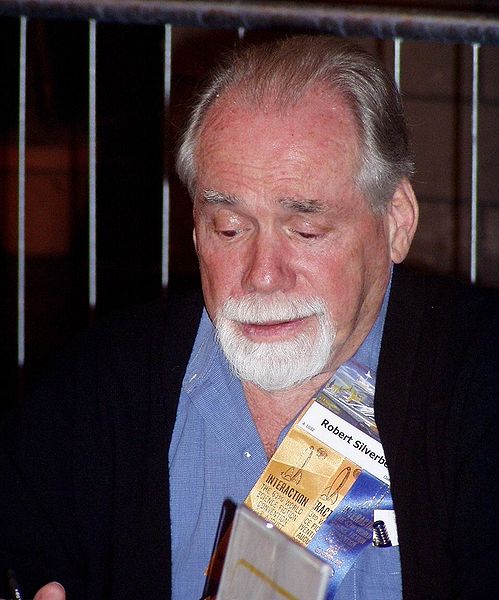
But the book that influenced me the most was Robert Silverberg’s The Time Hoppers, a story about people fleeing an overcrowded future dystopia through time travel. In those days, Silverberg had a reputation of being something of a copious hack writer, a reputation he was about to shuck with novels such as ThornsDownward to the Earth, and NightwingsThe Time Hoppers is not among his best, and readers who know him primarily through the Majipoor stories will be shocked at how spare his writing style was in The Time Hoppers (rather reminiscent of early Asimov). But it was my first real time travel story, with all the wonder that provokes, and a minor plot element gave birth to my interest in forteana: odd things and events that are hard to explain. 

Robert Silverberg in 2005 (credit Wikipedia/Szymon Sokół)

Robert Silverberg in 2005 (credit Wikipedia/Szymon Sokół)

After Doubleday’s negative option became a problem in several ways, my mother canceled my membership. It would be more than a decade before I read science fiction and fantasy books regularly again. One of my most pleasant rediscoveries was that Robert Silverberg was still writing.[iii] Not just writing, but still developing as a writer. I fell in love with Nightwings, was impressed with Dying Inside, and wallowed in the Majipoor stories.

Most importantly for this blog, I took Silverberg’s career as an encouraging example. If that man could develop as a writer over decades, if he could still be writing in his 60s, then maybe, though I was getting a late start, I could write something worth reading, too. So my hat’s off to the Doubleday Book Club and Robert Silverberg, because if it weren’t for them, you’d not be reading this blog!


[i] Doubleday is no longer an independent publisher, but an imprint in the Random House/Bertelsmann media empire, and while they still run a book club, the science fiction-specific book club seems to be defunct.

[ii] Watchers of the Dark was actually a sequel to All the Colors of Darkness. I think Doubleday left that little fact out of their book club blurb. Fortunately one doesn’t have to read its predecessor to understand it, apart from a few scattered allusions.

[iii] And unlike Doubleday’s Science Fiction Book Club, Robert Silverberg is not defunct, but still alive as I write this. Alas, he lives on the other coast, so I’m not likely to meet him.

Posted in Reading fiction | Tagged , , , , , | 7 Comments

Chapter 15 of Martha’s Children, and the Vampire Bureau’s star

Sherlock Kammen may now be a vampire, but he’s still a detective, and detectives rely on building up information to support their plans and actions. In chapter 15 of Martha’s Children, “Aye, marry, I’ll be gone about it straight,” Kammen works his network of sources and contacts to solve his problems. But one of his contacts takes Kammen by surprise with a problem she wants him to solve!

You’ll note there’s a new banner up this week. Now that Martha’s Children has been the ongoing serial for many weeks, it was time to change the banner for the blog to reflect this. However, I have restored the old Dragon Lady banner to that tale and its two related stories.

Chicago police wear a badge they call a star, which in 1969 was the same style that had been used since 1955, and which would be replaced in 2002. You can see some examples here. Vampire police were a radical change to the existing department, so they got a distinctive badge with several of the elements redesigned to reflect their peculiar and occult nature. Among other things, both the star itself and the images from the city seal were reversed (as well as altered), as you can see here:

Star # V 13, Vampire Bureau, Chicago Police Department (1969)

Star # V 13, Vampire Bureau, Chicago Police Department (1969) – E. J. Barnes

The painting is by E. J. Barnes, who reserves all rights, including copyright. And it is featured in the new banner.

Ned and his fellow vampires aren’t wearing this badge yet in the story, but it’s coming!

Posted in Martha's Children, Writing fiction | Tagged , , , , , , , | 7 Comments

Review: Spencer Kansa, Wormwood Star: The Magickal Life of Marjorie Cameron

N.B.: A revised and enlarged edition of this book has been published in 2014. The author informs me the new edition addresses some of the issues I raised. (This does not mean the author agrees with or endorses my review.) I have not had the opportunity yet to read the new edition, so this review should be read keeping in mind it refers to the older edition, published in 2011.

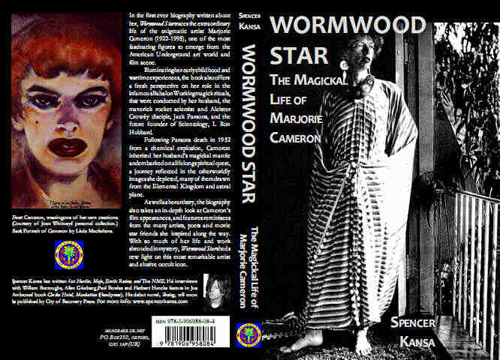
I mentioned in a post a while back that I wanted to read the recent biography Wormwood Star: The Magickal Life of Marjorie Cameron by Spencer Kansa (Oxford: Mandrake.UK.Net, 2011). Well, I obtained a copy and have read it. It’s not bad, but it’s not great. If you’re interested in Cameron’s life after the death of her (first) husband, Jack Parsons, this is a good place to go. But if it’s Parsons or magic that you’re interested in, you’ll need to wait for another book.

A painting and photo of Cameron adorn the cover of the book

A painting and photo of Cameron adorn the cover of the book

I learned about Marjorie Elizabeth Cameron Parsons Kimmel (1922-1995) when reading about Jack Parsons. John Whiteside Parsons (1914-1952) was a noted rocket pioneer who was also an occultist and follower of infamous British magician Aleister Crowley (1875-1947). “Candy” Cameron was his second wife and magical partner; indeed, Parsons thought of her as an elemental he had summoned using magic. Biographies of Parsons[i] mention that Cameron went on to star in Kenneth Anger’s 1954 art film Inauguration of the Pleasure Dome, and made a career as an artist of weird paintings and drawings, but don’t go into details.

Researching and writing the first full-length biography of an individual requires an adventurous spirit, because the biographer has no precedent and must blaze his own trail. Spencer Kansa deserves credit for making the attempt. He pulled together a lot of material, and, journalist that he is, supplemented it with many interviews, mostly of people who knew Cameron in the years after Parsons died.

The result is a more balanced view of Cameron’s life, with a bit more information on her life before Parsons, not much new at all about her life with Parsons, and a lot more about the her life after Parsons, which was actually the longer part of her life. Kansa does a good job of describing how Cameron was as much a personality as an artist in the underground art scene in southern California in the 1950s and 1960s, and how her years with Parsons continued to shape her life for decades after his death.

There are significant limitations and problems with Kansa’s book. Some of these may be unavoidable, because of a lack of evidence. It may simply not be possible to trace the evolution of Cameron’s art or her thinking on magic, subjects Kansa treats lightly. On the other hand, Kansa seems to have relied too heavily and uncritically on interviews, which reflects his background as a journalist. It gives the biography a gossipy air, which is often appropriate when discussing, say, Cameron’s busy sexual life, but leaves one wishing Kansa had done some fact-checking to anchor the gossip, and cover topics not captured in gossip. For example, Kansa mentions at one point that Cameron had not held a job in decades, but seems to have been uninterested in figuring out how she did support herself during those years.

The single biggest problem with the book is that Kansa needed a strong editor. The text raises obvious and significant questions that Kansa should have researched and answered, or at least indicated that he tried to do so. (To take the most obvious one, since Cameron spent some of her later years helping to raise her grandchildren, knowing when her daughter married and had children would have been helpful.) There are lapses in organization, such as when events appear out of chronological sequence for no obvious reason. A proofreader should have gone over the text for grammatical errors and other infelicities of language, which are numerous enough to be annoying. And a good editor would have discouraged Kansa from including several badly blurred or pixillated photographs of little significance in the book. (Though maybe that was the publisher’s call, saying the book needed so many pictures to sell.)

Journalism is sometimes called the first rough draft of history. I think it fair to say that Kansa has given us a first rough draft of a biography of Marjorie Cameron. Good and necessary that he did it, even if it is flawed. Subsequent biographers will start with his book.

Whether there will be subsequent biographers is another story. Marjorie Cameron may continue to attract some interest, but I am sorry to say that I expect she will never be seen as a major figure in the histories of the era. She sounds like an interesting person. But much of what makes her interesting is her relationship to other people who left behind more noteworthy accomplishments. Parsons gave her an aura of magic, Anger captured it on screen. Too many of her paintings and drawings have been lost (many she destroyed herself) for her to leave an influential artistic legacy. If she left a distinct magickal[ii] legacy apart from her relationship to Parsons, Kansa doesn’t mention it, and given her personality as he describes it, I rather doubt she did. New information may spur the writing of more biographies. But Cameron is more likely to remain one of those figures who crops up in other people’s biographies, someone who gives us an intriguing look, and then vanishes.

Cameron as the Scarlet Woman in "Inauguration of the Pleasure Dome"

Cameron as the Scarlet Woman in “Inauguration of the Pleasure Dome”


[i] The earlier Sex and Rockets: The Occult World of Jack Parsons by “John Carter” was mostly superseded by George Pendle, Strange Angel: The Otherworldly Life of Rocket Scientist John Whiteside Parsons, though Sex and Rockets is a bit more detailed on the magic.

[ii] The odd spelling “magick” is due to Crowley, who wanted to distinguish what he did from stage magic.

Posted in Reviews | Tagged , , , , , , | 6 Comments

Chapter 14 of Martha’s Children, the ’45, and the new blog background

In “If Fortune be a woman, she’s a good wench,” chapter 14 of Martha’s Children, we get to meet the woman Sherlock Kammen trusts the most. Yes, she’s dead. No, this is not just some cynical joke of Kammen’s. Ivy McIlwraith is not your ordinary dead woman, not by a long shot.

Martha’s Children, if you don’t know, is a story about vampires and cops in 1969 Chicago. A new chapter comes out every Friday. If you’ve not been reading it before, you can start out here.

In chapter 14, Kammen mentions the ’45, which he says refers to 1745 and tells you to go look it up. Well, I am not so rude, and will explain to what he is referring. Bear with me: it’s a long story, and I’m going to have to simplify it along the way to keep it from getting too confusing. There are footnotes for those of you who want the gory details.
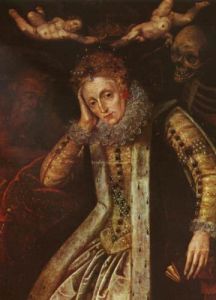
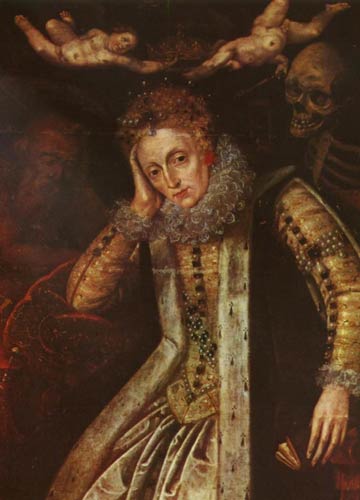
Having never married, Queen Elizabeth of England was reluctant to name an heir right up until she was on her deathbed

Having never married, Queen Elizabeth of England was reluctant to name an heir right up until she was on her deathbed in 1603

Back many centuries ago, England and Scotland were separate kingdoms. Really.[i] Completely and totally separate, except they existed on the same island, their royalty and nobility intermarried, and the lowland Scots eventually started speaking something resembling English.[ii] Thanks to the inability of the Tudor monarchs of England to reproduce after 1537,[iii] the Scottish House of Stewart (or Stuart)[iv] inherited the English throne in 1603 as the nearest heirs by blood. This didn’t mean England and Scotland combined into one. Both kingdoms still had their own laws, Parliaments, nobility, and such; they just happened to share a king. There were occasional disputes between the two kingdoms, but so long as they were under one king, those disputes would never lead to war.[v]

And then the sort-of-union between the two kingdoms ran into trouble. James VII (who was James II in England[vi]) was a Catholic, which put him into conflict with the Protestant state church in England and Scotland. Some nobles who were unhappy about James’s religion[vii] conspired to kick James out in 1688 and replace him with his Protestant daughters, Mary and Anne.[viii] To make sure he didn’t come back, the English passed a law, the Act of Settlement, that said all future monarchs had to be Protestants descended from the royal family. The problem was that the nearest Protestant heir, after James’s two daughters,[ix] was a German, George, the Elector (ruler) of Hanover[x] (so called because he helped elect the Holy Roman Emperor[xi]). The English didn’t mind so much: they’d been ruled by foreigners, Scots, for a century.[xii] The Scots, on the other hand, weren’t too keen on disinheriting their own royal family, and did not pass a similar law.

The Royal Coat of Arms for the Kingdom of Great Britain. Yes, that's the French fleur-de-lys in the upper right shield quadrant. The British monarchs were pretenders to the French throne (long story).

The Royal Coat of Arms for the Kingdom of Great Britain (1707-1801). Yes, that’s the French fleur-de-lys in the upper right shield quadrant. The British monarchs were also pretenders to the French throne (long story).

To the English, this situation was a disaster waiting to happen. Once Queen Anne died, the House of Hanover would take the English throne. But who would sit on the Scottish throne? James VII (II) was dead, but he left behind a Catholic son, who called himself James VIII (III), and who might use a base in Scotland to try to reclaim the English throne. To prevent that, through persuasion, threats, and bribery, the English got the Scots to agree to unify the two kingdoms, giving them one Parliament and, most importantly, one monarch, and that monarch designated by the Act of Settlement.[xiii] So when Queen Anne died in 1714, the Elector George became King George I of the Kingdom of Great Britain, as it was now called.[xiv] And that should have been that.

It wasn’t. Three things contrived to upset the new political order: the Stewarts themselves, European power politics, and discontent in Scotland. The so-called James VIII, known to history as the Old Pretender,[xv] naturally thought of Great Britain as his kingdom. The Pope was willing to back him, because he was Catholic. The King of France was willing to help him, because France and Great Britain were often at war with each other. And the people who lost out in the new political order in Scotland[xvi] were willing to support him, if he looked like he could win.

So the Old Pretender tried to invade Scotland several times to reclaim his throne. All the efforts were failures.[xvii] The last was in 1745. It was led not by the Old Pretender (who was getting on in years), but by his handsome, dashing, and amorous son Charles, the Young Pretender, also known as Bonnie Prince Charlie. Charles got off to a great start, thanks to good luck, but then turned it into a disaster, thanks to his limited abilities as a politician and general. After his army was smashed at Culloden in 1746, he had to flee the country. Many of his followers also had to flee. The British Army moved in to crush the Scottish Highland clans who had supported the Young Pretender. The Camerons had been one of the first clans to declare for the Young Pretender, so they suffered with the rest, their chief fleeing to France.[xviii] Never again would the Stewarts engineer a rebellion.[xix]
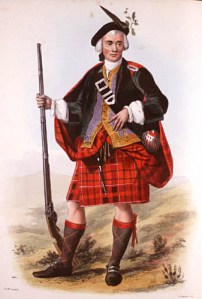
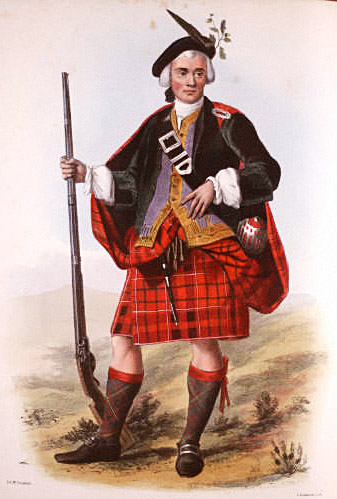
We're supposed to believe this was normal dress for a Highland Cameron

We’re supposed to believe this was normal dress for a Highlander of Clan Cameron

Generally, military disasters don’t become inspirations for subsequent generations. But just as the American South turned the disaster of the Confederacy into the legend of the “Lost Cause,” so the Scots turned “the ’45” into part of their national legend. Sir Walter Scott (1771-1832) deserves a lot of the credit for this. Before his time, the Lowland Scots, who were a majority of the population, despised the Highlanders as semi-naked savages, the uncivilized part of Scotland. In his novels, Scott recast the image of the Highlanders as romantic and chivalrous heroes, the best of Scotland. Then the “Sobieski Stuart” brothers came along. They claimed to be authorities on old Highland customs and costumes,[xx] and they did have some genuine scholarly knowledge, but they also freely made stuff up. The books they put out in the 1840s were shot through and through with their fabrications, but they came to define the popular image of how Highlanders dressed.

One hundred years, from 1745 to 1845, was all it took. The Highlanders went from being marginal figures, barbarians who had sided with a losing cause, to the essence of Scottish identity. Go to a Scottish heritage festival in America, and see everyone dressed up in a kilt with the clan tartan. Go to a Scottish music festival, and prepare to hear innumerable songs about the ’45, all of them favoring the Stewart cause. Probably the best known Scottish song is the Skye Boat Song, which is about the Young Pretender fleeing mainland Scotland after Culloden.[xxi] But why bother going to a festival? Everyone knows what Highlanders are like. Hollywood could call a movie Highlander, and everyone would know what to expect. Come to think of it, they did.
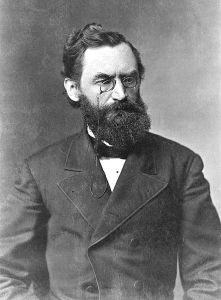
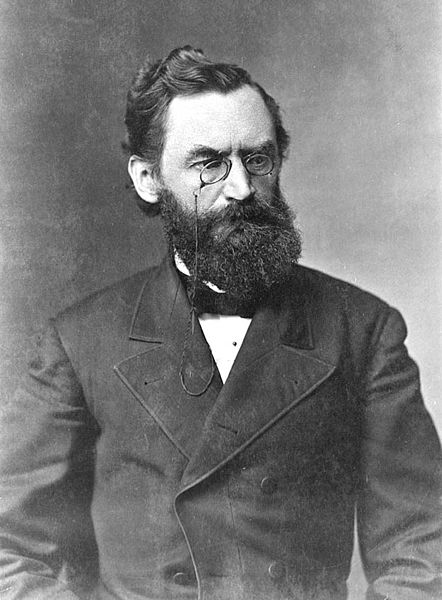
Carl Schurz, another refugee from Germany after 1848, was a Brigadier General at Gettysburg and a U.S. Senator after the war

Carl Schurz, another refugee from Germany after the Revolution of 1848, was a Brigadier General at Gettysburg and a U.S. Senator after the war

So how does this all connect to the new blog background? Let’s return to Martha’s Children. Sherlock Kammen’s paternal ancestors were Camerons who fled Scotland after taking part in the ’45. Being Catholic, they took refuge in a Catholic country, Bavaria, then an independent German state. They lived a century in Bavaria, marrying into the local German population. Along the way they adopted the Germans’ mispronunciation of their name as “Kammen,” but kept alive the memory of their Scottish forefathers. However, they did abandon their Catholicism for Protestant pietism, which meant they faced persecution in Bavaria on religious grounds. And then Sherlock’s great-grandfather compounded the family’s difficulties by coming out for the liberals in the Revolution of 1848. When the revolution was crushed all across Germany, he had to flee. And like so many other German refugees from that Revolution, he ended up in America, in Chicago. Three generations later, the family was still living in Chicago when Sherlock’s father was born. He found out about his family’s Scottish ancestry, and although he was much more German than Scots by blood,[xxii] he did all he could to recreate an authentic Scottish identity. That included adopting the Cameron clan tartan, which I’ve put up as the blog’s background.

The joke on Sherlock’s father? The source for the Cameron tartan is the 1842 book, Vestiarum Scoticum, written by those frauds, the Sobieski Stuarts. The odds are the Sobieski Stuarts invented the Cameron tartan out of their imagination.[xxiii] Sherlock’s father’s choice of costume was no more authentically Scottish than he was.


[i] The English sometimes claimed that Scotland was part of the English domains, and on occasion even overran much of the country. The movie Braveheart inaccurately depicts one such episode in the 1290s.

[ii] England was a richer, more populous, and more powerful kingdom than Scotland, which explains why the influences tended to run from England to Scotland, and not vice versa. The Lowland Scots developed a distinctive dialect of English sometimes called “Scots” or “Scottish,” which is the language of the poet Robert Burns. It is to be distinguished from the older Celtic language originally spoken by the Scots, a branch of the Irish Celtic language usually referred to as Scottish Gaelic.

[iii] Henry VIII had contracted syphilis and seems to have become sterile or impotent after fathering Edward VI. Edward VI died young and unmarried. Mary did not marry until she was 38, may have been menopausal, and had a husband who often left the country. Elizabeth never married.

[iv] It’s spelled both ways. The name originally referred to the occupation of steward, hence the “Stewart” spelling. The Scots had a long alliance with the French, who rendered “Stewart” into “Stuart,” and that form managed to work its way back to Scotland. I’ve used “Stewart” consistently for clarity, with one exception.

[v] Theoretically, this did happen during the English Civil War and its aftermath, around 1647-51, but that was a minor part of the war by English Puritans and Parliament to impose their rule over the whole island. The king’s role was a sideshow.

[vi] An ordinal number after a monarch’s (or pope’s) name indicates that he/she is the nth person of that name to rule that kingdom. James was the 7th king of Scotland named James, but only the 2nd king of England by that name, hence his designation as James VII and James II. Confusing? It gets worse. Thanks to the fact that the English have been more powerful than the Scots, the monarchs of the combined kingdoms are usually known by their English designation. Hence, this James is almost always called James II, even though in one of his kingdoms he was James VII. The current queen is commonly called Elizabeth II, because England already had a previous Queen Elizabeth, but Scotland never had, so there she is technically Elizabeth I.

[vii] The nobles were unhappy about many other things, too. They thought James was turning into some sort of tyrant. At least, that’s what they said later. While James could in fact be high-handed and arbitrary, one of the reasons he was overthrown was because he was going to allow Catholics and dissenting Protestants to worship freely. Tyranny is sometimes in the eye of the beholder.

[viii] Mary, as the eldest daughter, ruled first in conjunction with her Dutch husband William, who was also crowned as king, and ruled for several years after Mary’s death. Only when he died did Anne become queen. And, no Anne’s husband did not become king. Why the difference? Mary’s husband was the ruler (stadtholder) of the Netherlands. The English needed his moral and military support to get Mary to come to England, and they wanted an Anglo-Dutch alliance. Making William king was part of the deal. Anne, in contrast, inherited the throne peacefully, and her husband was considered a lightweight, anyhow.

[ix] Neither of whom had any children who survived their mothers, though Anne heroically endured at least 18 pregnancies!

[x] Actually, it was his mother, Sophia, wife of the Elector of Hanover when the Act of Settlement was passed in 1701. But she died two months before Queen Anne died, so her claim passed on to her son.

[xi] Yes, there was a ruler called the Holy Roman Emperor, whose domain included much of central Europe, and he was officially elected by a collection of German princes, called electors. The details are another very long story, beyond the scope even of my footnotes for this blog post.

[xii] And the Welsh Tudor family before that, the French Plantagenet dynasty and its Lancastrian and Yorkist offshoots before that, and the Norman family of William the Conqueror before that. And English kings usually married foreigners, for political reasons. Let’s face it, the English have been ruled by foreigners since at least 1066. The Stewarts had foreign blood in them, too, but they started as a native Scottish dynasty.

[xiii] However, not everything became the same in the two kingdoms. The Scots still retained their customary law, which is why a Scottish jury can deliver a verdict of “not proven,” but English and American juries cannot. And when I visited Britain in 1993, Scottish one pound bank notes were officially not legal tender in England.

[xiv] When the thrones had been united in 1603, King James VI (I) had taken to calling himself the king of Great Britain. But that was not legally true. And these days, the kingdom is officially known as the United Kingdom of Great Britain and Northern Ireland.

[xv] A pretender is someone who claims a title, but does not actually hold power and is not recognized by the authorities as the title holder.

[xvi] Including, naturally, the Catholics, many of whom lived in the Highlands.

[xvii] There were attempts in 1689, 1708, 1715, and 1719. These are collectively known as the Jacobite rebellions and the Old Pretender’s supporters as Jacobites, “Jacobus” being a Latinization of “James.”

[xviii] He died there. His predecessor in 1715 had also supported the Stewarts, and had also fled to France.

[xix] By the time the Old Pretender died, in 1766, the Stewart cause was so weak that even the Pope didn’t bother to recognize the Young Pretender as the British king. The Young Pretender died in 1788, without any legitimate heirs, so his claim was inherited by his brother Henry. Henry lost what was left of the family fortune in the 1790s. By this time, he was more a pathetic figure than a danger to the British crown, so the Hanoverian King George III of Great Britain felt it safe to grant Henry a pension in 1800. Henry died in 1807. A Catholic cardinal, he had no legitimate descendants. And so the main line of the Stewarts died out.

[xx] They also claimed to be descended from the Polish royal family, hence the name “Sobieski,” and from the Scottish royal family, hence the name “Stuart.” In fact, they were descended from neither.

[xxi] My Scottish-born mother sang it to me as a child. Her ancestors were almost certainly on the side of the Hanoverians, not the Stewarts, in 1745.

[xxii] In fact he was 1/64th Scottish by ancestry.

[xxiii] There is evidence that some version of the pattern existed before 1842, but that doesn’t prove it was commonly used by members of the Clan Cameron as a tartan designating their clan.

Posted in History, Martha's Children, Writing fiction | Tagged , , , , , , , , | 14 Comments

The false prophet of Leyden, Massachusetts

My recent post on cities reminded me of a curious story from the town of Leyden, Massachusetts.

The Commonwealth of Massachusetts (for that is the official name of this state, a peculiarity shared with Pennsylvania, Virginia, and Kentucky) is completely divided up into municipalities, the smaller ones being towns, the larger ones cities. Since 1938, there have been 351 municipalities. Some of the towns are very small (Nahant is 1 1/4 square miles and Gosnold has only 75 inhabitants) but they are all fiercely independent.

Although I had lived in the state most of my life, I realized some years ago that I had visited less than half the municipalities in the state. I decided to visit them all. It took me a few years, not to mention at least three ferry rides to reach towns on the islands off Cape Cod. Along the way, I picked up some curious stories about some of the lesser-known towns.

Leyden is a hilly and heavily forested town

Leyden is a hilly and heavily forested town these days

Leyden certainly is not well known. With a population of 711 in 2010, it is a sleepy little town on the Vermont border. It’s not even easy to find, because no numbered state highways run through the town. Back in the 1790s, it was a somewhat more important place, with a population of about 1000, which made it one of the bigger towns in the western part of the state in those days.

It so happened that in the year 1797, Sgt. Dorril, a former British Army soldier, said by some to be a deserter, appeared in town, proclaimed himself a prophet with divine powers, and organized a communal society. This society practiced the sharing of property in common. They were also vegetarians, even giving up leather shoes so not as to exploit animals.

According to the most common versions of what happened, Dorril’s downfall came about in classic fashion. Dorril was speaking one day to his followers from a platform. He proclaimed his physical invulnerability as part of his divine attributes. It so happened that Captain Ezekiel Foster, one of the townspeople who did not accept Dorril as a prophet, was in attendance. He promptly got up on the platform, and beat up Dorril until Dorril agreed to renounce his claims to prophetic and divine powers. Naturally, his community swiftly disbanded. This was in 1798.

Dorril dropped out of sight. But some decades later, a newspaper reporter tracked him down for an interview. And this is where Dorril’s story takes on a sulfurous tinge. According to the reporter, Dorril claimed that he had deliberately taken on the role of one of the false prophets mentioned in the Bible, whose coming was a presage of the End Times. In effect, he was claiming to take on the role of one of the Damned to bring on the triumph of God.

Why he made this claim is unclear from what I’ve been able to find out. Perhaps he was trying to justify his ultimately ridiculous role by making it seem more important. Perhaps he was trying to capitalize on the Millenarian thinking so popular in the United States in the decades before the Civil War. If so, he failed, for he vanished out of the historical record. And so far as I can tell, the End Times haven’t yet arrived.

I remember passing by the town hall, which is a small wooden building

I remember passing by the town hall, which is a small wooden building

My own visit to Leyden was unremarkable, apart from needing street maps of the towns in the region to find my way there. Coincidentally, another religious commune had formed in Leyden around 1968, but it had broken up for good only a few years before I visited. So I saw nothing remarkable. And because it is so out of the way, I’ve not been in Leyden since.

Posted in History | Tagged , , , , , , , | 11 Comments

Part 2 of Martha’s Children begins, and on city boundaries

Martha’s Children takes a sharp turn as part 2 begins with chapter 13, “He sleeps by day, more than the wildcat.” And like a wildcat, Sherlock Kammen dislikes being bothered, unless it’s for a darned good reason. Being turned into a vampire by Martha didn’t qualify. What will Sherlock make of Ned’s proposal for vampire cops?

As you can see, I’m behind in the redesign of the blog, which is a pity, since I wanted it to coincide with the beginning of part 2. The header will definitely change soon. As for the new background, it will be explained next week.

I’ve been talking so much about Chicago in the 1960s and about Chicago’s Bronzeville. With chapter 13, we’ve switched to Chicago’s North Side. And here we need a bit of history and politics to explain just what Sherlock Kammen was doing in a North Side suburb.

One of the key features about local governments in the United States is that they are all creatures of the states, which can create them, change them, and abolish them as they like. In Illinois, like many Midwestern states, its territory was originally divided up into counties, which provided a more local level of government. (There are currently 102 counties in Illinois, most a few hundred square miles (or about 1,000 square kilometers) in size.) And counties may be subdivided into various smaller districts, called townships, villages, towns, and cities. The exact distinction between all these types of municipalities doesn’t matter much to us here. Suffice it to say that cities are generally the largest in population and most powerful in terms of what their governments can do.

Chicago city seal

Chicago city seal

Chicago is a city, has been since 1837. Like many cities in the United States, it began as a relatively small place in terms of area, a mere 10 square miles. But starting in 1851, Chicago started annexing neighboring lands, sometimes including entire townships. Again, this was not unusual for American cities of that era. The rising industrial age made cities richer and more populous and caused them to spread out. The communities at the edge of the cities were composed of farmers and poorer city folk who couldn’t afford to live in the central part of the city. Consequently, major cities had a bigger tax base and could offer better services than the surrounding suburban communities. Sometimes the inhabitants of outlying areas would vote to be annexed to the city to get those better services. Other times the cities would use their political clout to get the state legislature to pass a law annexing adjacent territory to the city. By 1890, after annexing three townships the previous year, Chicago had grown to 169 square miles. (See map of annexations here.)

And then the pace of annexation slowed, again as it did for many other cities in the East and Midwest. What had changed? The development of streetcars, trains, and eventually the automobile made it possible to work in the city without living there. Rich people, and even people who just had high-paying jobs, began moving out to the countryside and living there. The suburbs became wealthier on average than the central city. They became able to provide better services than the central city. They developed more clout in the state legislature. They no longer wanted to be annexed to the central city, and had enough political pull to prevent it. After 1915, it was extraordinary when Chicago could annex any adjacent land.

The City of Chicago and other communities in Cook County.

The City of Chicago and other communities in Cook County.

In the legal sense, Chicago is a city that hasn’t expanded much since 1915. But there’s another meaning to the term “city:” land that’s built up, that has a high population density, the urban area. In that sense, Chicago expanded as a city in 1889 way beyond its urban area. But since 1915, the urban area has spread far beyond the legal boundaries of the City of Chicago. Chicago’s not unique in this. New York City reached its current legal limits in 1898, Boston in 1911, Philadelphia as far back as 1854.

As a result, most major metropolitan areas in the East and Midwest consist of a central city, which includes what is often a decaying industrial district and slums, surrounded by an urban belt which may or may not be legally part of the central city. Beyond the urban zone are suburban communities, which are almost certainly not part of the central city. In terms of their economies and population, the central city, surrounding urban belt, and suburbs are all one metropolitan area. But legally, the metropolitan area is made up of many jurisdictions, which need not and often do not work together. This is one of the reasons why there was a busing controversy in the North in the 1970s: the city/suburb divide had become not just one of class, but also one of race, with the suburbs being whiter and richer than the cities. Courts mandated busing to exchange students between the cities and suburbs to achieve racial integration for the metropolitan regions as a whole, regardless of legal boundaries. The suburban communities resented having to send their kids into the city, when one of the major advantages of living in the suburbs was supposed to be better schools there.

Why this matters to Sherlock Kammen comes down to one point: the Chicago Police Department has jurisdiction over the legal City of Chicago, but not over the suburban communities beyond Chicago’s city limits. In settling down in a North Side suburb, Kammen hasn’t just picked a rich suburb. He has also put himself legally out of reach of the Chicago Police Department, making it harder for them to find and kill him.

Posted in History, Martha's Children, Writing fiction | Tagged , , , , , , | 10 Comments

Art show/art sale: Rebecca’s walking stick drawings

India ink and gouache on Bristol board, $125

India ink and gouache on Bristol board, $125

As readers of The Dragon Lady of Stockbridge know, Rebecca Farnsworth Maxwell got her nickname from the fearsome walking stick she carried. Now all three of the original drawings of that walking stick are going on sale.

Conte on toned paper, $150

Conte on toned paper, $150

E. J. Barnes, the artist, has framed each of the 8″ x 11″ drawings in a 14″ x 17″ frame. They are going to be shown at her house, which doubles as her studio, during Cambridge Open Studios this coming weekend, May 18 – 19, 2013. The public is welcome to attend between noon and 6 P.M. All three drawings will be on display and for sale.

Prismastix and Conte on toned paper, $150

Prismastix and Conte on toned paper, $150

For more information on Cambridge Open Studios, see their web site; the downloadable pdf has a map and contact information for all the participating studios. You may contact E. J. Barnes directly using the information on her web site here, or drop me a line at the e-mail address on the right.

Posted in Dragon Lady | Tagged , , , , | 2 Comments

Chapter 12 of Martha’s Children, and blog changes coming

If Ned’s ever going to be a cop again, he’s going to need the list of cops Martha turned into vampires. Because Love told him it was the only way, he’s risked his life, and come close to killing Martha, to get it. And now, in “The list,” chapter 12 of Martha’s Children, Ned’s finally going to get his chance to get that list from Martha. But will she give it up? And under what conditions?

Sillyverse, this blog, is about to undergo a number of changes. So don’t be surprised if you check in and find things look different or have been rearranged.

Time to tinker with the blog's machinery!

Time to tinker with the blog’s machinery!

The most obvious change will be in the blog’s “dress.” It’s been the same since the beginning, except for the banner header, which belongs to The Dragon Lady of Stockbridge. Dearly though I love Dragon Lady, that story’s been finished for three months, and Martha’s Children has been the ongoing serial for more than two months. It’s time the blog’s appearance reflects that. I expect to complete changing it by next Friday.

Less obviously, I’ll be changing the structure and contents of the blog. It’s outgrown its original design as simply the place I was offering Dragon Lady. I have certain types of readers I didn’t expect, as well. And finally, some of the old posts are no longer relevant, while others still have useful information but in less than useful form. The reorganization will be a more gradual process, probably taking about a month.

I’m not planning any major changes in the purpose of the blog. But if I come up with some ideas while reorganizing it, you’ll all be the first to know!

Posted in Martha's Children, Writing fiction | Tagged , , , , , , , , | Leave a comment

The writer’s happy lament; or, writer’s block as an aid to writing

This is your mind on writer's block

This is your mind on writer’s block

I have been suffering from writer’s block for a month. It’s not that I couldn’t write. I just couldn’t write anything that felt good. That, as it turns out, was a valuable warning sign. It told me I needed to think more about what I was trying to write and why.

You readers of this blog haven’t noticed, because I wrote chapters 5 – 14 of Martha’s Children back in early March. I could see that far ahead, and it was easy to write all those chapters. And then . . . nothing. I haven’t written a word since.

I knew what was happening. I had started writing Martha’s Children to solve a problem in 1969 that affected an unpublished story set in the present. I hadn’t really figured out why I was writing the story, except for entertainment. But this created a problem in the long term. The more I wrote, the more I tried myself to understand why the people in the story acted as they did, the more I tried to work out the significance of the story, and the more I wanted to provide a reason why people might actually want to read the story. On top of all that, the actual writing of the story created possibilities I did not envision when I started writing it. By the time I came to a halt in writing, I had three different endings for part 2, and I could offer no reason why any one of them was better than any other.

Something similar happened in The Dragon Lady of Stockbridge back when I was writing chapter 8, the werewolf chapter. The events in that chapter broke some of the existing conventions of the story up to that point. I had to sit back and rethink what I was doing. Ultimately, it made Dragon Lady a better story.

Sorting out a story's plot, characters, and themes feels like this

Sorting out a story’s plot, characters, and themes feels like this

So it was time to switch out of my “panzer” hat and over to the “plodder” hat, and keep it on for a while. I had to sit down and ask myself what I was trying to do with Martha’s Children, and compare that to what I had already written. And then I had to work out how I could continue the story, consistent with what had already been written, to achieve my purpose. That’s a tough process. I’ve been at it for a week, and I only finally made sense of it this morning over a cup of coffee and a chocolate chip scone.

The other piece I had to consider was what readers have said in their comments. It matters, at least to me. When you readers give me feedback that agrees with what I think I’m doing, I credit you all with the same brilliant insight I have, and go on my merry way. But when you make a comment that is critical, or even just shows you don’t understand my story on the same terms I do, or that you have different expectations of the story than my intentions, then I sit up and take notice. Doesn’t mean I agree with you. But it does tell me I’m not getting across what I thought I was saying. I have to look at how I might be responsible. And sometimes, you readers say things that give me a whole new slant on the  story, and I change the story I’m writing because of that insight you gave me.

That I go on about the effects of readers’ comments should clue you in that some of them have been ruining my sleep of late, and that I had them in mind this morning while plotting out the rest of Martha’s Children. I hope the story will be the better for that.

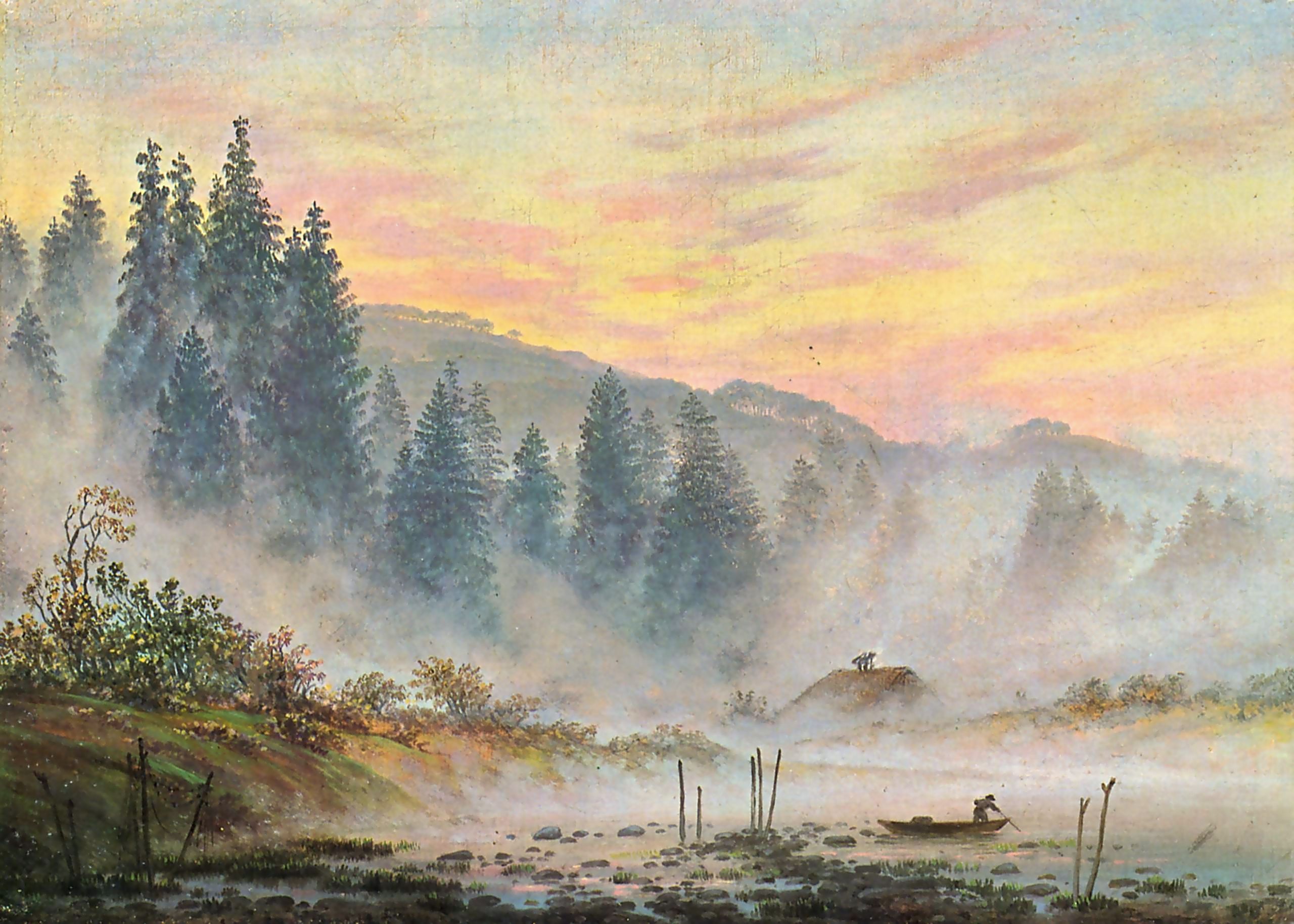
And this is how I feel now (with a tip of my hat to C. D. Friedrich, who died 173 years ago today)

And this is how I feel now (with a tip of my hat to Caspar David Friedrich, who died 173 years ago today)

Posted in Martha's Children, Writing fiction | Tagged , , , , , , | 7 Comments