2012 in review, from my perspective

WordPress prepared a statistical summary of activity on my blog for 2012. But I’d rather give you my version of what really happened on the blog this year.

This blog, Sillyverse, which is my first and only blog so far, began on August 21, 2012. Its original purpose was to publish The Dragon Lady of Stockbridgewhich began appearing weekly starting Friday, August 31, 2012. 18 chapters have appeared on schedule so far. Along the way, I decided to put up a second post every week, usually on Mondays, on topics related to reading and writing fiction. I also decided to get more creative with my posts, which is why they typically are illustrated now. That’s the author’s story, in a nutshell.

You, my readers, have changed greatly from the beginning of this blog. The initial readers were primarily Facebook friends who had read “The Troubles of the Farnsworths” when I originally wrote it on Facebook. I picked up a scattering of visitors and followers over the next three months, who seemed equally attracted by what I had to say about magic and writing as by the story I was telling.

Then came WordPress’s choice to display my blog entry “Beyond fan fiction, a personal account,” on their “Freshly Pressed” page. I got 97 hits on my blog the first hour after it appeared there, which is more than I ever got in an entire day. And many of you decided to  stay with me. In fact, the majority of followers of this blog came from the four days that post was on “Freshly Pressed.” Amazing what visibility can do!

Probably not a typical reader of this blog

Probably not a typical reader of this blog

The attention has been wonderful. It has also been perplexing for me. You see, more of you follow my posts than read Dragon Lady, which was the original reason I started this blog. (In fact, “On Huckman Causeway,” a short story I wrote for Halloween, has had more visitors than any chapter of Dragon Lady except the first.)  So I find myself with two audiences, the one I originally sought, and the one I’ve acquired and to which I owe most of the attention this blog receives. I’m still trying to figure out what that means and how that should guide the direction of this blog.
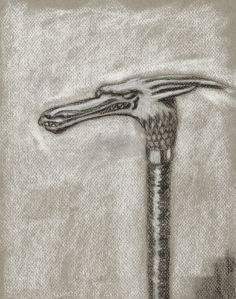
If you're not reading "Dragon Lady," you probably don't know what this is

If you’re not reading “Dragon Lady,” you probably don’t know what this is

I’m thankful to you all, but must call out a few of you by name. Russell of “Edward and Amelia versus the Vampire King,” crimsonprose, and lly1205 of “Serial Outlet” have been my most frequent commenters, along with Dana Peleg and E. J. Barnes, who also did the dragon-headed walking stick illustrations. Patrick Latter, Tourism Oxford, and ellisnelson were the first three people to follow this blog. I happen to like all the blogs that belong to these people, and recommend them to my readers. Don’t think they are all like my blog; some are quite different!

For 2013, I expect to continue posting twice a week. Dragon Lady should finish in February. Something will take its place, I’m just not sure what. Or when, for that matter, as I may need to take a break for a month, or not. I’m going to try to get to visit more of your blogs; “Freshly Pressed” created a backlog of blogs to visit that I’m only slowly working through.

Apart from that, I look forward to hearing from you all. Thank you.

Posted in Dragon Lady, Reading fiction, Writing fiction | Tagged , , , , | 4 Comments

Chapter 18 of Dragon Lady, and servants

“A day in the life of Patty Leigh,” chapter 18 of The Dragon Lady of Stockbridge, is now available. Our magicians have been busy. But as everyone ought to know, they could not survive a day without the help of Patty Leigh. At least she thinks so. Not that she would tell you, for she is working undercover.

In the above chapter, I mention in passing the attitude of antebellum Americans to being servants, and how this surprised and annoyed foreign travelers. This aspect of American society and attitudes became famous in the 1815-1850 era, when many Europeans traveled to the United States and wrote accounts of their visits there. These works invariably compared American political and social institutions and manners with European ones. Suffice it to say that as people generally approve of their own customs, European visitors often found Americans uncivilized.

One of the most famous accounts was written by Mrs. Fanny Trollope (1779-1863), the British mother of the novelist Anthony Trollope. Her Domestic Manners of the Americans (1832) painted a highly unfavorable view of the nation and its people. Her work was so popular in Britain that to “trollopize” became a slang term for abusing Americans. Naturally, it was endlessly criticized here in the United States.

Comparing ancient Greeks and modern Americans this way earned her no favor in the U.S.

Comparing ancient Greeks and modern Americans this way earned her no favor in the U.S.

On the subject of servants, Fanny is quite acerbic. “The greatest difficulty in organizing a family … is getting servants, or as it is there called, ‘getting help,’ for it is more than petty treason to the Republic, to call a free citizen a servant. The whole class of young women, whose bread depends upon their labour, are taught to believe that the most abject poverty is preferable to domestic service. Hundreds of half-naked girls work in the paper mills … for less than half the wages they would receive in service … ” Fanny goes on to explain that American girls who will work as servants will do so only until they have enough money to buy some new piece of clothing, that they resent eating in the kitchen, that they demand to be able to come and go as they please, and that they are forever borrowing money from their masters. If you’d like to read the colorful details, they may be found in Book I, chapter 6 of Domestic Manners.

By 1886, when Dragon Lady is set, this prejudice against working as a servant had declined greatly in the United States. It is quite likely that the end of slavery had removed some of the more more servile connotations of service. And the immigrants pouring in from Europe and from French Canada sometimes found work in the mills so undesirable that they would go into service as lighter work. The older Yankee stock in New England was still prejudiced against service, but even they sometimes bowed to economic necessity and became servants.

Posted in Dragon Lady, Writing fiction | Tagged , , , , , , , | 2 Comments

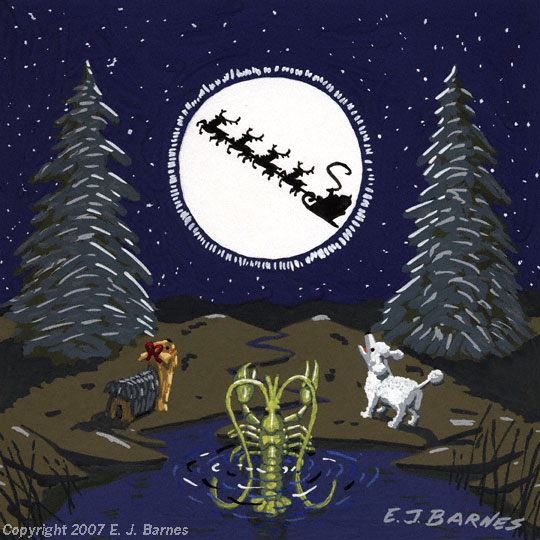
Xmas meets Tarot (the holiday non-post post)

Feast of Fools - E. J. Barnes

Feast of Fools – E. J. Barnes

A mystical, magical holiday season to you all!

(If you want the artist’s explanation of the symbolism of this variation on the Moon card of the Tarot, go here.)

Posted in Uncategorized | Tagged , , , , , | 1 Comment

Chapter 17 of Dragon Lady, the future, and the holidays

“Teamwork,” chapter 17 of The Dragon Lady of Stockbridge, is now available. Rebecca and Abigail know who their foe is. Can they find clues to defeat him by searching in the town, in the Burning Dog, and in the Devil’s Acre?

It has been great fun writing The Dragon Lady of Stockbridge so far, even though I’ve just been going through my worst case of writer’s block with the story. It’s been even more fun because I’ve had an audience of appreciative and critical readers. However, I can see an end to the story, the end I always planned, coming closer. And that raises two questions. What do I do with Dragon Lady next? And what do I do next with this blog?

Dragon Lady is the easier problem. She’ll be published, somewhere, somehow, probably after a round of revisions to tidy up some points and sharpen others. I’ll let people know when it happens.

I began the Sillyverse blog to publish Dragon Lady as a loosely connected sequel to “The Troubles of the Farnsworths.” Clearly it has expanded beyond that simple mission. I’ve tried to set forth my theories about writing, explained some of the history behind Dragon Lady, and explored just a bit of the fictional universe in which the story is set. And the blog has become a small addition to the WordPress community, which means I have readers and other blog writers to whom I owe time, attention, and care.

I’m not sure there is any point to this blog unless I’m writing something on it. My writing doesn’t just provide entertainment (that is, when it does), but serves as my springboard to talk with you all. I certainly can lay no claim to being a pundit on current cultural or political trends!

However, I don’t have a story immediately at hand to follow Dragon Lady. This isn’t surprising when you consider it took me from May 9, when I finished “Troubles” on Facebook, until August 31 before Dragon Lady started appearing here. My best guess is that I’ll need to take off a month after Dragon Lady finishes, and that the next story will not be a sequel, but will instead be set in a different fictional universe, in which a Chicago cop wakes up in 1969 to find himself in a very bad situation. That doesn’t mean I’m finished with the universe of Dragon Lady, or even all of its characters, just that I may need a break from them.

Finally, while Dragon Lady will continue to appear on schedule over the holidays, I may not get to a blog post this Monday or Tuesday coming. Family and travel commitments have to take priority. And with that, I wish you all the best of the holiday season, whatever holidays you celebrate.

Posted in Dragon Lady, Writing fiction | Tagged , , , , , , | 8 Comments

Query to readers: criticizing the writing of others

I’ve run into an issue, and need help. I’m reading the blogs of several writers. Their experiences are varied, the quality of their writing more so. What kind of criticism should I offer them?

My difficulty can be boiled down to two observations. One is that an author, by putting his or her writing before the public, is by that very act inviting judgment. No one put a gun to the author’s head to publish on a blog, or elsewhere. And if the author didn’t want other people, even total strangers, to judge it, then the author shouldn’t publish anywhere. The other observation is that criticism stings (unless it is unreserved praise), and some authors can’t handle it. I speak from personal experience: I have been reduced to tears by criticism. It was no help that it was fair criticism. Even knowing that, I could barely look at it.

Let’s take it as given that we’re talking about constructive criticism here. Calling the author a “microcephalic idiot with the charm of a dead possum” and the writing a “fetid, steaming pile of maggot-ridden zebra waste” is out of bounds. What kinds of criticism are acceptable? Please offer your suggestions as comments. (If you don’t want to make your suggestions public, my e-mail address on Gmail.com is sillyverse.) Once I’ve read them all, I’ll write up a new post with the results and any additional thoughts I have.

Thanks in advance to all of you who reply.

Posted in Reading fiction, Writing fiction | Tagged , , , , , , , | 14 Comments

Chapter 16 of Dragon Lady, and money

“Family and friends,” chapter 16 of The Dragon Lady of Stockbridge, is now available. Rebecca goes home to see her parents, only to confront new magical surprises. And how does one receive a daughter who is feared by the town as a witch? If you’re not reading the story already, you can start here.

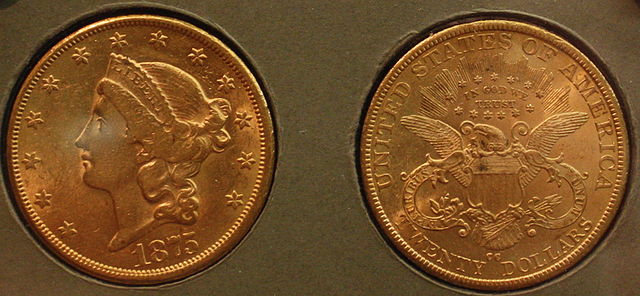
Today’s historical digression is money. The hotel Rebecca is staying in, the Double Eagle? It’s named after the twenty-dollar gold piece, which was then the highest denomination coin in circulation. A crass name, but it was Barnabas Dawson who named it. What more need I say?

Back when the dollar was worth its weight in gold

Back when the dollar was worth its weight in gold

Not that many people would see a twenty-dollar gold piece. Rebecca and the wealthy summer people from New York might use them, but the local workers wouldn’t. A manufacturing laborer might expect to make between $1 – $1.50 per day. About 60% of that would go toward food, 25% toward housing, 10% to clothing, leaving him maybe 5% of his wages as “discretionary” money. A farm laborer would make half that, though he’d get some allowance in room and board.

The wealthy visitors to the Berkshires thought in different terms. They were willing to spend tens of thousands of dollars, or even hundreds of thousands, to built their modest summer cottages of twenty or forty or more rooms. No wonder they could afford to hire servants!

You sometimes hear people talk about the gold standard? Well, that’s what the United States was on in 1886. (Technically, the country was on a gold and silver standard, but for various reasons the silver part of the standard didn’t work and wasn’t really expected to.) An ounce of gold was worth just over $20, a rate set by law, and so the double eagle coin had just under an ounce of gold in it. Any time you wanted, you could exchange American currency for gold, at a rate of about $20 an ounce. Most of the “civilized” (i.e., European) countries were also on the gold standard.

The gold standard does have its benefits. But it also created a major social problem in the period 1873-1898. The money supply, namely the amount of gold in circulation, increased more slowly than the economies of the civilized nations. That put a downward pressure on wages and prices. And wouldn’t you know, wages fell faster than prices did. Bad enough to see your pay cut. But to see it cut when the price of necessities doesn’t fall by the same amount drove workers to the edge of poverty. It was a period of substantial labor strife. Workers tried to hold the line on pay. Corporate managers insisted they had to cut wages to pay out the dividends to which shareholders were entitled. And so there were strikes, lockouts, and violence on both sides.

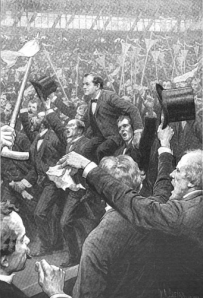
By the 1890s, the country had split between those who supported the gold standard, and those who believed it was harming the country. At the Democratic Party convention in 1896, a dark horse Presidential candidate named William Jennings Bryan would capture the nomination with just one speech, which ended with this memorable protest against the gold standard: “Having behind us the producing masses of this nation and the world, supported by the commercial interests, the laboring interests, and the toilers everywhere, we will answer their demand for a gold standard by saying to them: You shall not press down upon the brow of labor this crown of thorns, you shall not crucify mankind upon a cross of gold.”

The convention went wild

The convention went wild

Bryan lost the election, though. Gold strikes in the Yukon and South Africa increased the money supply and ended deflation as a political issue. In 1900, Congress made the gold standard official, dropping any pretense at having a silver standard as well.

Posted in Dragon Lady, History, Writing fiction | Tagged , , , , , , , | 2 Comments

Inspiration and Transformation

They tell you “write what you know.” But that’s not really what you have to do. What you know is only your start, your inspiration. You need to transform it into something that others will read, that will inspire and affect them in some way.

There was a tavern here once

Hardly any trace of the building remains

Listen! Two centuries ago a tavern stood here. It had the only room for miles around big enough to hold village meetings. Two men came here, missionaries for an odd Christian sect. They preached with their hearts and impressed the village people. And when it was over, the people went outside. There had been a rare winter electrical storm while they were listening to the missionaries. The villagers saw new snow on the ground and St. Elmo’s fire on the trees, throwing a strange light on the landscape. They took it for a sign that these missionaries spoke the word of God, and they believed.

They took that inspiration and transformed their lives. In a few years’ time most would move away to join others of their faith. But inspiration does not transform everyone in the same way. Some never returned and died in their new faith. Others came back to this land because they loved it, maybe continuing to practice their new faith, maybe abandoning it for other faiths. They died here, and were buried in small family lots. What had inspired them did not inspire their heirs, who moved away. The buildings fell down and disappeared, the woods reclaimed the farms and roads, but here and there some traces of the people remain.

A believer who returned

A believer who returned

An abandoned family burial lot

Even the burial grounds have been lost to the forest

That was history, an episode of history I know well. Those of you who have been reading The Dragon Lady of Stockbridge will recognize how I took this material as my inspiration, and transformed it into the episode where Abigail Lane comes across an abandoned farm with a family burial lot. Abigail sees magic pervading the land and the trees of the old farm, just as those people long ago saw St. Elmo’s fire suffuse their landscape.

I didn’t expect to transform my readers’ lives with that episode. But I did want to inspire them with a sense of the eerie and mysterious, and add a touch of sadness. That much I wanted to carry over from the history to my fiction.

If it sounds like I’m comparing religion to fiction, well, yes I am. Religion reaches out from its realm (whatever that may be in your eyes), and inspires people with meanings that transform their lives. Fiction reaches out from the minds of other humans and inspires people with ideas and plots and characters and descriptions. If fiction doesn’t often transform other people’s lives completely, it at least allows them the temporary transformation into another world of other people.

So don’t write what you know. Take inspiration from what you know and transform it into something that will affect and maybe even inspire your readers.

Posted in Dragon Lady, History, Writing fiction | Tagged , , , , , , , , | 5 Comments

Chapter 15 of Dragon Lady, and Bridget Leigh/Lee

“Abigail in Flight,” chapter 15 of The Dragon Lady of Stockbridge: A Tale of Magic in the Gilded Age, has been posted. Injured and on the run, can Abigail acquire allies faster than she acquires enemies?

For the many of you who have just started following this blog, my thanks for your interest. I hope I can continue to engage it. I explain what happens on this blog here and here. If you want to follow Dragon Lady, I post a chapter every week on Friday, and you can start reading here.

I use a lot of names in Dragon Lady. A few belong to historical individual, whom I use in ways similar to their actual roles in history. Rev. Henry Martyn Field and Secret Service Chief James Brooks (first mentioned in chapter 9 of Dragon Lady) are examples. Others I constructed from appropriate names suitable to that period and culture. Jeremiah Farnsworth’s Biblical given name and English surname are examples of this type. However, there’s one name that falls in between these two categories. Readers, meet Bridget Leigh:

Bridget Lee Bixby

Yes, there was a real Bridget Leigh. She was born on December 22, 1827 in Annascaul, Ireland, the daughter of a blacksmith. She came to this country around the time of the potato famine. Her sisters joined her a few years later, walking barefoot all the way from Montreal to Boston in the wintertime because they didn’t want to wear out their only pairs of shoes. Along the way, a family in a small Massachusetts village took them in, and Nellie decided to stay and work for them. Bridget Lee, for that is how they spelled her name in America, joined Nellie in the village not long after. There, Bridget met a young man who was working for the same family as Nellie, married him, moved to their own farm, and had eight children. One died in infancy, but the other seven grew up and married. Bridget lived long enough to see three of those marriages before she died on January 29, 1882, only fifty-four years old. Her youngest daughter was still only fifteen. Her husband, who was sixty-one, never remarried, dying almost twenty-one years later.

Bridget is buried on sloping ground in a family lot. I’ve seen her grave many times. She’s my great-grandmother.

Although she left no ghost, Bridget’s influence continued on in several ways after her death. There were her children, of course, and their numerous descendants. One of her sons ran the village’s general store. Another, my grandfather, ran the old family farm. The store was more profitable than the farm, by the way, so my Granduncle Charles got the better of that deal. The village they lived in was growing because of the paper mills along the river, so it’s no wonder the store did well.

And this leads to the other way Bridget’s influence extended past her life. The old farming families were mostly Congregationalists, while the new mill hands and their families were heavily Catholic. Didn’t matter what they were, they had to leave the village to worship, as there were no churches of any kind in the village in Bridget’s day. Being a good daughter of Ireland that she was, Bridget traveled to the next town to have her children baptized as Catholics, but they grew up surrounded by Congregationalists, and by and large became Protestants of one kind or another.

Doesn’t sound like Bridget was all that influential, eh? But wait! In the 1920s, long after Bridget was dead, the Ku Klux Klan came to the North. They weren’t just against blacks, they were also against Catholics. The town where Bridget’s descendants lived became a hotbed of Klan activity. My grandfather, who still lived on the family farm, was horrified. He attended a Congregational Church, but he hadn’t forgotten his baptism, nor the faith of his mother Bridget. He opposed the Klan, and made it clear he expected his family to have no part of it. He even went another step further. There was an ambitious Catholic priest in town, trying to build a church for the Catholics in the village. My grandfather, who naturally had subscribed support to build the Congregational church in the village a few decades earlier, went and did likewise for this Catholic church that was abuilding, making him one of the few people to support construction of both churches in the village!

The two churches, Congregational (now UCC) and Catholic, still stand and both are in use. Personally, for me, they are a monument to the spirit of religious toleration. And they wouldn’t mean that to me, if it hadn’t been for the real Bridget Lee.

Posted in Dragon Lady, History, Writing fiction | Tagged , , , , , , , , | 8 Comments

Review – Magic: An Anthology of the Esoteric and Arcane

Instead of reviewing a new book from a reader’s perspective, I’m going to review one from as aspiring writer’s perspective. Reading new material is problematic for aspiring writers. Why not just stick to the old classics? Well, I hear there have been a few good writers of the supernatural since the master of the English ghost story, M. R. James, died in 1936, and they must have some good ideas worth borrowing. Then, too, fashions and fears, beliefs and wishes change over time. If one wants to write stories that will resonate with today’s readers, finding out what contemporary successful writers publish is a good starting point. Reviewing a themed anthology is a particularly useful way to do this, since one can see how a variety of writers treat a subject area. At the same time, one doesn’t want to become too trendy or a slavish imitator, another reason to consider an anthology.

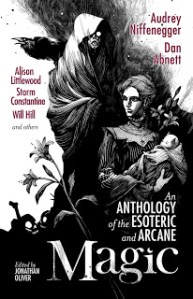
(Artist: Nicolas Delort)

(Artist: Nicolas Delort)

I was wandering around my favorite book store when I saw the cover for this book, Magic: An Anthology of the Esoteric and Arcane, edited by Jonathan Oliver (Oxford: Solaris, 2012). Considering what I write about, and with a cover like that, how could I pass it up? And while I recognized only one author’s name, that reflects more my ignorance of contemporary authors; the information on the contributors in the back tells me several of these writers have substantial publication credits (and any is more than I have, in fiction that is, so I shouldn’t get uppity). And just so you know, the publisher and editor are British, as are ten of the writers, while the rest include one Canadian, one South African, and four Americans (including a couple who co-wrote one story). Now that I’ve read it, let me tell you what lessons I learned from the fifteen stories of the supernatural in this collection.

First, don’t settle too comfortably into one place on the traditional – contemporary –futuristic spectrum. Pick your spot based on your story. Liz Williams’ “Cad Coddeu” requires a traditional (Celtic) fairy world, while Sophia McDougall’s “MailerDaemon” relies on what looks like standard magic running up against contemporary computer technology, and reminds me of a Star Trek: The Next Generation story that was less interesting than hers. You can borrow and use myths for a richness that can’t be developed otherwise in under a few hundred pages, but you can use the familiar to set off your magic as a wonder in an otherwise ordinary world.

Second, if you are good at story telling, even an old idea can be the basis of a good story. Sarah Lotz’s “If I Die, Kill My Cat” uses an idea so old that there are movie remakes of stories using it. Yet she frames it in a new setting and from a delightfully different perspective. Being set in South Africa is only a small part of it. And, as mentioned above, McDougall’s story improves upon an older idea by changing contexts and making it more personal.

Third, get personal. The most effective stories in this collection involve people having to come to grips with situations that require them to act in ways that are meaningful to them. Storm Constantine’s “Do as Thou Wilt” is almost entirely about personal relations; magic becomes only a representation of these, but a clarifying one. And Christopher Fowler’s horrific “The Baby” presents the protagonist with her own wishes in a truly unpleasant way.

Speaking of getting personal, consider using unsympathetic characters. We all like sympathetic characters, particularly in “good versus evil” conflicts. Unsympathetic characters are often less fun to write, hard to develop well, and rarely meaningful except as foils. So please do think of using them more often. They’re a useful challenge to stretching your writing. Steve Rasnic Tem’s and Melanie Tem’s “Domestic Magic” is all about unpleasant characters. But they aren’t unpleasant for the reasons one presumes upon opening the story, and that change is what caught this reader’s attention after initially reading with indifference. There’s a lot of other misbehavior in this collection, but this story stands out.

Fifth, you can create suspense by presenting the reader with a mystery. But you can also create suspense by letting the reader solve the mystery long before the protagonist does. If you’re really talented, you can do both. And that’s what happens in the aforementioned “If I Die, Kill My Cat.” If you don’t catch on, you get the surprise at the end. If you do, you worry about how long it will take the protagonist to figure it out and what will happen in the meantime. Will Hill’s “Shuffle” uses a nonlinear structure for similar reasons: either you’re trying to figure out the story, or you’re waiting to see the consequences. Both work.

Fifteen stories, five lessons for aspiring writers, including yours truly. I haven’t covered all the stories and authors, because I wanted to keep to a few major points. My apologies to those I didn’t mention.

You want to know what I think as a reader? I have to admit that trying to read these as a writer changed my perception of the stories. I’m not sure how, because I’ve not done this type of review before. I also worry that my two favorite stories are near the beginning; did I get bored by familiarity as I read? Still, I recommend “Domestic Magic” on the serious side, and “If I Die, Kill My Cat” as an amusing lighter story, though I would not call it comic as the editor did.

Posted in Reading fiction, Reviews, Writing fiction | Tagged , , , , , , | 5 Comments

Chapter 14 of Dragon Lady, and “Freshly Pressed”

It’s Abigail Lane’s turn in “At the Burning Dog,” chapter 14 of The Dragon Lady of Stockbridge. See how a professional government magician conducts an investigation. Abigail goes “by the book” because she wrote much of it. But will it be enough to keep her safe in her undercover assignment?

I just got word the other day that one of my previous blog posts, “Beyond fan fiction, a personal account,” has been selected as worthy of a broader readership and will be “Freshly Pressed” on WordPress.com’s home page in a day or two. Hooray! Considering people used to joke that I thought in semicolons, I guess my writing style has improved. Either that, or it was the embedded YouTube link to the introductory theme for the old TV series The Green Hornet; “The Flight of the Bumblebee” gets them every time!

So, for first time visitors to this blog, here’s the scoop. This is a blog about writing and reading about “magic and mystery,” as the blog’s title says.

Every Friday I post a new bit of writing, and add a blog entry to announce it. Currently I’m posting chapters for The Dragon Lady of Stockbridge: A Tale of Magic in the Gilded Age. If you want to start at the beginning, here’s a link to chapter 1. All the chapters are linked forward and backward, there’s a table of contents, and you can always use the link that’s part of the header at the top of the page. I put this out there for people to read, so I appreciate comments, and will try to respond intelligently.

Every Monday or Tuesday, I put up another post. Some have been on the background of Dragon Lady, while others are more general. I even did a book review . . . for a book written in 1890! Maybe I need to be more timely. I don’t have a fixed agenda for these posts, save that they relate to the general purpose of this blog.

There are some other odds and ends here on the blog. You can go to my “About” page for a description of them, an explanation for how this blog came to be, and a one-sentence autobiography.

I hope you find posts and pages worth reading, that they provide enjoyment, and stimulate interesting thoughts you’ll share with me.

Posted in Dragon Lady, Writing fiction | Tagged , , , , , , , | 15 Comments