Review: Timepiece by Heather Albano

It’s time for another book review, and like the last one, this one will tackle the book from a prospective author’s perspective. Like the book in the previous review, I picked this one up almost by chance. I was at the Arisia sci-fi/fantasy (SF/F) convention a week ago, as I mentioned in a previous post. One of the panelists lit up when I mentioned how history informed my writing. And since the first of her own books involves time travel and the Battle of Waterloo, and I was an ardent wargamer in my youth, how could I not take a look at what she’d written?
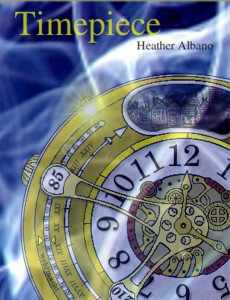
This is steampunk, so it's not a DeLorean

This is steampunk, so it’s not a DeLorean

So what lessons can Heather Albano’s Timepiece (2011) teach an aspiring writer?

Write what you read. “Write what you know” is the common advice, and in fact the author was on an Arisia panel of that name. Given the improbability of most of us living SF/F plots, I prefer the variation I’ve suggested. This book starts out in 1815, and given the amount of detail the author put into it, I suspect she’s in love with Regency Britain. And there’s at least one early SF/F novel that informs the main plot of this story. Those two reading-loves help the book by providing detail and hinting at something that will excite the more knowledgeable readers.

Pile mystery upon mystery. You can write a good story and explain everything as you go along. But isn’t part of the fun of SF/F trying to understand a different and mysterious world? And to pile mystery upon mystery is a good way to introduce an SF/F story and suck the reader in. This one uses mysterious soldiers, a mysterious timepiece, and a mysterious threat to draw the reader into the plot. And the author plays fair with the reader, to her credit: the three mysteries are all related and central to the plot.

When your characters encounter the unexpected, ground their reactions in their life stories. There’s an ancient debate over whether people will take the extraordinary in stride or freeze up. It’s a stupid debate. People react according to what their characters, knowledge, and expectations. Albano’s time travelers are definitely out of place, and their problem is adapting to quite foreign worlds. At the same time, how well they adapt depends on their backgrounds. I found William’s adaptations to be the liveliest, possibly because he gets to play many more roles that show off more facets of his character.

You don’t have to answer all the questions. Time travel begs questions. Can you change the past? Can you create a paradox? Almost any SF/F idea will suggest many questions. (How do vampires cope with different blood types?) You can sit your characters down and have them get a lecture, but that can become boring very easily. Or you can rush them pell-mell through your world, and let them learn it all by themselves, at the risk of confusing your reader. Don’t do either if you can avoid it. Figure out what questions must be answered in your story for the reader to follow it, and not feel your universe is run arbitrarily, and find a way to have your characters encounter the questions and their answers. Leave everything else about your world aside. This story is not about time travel, as such; it’s about how three time travelers deal with the situations they encounter, given their ability to travel in time. So we learn a lot about where and when they travel as they do. We learn what happens when time travelers try to change the course of events. But we do not get a general theory of time travel, or even of the paradoxes that might be produced, because we don’t need one for the story.

If you’re going to tease your readers, give them a pay-off as well. This book is the first in a series. (I have not read its sequel yet.) This is a common practice in the SF/F world; just ask the fans of Asimov, Tolkein, and even of the last time travel story I read, Connie Willis’s award-winning Blackout/All Clear pair of novels. By definition, plot threads are going to be left hanging at the end of a book such as this. The issue for the author is whether she/he has given the reader enough so they can finish the first book with a feeling of satisfaction, while still wanting to read the next book. Too many threads hanging, and the reader feels cheated. Guessing as to what is probably in the sequel, I think the author here picked a logical place to break the series. The main characters have dealt with their first major problem. Now, at the very end, they have to consider the consequences of what they did and how they will resolve their other problems. And there are hints of a mystery yet to be disclosed that I suspect will be used to bring either the second volume or the series to a close.

So there you have it: five rules for writing you can derive from this book for use in your own writing. They can be used in SF/F, or any other genre that depends on suspense to drive your interest. For example, I was just rereading Dashiell Hammett’s Red Harvest (1929) the other night. It’s a detective novel that piles on the mysteries, most of which get explained, and those that don’t end up not mattering much.

As a reader, I have to admit to a number of prejudices against this book. It’s labeled “steampunk,” a designation that usually sends me fleeing in the other direction, because it seems to be more of an æsthetic that’s been done to death than a real genre, in my opinion. (Look up the cover of Fortean Times #295 to see a pretty example of the æsthetic.) Although it is effective, I have ethical as well as æsthetic objections to the “mystery upon mystery” approach, which are too lengthy to go into here. And I loathe a book that ends with threads hanging that you have to buy another book to get answered. Have I read many such? You bet. Did I do something similar by serializing my own story on this blog, and therefore am being a bit of a hypocrite? Guilty as charged.

That said, in general I enjoyed the book, despite myself. The author loves her historical details, and it shows. The book features credible characters. The plot’s a good bit of fun, and I give the author credit for combining her three mysteries together as well as she does. The story generally runs along at a good pace, though I think it sagged a bit around the time the main characters arrive at Waterloo. Bottom line? I bought the sequel. Maybe I’ll review it another day.

Posted in Reading fiction, Reviews, Writing fiction | Tagged , , , , , , , , , | Leave a comment

Chapter 22 of Dragon Lady, and my patron saint of digressions

“Solomon Davis takes charge,” chapter 22 of The Dragon Lady of Stockbridge, is now available. The future leader of the Office of Occult Affairs arrived on the scene too late to prevent the holocaust in the previous chapter. What’s left for him to take charge of?

Just one chapter remaining after this. If you’ve not been reading Dragon Lady, start here.

Today’s post is dedicated to my current patron saint of digressions, Jan Potocki (1761-1815). Why him? Well, let me tell you a story.

Count Jan Potocki

Before he shot himself

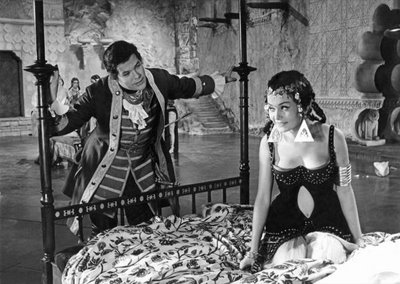
You see, there’s this film, The Saragossa Manuscript. It’s a black and white flick from 1965 made in Poland. And Jerry Garcia was very fond of it. He might still be, if he wasn’t dead.

Jerry Garcia? You know, member of a band called The Grateful Dead? A band famous not just for bootleg recordings of their live performances, but for spectacular drug use by the band and its fans? Which might give you an idea of how to appreciate The Saragossa Manuscript. Because it does sometimes seem one is on a trip. Of course, the protagonist is on a trip in the film, but you know what I mean.

Anyhow, getting back to the story, my girlfriend persuaded the local DVD rental shop to buy the film and rent it out. How did she do that? She’s a nerd. Nerd girlfriend talks to nerd store manager/part-owner. Need I say more?

Anyhow, so I saw the film. It helps to take notes. Then again, if you’re on drugs, these notes might not be informative. So maybe you’re better off not doing drugs the first time around. Or the second. Or the third. Or maybe being drugged all the time is the only way to watch it.

I don’t mean to digress, but I have to admit my own experience with drugs is not very extensive. Caffeine, alcohol, aspirin (my second favorite; why? don’t have time for that digression), whatever the dentist uses when procaine isn’t enough, a token pot experience, and a demonstration of how easily pain killers can knock me for a loop. But not tobacco.

Why not tobacco? I was about six years old, and the family had gone out to a drive-in to see a movie doubleheader. Got my soda and popcorn, and consumed them both within fifteen minutes of the beginning of the first film. I put way too much salt on my popcorn, so I was thirsty. Went looking to see if any of the soda cups had melted ice water in them. Found one that did, put in my straw, and sucked. Nothing. Sucked harder. Nothing. Gave a really big pull on the straw. And the water came up. As did the cigarette ashes. My mother had used the cup as an ash tray. I had cigarette ash coating my mouth. It was horrible. I needed to explain this to my parents, to get them to pay for me to go get another soda to clear my mouth out, but didn’t want any surface in my mouth to touch any other surface while I was talking. Must have sounded like a drunk with a speech impediment. But I finally managed to convey my agony, and got the change for the soda. And that’s why not tobacco.

Soda and popcorn? Yeah! Cigarettes? Yuck!

Soda and popcorn? Yeah! Cigarettes? Yuck!

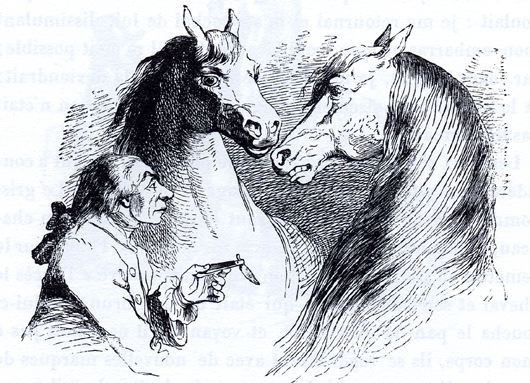
Anyhow, to get back to the story, if I see a movie I like, I’m often tempted to read the book. The Manuscript Found in Saragossa (which is how the paperback version I have is entitled) is the English language translation of the posthumous Polish translation of the lost French original written by a Polish military officer. Say what?

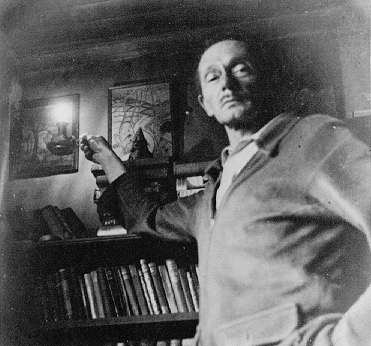
Count Jan Potocki (1761 – 1815) had the misfortune of growing up while his native land of Poland was being wiped off the map in the three great partitions (1772, 1792, and 1795). He was a noted engineer, hot air balloonist, and travel writer. On the other hand, he was a man without a country, a reformer without success, and partner to two failed marriages. He committed suicide, but for some reason I can’t fathom, the date on which this happened is uncertain. You would think people would know on what day a man shot himself in the head with a silver bullet.

Oh, and speaking of people shooting themselves in the head, weren’t you taken aback by Rebecca Farnsworth’s rather drastic method of solving her problems? Doing to herself what Maverick would have had Rev. Wilson do to her earlier?

Anyhow, back to the story. Potocki, civilized nobleman and reformer that he was, composed The Manuscript Found in Saragossa in French to reach a wide readership, but he never published it as a whole, and was revising it in his final years. His reputation in Polish lands for his other achievements was such that someone bothered to translate and publish the book as a whole in Polish . . . and then the French manuscript vanished from history.

The Manuscript Found in Saragossa is structured as a complex series of tales within tales, ostensibly about the journey of a military officer through a wild and desolate region of Spain. It’s a wild ride, filled with mysticism, gypsies, secret societies, and much more. Initially, the story seems to be going nowhere, and getting there in no hurry, either, as each story seems to spawn digressions, repetitive loops, and the interweaving of other stories.

Some digressions are more pleasant than others

Some digressions are more pleasant than others

In the end, although the Manuscript seems to wander as much as Tristram Shandy, Potocki does pull all of its threads together. The digressions cease to be digressions, the mysteries are revealed, and the story comes to a fitting conclusion. Which is more than can be said for Potocki’s life, sadly.

It’s one of the rules of writing, so I was repeatedly told at Arisia (a Boston-area sci-fi/fantasy convention, for which see previous post), that one should not digress, that every element of your story contribute to the main plot and themes, and in particular that sci-fi/fantasy writers do not fill up page after page with the extensive world-building in which they engaged to serve as background for their stories. The very first story I wrote almost collapsed because I felt I had to write in too much background. But, just as I learned from the drive-in incident to avoid tobacco, so that story taught me to avoid long background digressions that don’t contribute to the story.

So you readers may have been wondering just why I spent half a chapter back in chapter 10 of Dragon Lady using a pair of telegrams to introduce this otherwise irrelevant character, Solomon Davis. It looks like a pointless digression, much like about 90% of The Manuscript Found in Saragossa. And that violates the rules.

Well, stuff the rules! Because here’s Solomon, twelve chapters later, doing what has to be done to help explain the whole story and bring it to a conclusion. Just like a lot of Potocki’s apparent digressions. And that’s why Potocki is my saint of digressions, for today.

Tomorrow, well, that’s another story . . .

Posted in Dragon Lady, Reading fiction, Writing fiction | Tagged , , , , , , , , , , , , , , , | 5 Comments

After the convention, a prospective writer’s report

Yours truly went to Boston’s four-day sci-fi/fantasy convention, Arisia, this weekend. I did it partly as a fan, but mostly as a prospective writer (i.e., someone who wants to actually make some money and get some recognition for writing). My overall take? Easy to do, hard to do well.

Arisia is a convention that’s held every year in Boston. About 3000 people go to it, and they go for a lot of reasons. There are the readers, who want to talk about their favorite stories and changes in the genres. There are the media fans, which this year included a lot of Doctor Who fans celebrating that show’s 50th anniversary. There are the gamers, who occupy several rooms ’round the clock. There are the costume lovers, who dress up for the whole con, some with truly spectacular outfits. I swear I saw Tasha Yar’s clone. And there are the writers, professional, part-time, aspiring, and would-be. These categories overlap a great deal.

For someone who’s read sci-fi/fantasy since childhood, I’ve gone to very few conventions, as in three, including this one. One of the others was another Arisia a few years ago. Then I went as a reading fan. This time I went as an aspiring writer. I wanted to go to panels to meet successful writers, hear their tips, maybe chat with them, and if I was really lucky, spend some time with a publisher, show them my heart (or manuscript), and have them fall in love with it and make me a millionaire.

The good news is that I didn’t score a million-dollar advance, so you’ll have my blog to read for a while longer. The other good news is that it’s really easy to get published (though not by a major publishing house). The mixed news is that the major publishers in the field apparently are as confused as everyone else about where the business is going. And the final truth is that if you want fame and/or money, you’re going to have to work hard. Or be such a charismatic figure that people will flock to you and read whatever you write and do whatever you say. You may be such a figure; I am emphatically not.

The key problem is reaching a wide audience, otherwise known as distribution and marketing. Self-publication of an e-book through the major services short-cuts the distribution problem, at the cost of excluding you from bricks-and-mortar bookstores, which still have quite a following, if only because people will see your book there. And that still leaves you with marketing to be done all by yourself, and the stigma (and yes, it is still a stigma) of being self-published.

Now the writers on the panels I attended were predominantly published through small presses, some though the majors, and a few were only self-published. (Yes, that is still a level of success and you should not belittle it; most would-be writers even today never really get that far.) What was most interesting was their view that publishers do a better job at distribution than at marketing, and that unless you are one of the top writers for a publisher, you should be prepared to shoulder the burden of most of the marketing yourself.

If you have your heart set on signing with a major publisher, having an agent still seems to be all but a necessity. It’s not just getting your foot in the door, it’s also dealing with the complexities of contracts. There was a dearth of inside information on getting an agent at the panels I attended.

But let’s say you’re willing to take things gradually: do some writing, do some marketing, gradually get more sophisticated and successful at both, and then land a contract with a major publisher (if they’re still around then). My impression is that most writers on the panels I attended would recommend such a course. The issue is that almost anyone can self-publish an e-book, if they want to, so self-publication is no guarantee of quality. The writer’s problem is building up a reputation for quality, expanding the base of readers, and then using those two things to attract a deal from publishers. In short, the would-be successful writer has to take on the roles of writer, lawyer, distribution strategist, technologist (if going the e-book route), marketer, and financier, or have other people help out on these roles (at a price).

None of this was entirely new to me. What made Arisia valuable was hearing a lot of writers say it, support it with their experiences, and lay it out in detail. Being a professional writer can easily become a full-time job, and we’re not talking about spending 8 hours a day writing, either. This explains why so many would-be writers don’t publish, or only publish a few e-books these days. It also explains the tension in the lives of most writers, who depend on a day job for most of their income, and so find they have little time to write, time that’s further reduced by having to manage the other aspects of being a writer as well.

I’m not sure if the writers I saw were representative of the field, but the two sub-genres they discussed the most were epic fantasy and “steampunk” (which seems to have expanded beyond its original lack of definition to include a lot of sci-fi/fantasy with advanced technology set in the past), with “urban fantasy” (which is sometimes coded language for black/Hispanic fiction) coming in third. Everyone wanted to badmouth vampire fiction in the aftermath of Twilight, but no one went so far as to say the sub-genre was dead.

There were quite a few panels on improving your writing, with all of the panelists in agreement that you don’t want to submit crap (shoddily edited work) to a publisher. If you’re not sure about your writing skills, these are worthwhile attending. And while I think I know my strengths and weaknesses, they did mention a problem I’ve noticed in my writing, gave it a name, and suggested a solution. The one major recommendation, above all others: find someone to serve as a reliable editor of your work. That person should note anything in your text, whether grammar, word choice, plot holes, inconsistent characters, and anything else that would make a reader and publisher want to stop reading your work.

Overall, a good convention is a decent resource for the would-be writer, in that she or he can learn from the experience and advice in detail from several people who have already made it so far. I’ve got a lot more information than I’ve covered here that I need to review and digest.

Oh, and the t-shirt with the dragon-headed walking stick? A case of not thinking it through. At a con where there are hundreds of people walking around in costumes, a t-shirt with a unique design is still almost invisible. Glad I had it done up and will use it again somewhere else. But at the con, I would have attracted more attention by wearing a codpiece.

This would have looked normal at Arisia

This would have looked normal at Arisia

Posted in Writing fiction | Tagged , , , , , , , , , , | 17 Comments

The climax of “The Dragon Lady of Stockbridge”

Chapter 21, “‘It is not what we have lost . . .'” is now available. There’s no point in saying anything more about it, or gussying up this post with pictures.

(If you’ve not read any of the story before, you can start here.)

Posted in Dragon Lady, Writing fiction | Tagged , , , , , , | Leave a comment

Must go to conventions properly attired

I haven’t gone to any sci-fi/fantasy conventions since I started writing this blog, but with one coming up soon, it seemed appropriate to have a Dragon Lady t-shirt made up to wear to them. So here’s what it looks like:

Front: THAT walking stick

Front: THAT walking stick

Back: The story identified

Back: The story identified

Posted in Dragon Lady | Tagged , , , , | 16 Comments

Clark Ashton Smith influenced me, but I don’t write like him!

As I write, it’s the birthday of Clark Ashton Smith (January 13, 1893 – August 14, 1961), a horror and fantasy writer who might best be described as “almost famous.” He’s most often remembered as a member of the triumvirate that dominated the pulp magazine Weird Tales in the early 1930s, but he doesn’t have quite the dedicated following of Robert E. Howard (best known for Conan the Barbarian) or H. P. Lovecraft (the Cthulhu Mythos).

A writer, his books . . . but Smith was a painter, too.

A writer, his books . . . but Smith was a painter, too.

Like many readers, I encountered Smith’s writings through his association with H. P. Lovecraft. And Lovecraft I picked up from the 1970 movie version of The Dunwich Horror. Say what you want about that film, the opening animated credits are creepy. So I got around to reading Lovecraft in college, and that led me to Clark Ashton Smith’s “The Return of the Sorcerer.” Only . . . wait, I knew this story. I’d seen it adapted to TV on the old horror anthology Night Gallery, hosted by Rod Serling (trying to repeat his success with The Twilight Zone). The episode stars Vincent Price, who looks like he’s having a great time, a very spacey Patricia Sterling, and, as the normal person, Bill Bixby (who is probably a very distant cousin). The episode is done up gorgeously, and if it’s a bit campy, this is one time camp works. You can watch it for yourself here.

A few years later, Pocket Books put out three volumes of Smith’s short stories, which gave me a broad sampling of his writing. My opinion of Smith’s stories changed radically while reading those volumes. Of the three Weird Tales writers, Smith was by far the master of the largest vocabulary, the most colorful description, the lyrical turn of phrase. While he had the customary amount of gore, there was a curiously antiseptic quality to it: it was less described than suggested, quite different from the bloodbaths one finds in horror literature today. In fact, it’s hard to segregate Smith’s stories into exclusive categories of horror and fantasy. His horror was fantastic, as in “The Return of the Sorcerer,” and his fantasies, however pretty, often concealed a horror, as in “The Enchantress of Sylaire.”

One of the reasons why fantasy and horror were so closely intertwined in Smith’s stories is that he was a master of irony. It’s a rare Smith protagonist who got exactly what he or she wanted. Either there was a price to be paid, or the goal turned out to be something quite different from what was imagined. Malygris tried to recapture his youth in “The Last Enchantment,” with poignant results. The wizard Eibon, armed with a magical word, escaped to another world in “The Doorway to Saturn,” only to find out that everything he knew was wrong. Life went spectacularly wrong, to the amusement of the reader but not the protagonist, in “The Seven Geases.”

Many of Smith’s stories were tied to an elaborate mythology that overlapped the writings of Lovecraft and Howard (whom he knew by correspondence). But I happen to like his Averoigne stories the best, the ones that were based in a fantastical version of medieval France. I suspect that my rogue scientific magician from the year 2000 (from a story I have only alluded to on this blog) owes some of her morally ambiguous character to the sorcerer Gaspard du Nord, featured in “The Colossus of Ylourgne.”

It’s rare that a horror story actually spooks me. But Clark Ashton Smith did it, with “Genius Loci.” Unlike many of Smith’s fantasies, the horror in this one was open and obvious . . . and therefore somehow more enticing and marvelous. I’d like to write a story like that one. I’ve never come close.

Posted in Reading fiction | Tagged , , , , , , , , , , , | 7 Comments

Summer vacations on Winnisquam

In The Dragon Lady of Stockbridge, and in a related blog post, I’ve written about how the wealthy of the Gilded Age erected “cottages” of up to one hundred rooms to spend part of their vacation time. It’s made me reflect on my summer vacations, which were quite different. My family was not rich, we had only two weeks for a summer vacation, and we did not spend it in the hills. Instead, we spent many summers on the shores of Lake Winnisquam in a cabin with four rooms. And what a glorious time we had!

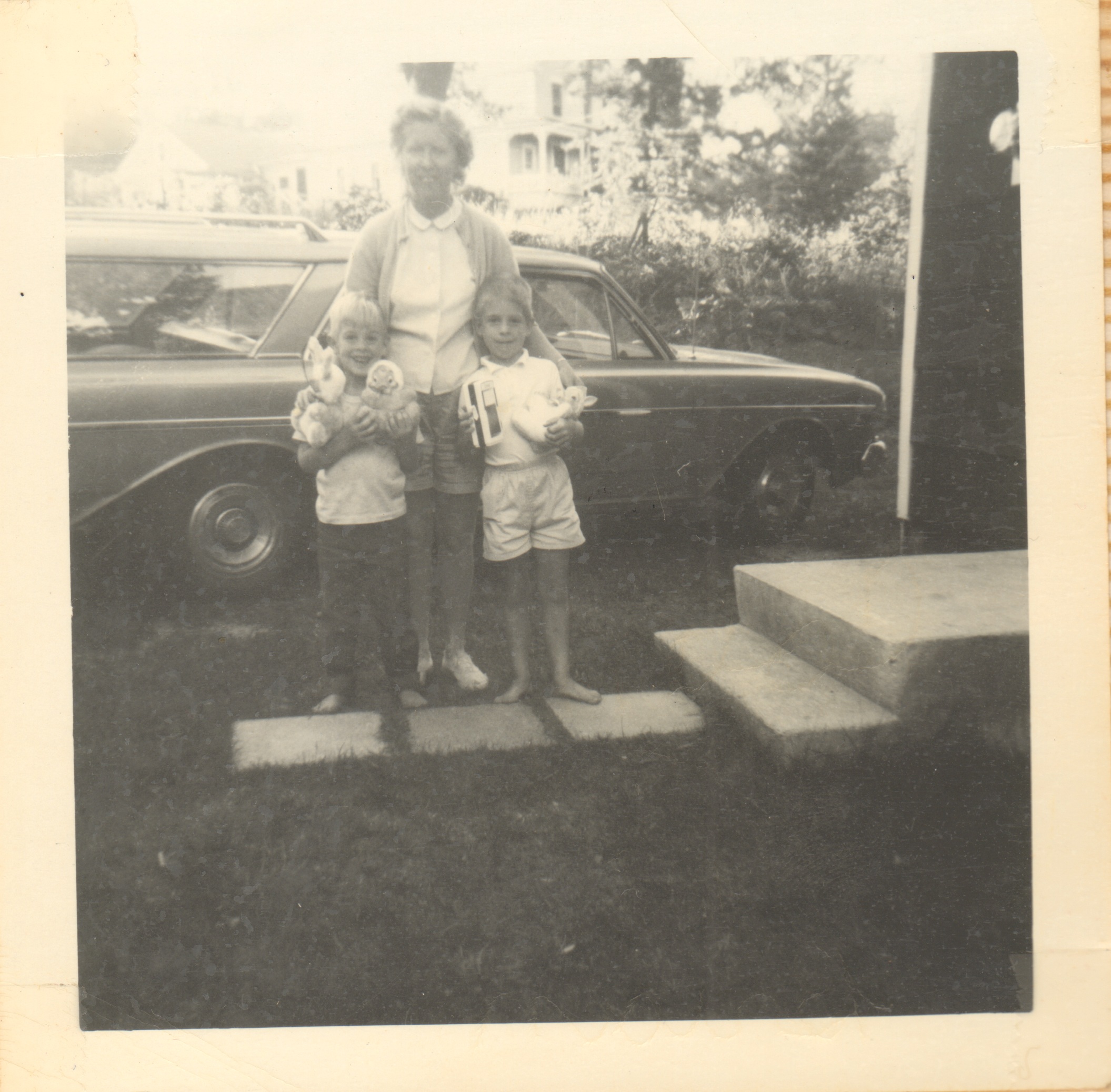
Lake Winnisquam is the downriver cousin of the more famous Lake Winnipesaukee, the largest of the lakes in central New Hampshire. To get there, we had to pack up the station wagon, cramming the “wayback” with the luggage.

That is a station wagon back there; they died out in the oil embargo.

That’s a station wagon back there. They became extinct due to the oil embargo.

Then we had to drive three hours up U.S. Route 3. It was a different world up there. There was the lake, of course, and swimming and boating and fishing, and croquet on the lawn. There was chocolate milk in a carton, brought daily by the milkman in his truck. Your heaven pales compared to the pleasure of drinking that chocolate milk! On a cold day, there was a fire in the cast iron stove in the middle of the cabin. And during a thunderstorm, it was a lifetime treat to sit out on the screened-in porch and see lightning strike across the lake.

If we needed things, it was a quick trip to the village, such as it was. The Jumpin’ Jack had the best milk shakes and fried clams. I could get comic books at the general store, something I never did at home, and interesting candy bars that came down from Canada.

We might venture farther. There were many wonders in the nearby White Mountains. There were children’s amusement parks such as Story Land and Six Gun City. There was the “ski mobile,” a unique ski lift on Mount Cranmore that was just as good as an amusement park ride. There was Ruggles Mine, which I could never see because I was afraid to step onto the ladder you used to climb down into the pit. To this day, I’ve never gone down into the mine.

You WILL NOT laugh at me!

You WILL NOT laugh at me!

And then there was Laconia, the only real city in the area, and the Weirs. Weirs Beach was the port of the good ship Mount Washington, if you wanted a tour of the lake. But we kids had our eyes on the other side of the boulevard. That’s where the arcades were: pinball machines, “driving” game machines, coin-operated machines that would let you grab a prize with the claw, skee ball, and the like. It was all kind of seedy and run-down in those days, but we kids didn’t care. Toss in soda and a hot dog, and it was an afternoon of unique entertainment. There was even a nearby drive-in, which was good for at least one movie night a year.

Did I forget to mention the famous motorcycle riot?

Did I forget to mention the famous motorcycle riot?

But I was an introspective kid, a bookworm, and even all the activities at Winnisquam couldn’t keep me from reading and dreaming. There was the little wooden bridge over the stream at the edge of the property, and visible but unknown lands just beyond, places that could hold anything I imagined. One year I was reading Mary Stewart’s The Crystal Cave, and through sheer force of imagination conjured up Merlin on the banks of the stream, strange gods in the woods, adventures just beyond.

Did I want to free Merlin, or be bewitched myself by Vivien?

Did I want to free Merlin, or be bewitched myself by Vivien?

I read J. Frank Dobie’s Coronado’s Children, and dreamed of finding buried treasure through following the signs and markers he described. When I was fourteen, we saw The Godfather at the drive-in, and I tried to make sense of rooting for criminals and contemplated the awful possibility of having sex with a bridesmaid.

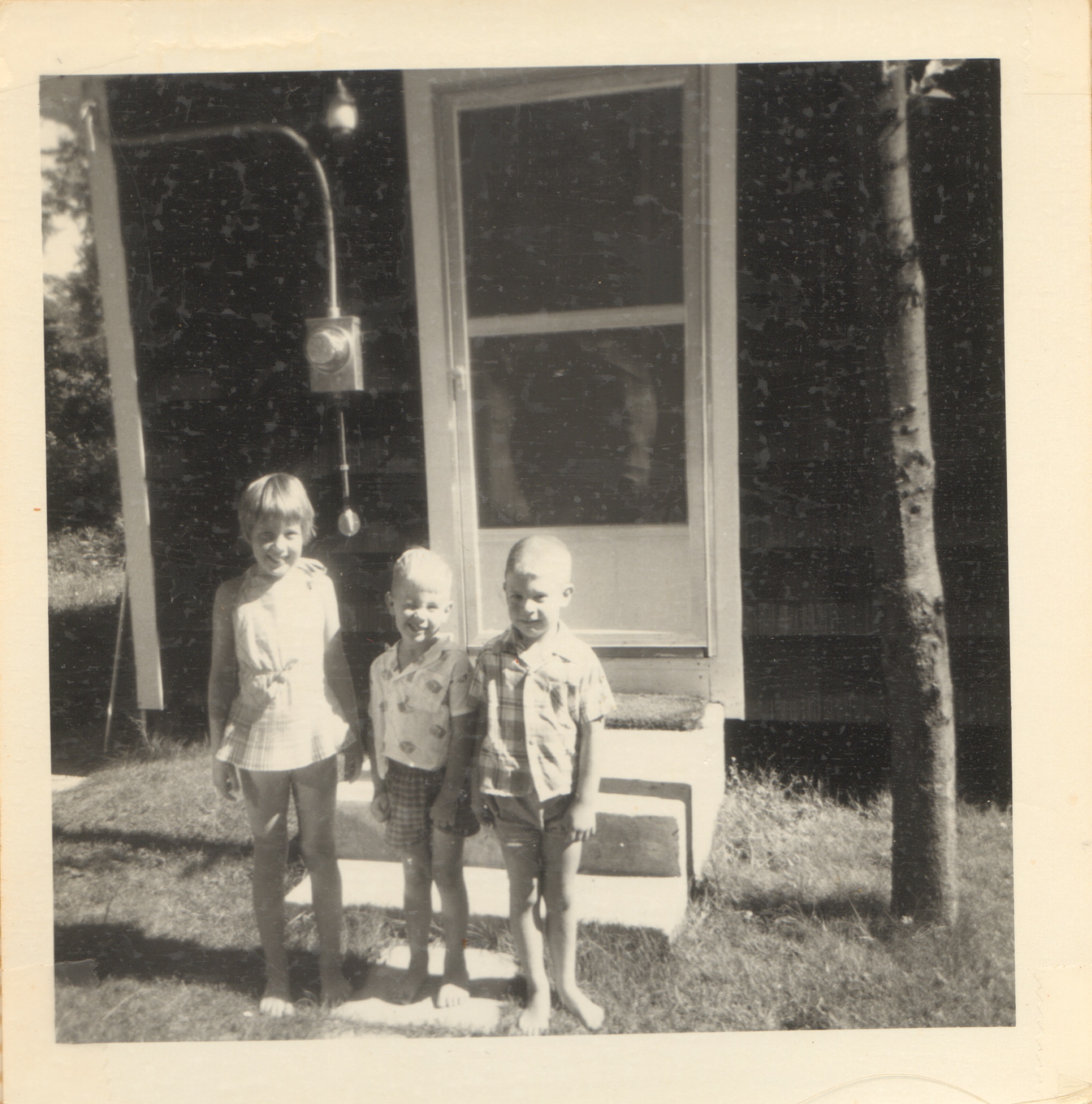
As we three kids became teenagers, my parents asked us if we were tired of going to Winnisquam, if the place was too boring. It never was. And we kept going for as long as we vacationed together as a family.

We make places our own by spending time in them, by doing things, by having experiences that are forever associated with that particular place. So when Rebecca pines for her beloved Berkshires, I say to her, “I know what you mean, daughter of my mind. For I have a summer place I’ve never quite left, even when I am not there.”

Gail, Colin and me in front of our cabin

Gail, Colin and me in front of our cabin

Posted in History, Reading fiction, Uncategorized | Tagged , , , , , , , , , , , | 19 Comments

Chapter 20 of Dragon Lady

“Everyone is a star in their own life,” chapter 20 of The Dragon Lady of Stockbridge, is now up and available. William Maverick, our villain, emerges from behind the curtain. Just what has he been up to? How did he get hold of Patty Leigh? For those of you who haven’t read the story before, you can start here.

I’ve two quick related matters to cover. First, I’ll be attending a sci-fi/fantasy convention soon, so I’m having a t-shirt for Dragon Lady made up. I’ll try to get a picture of me at the con wearing the t-shirt, and post it here.

Second, I now have 100 “followers” on this blog. (Maybe “regular readers” would be a better term?) My thanks to all of you for your interest, tolerance, and patience, in that order.

Perhaps an image of people applauding at the impeachment trial of Pres. Andrew Johnson is not the most auspicious choice for the occasion

Perhaps an image of people applauding at the impeachment trial of Pres. Andrew Johnson is not the most auspicious choice for the occasion

(There used to be a third point, that Dragon Lady was now up on Goodreads. It was. It isn’t. I received an e-mail from them which in so many words indicates that serial blog publication is unacceptable.)

Normally, I extend this post by covering a related subject. However, because my related subject essay turned out to be only tenuously connected to Dragon Lady, I’ve done it up as another post, which I’ll put up right after this one.

Posted in Dragon Lady, Reading fiction, Writing fiction | Tagged , , , , , , , , | Leave a comment

The phrenomagnetists, 19th century scientists of the mind

It’s not easy being a researcher into the powers of the human mind. And without today’s technologies, it was even harder in the nineteenth century. But they did have a map of the human brain, and tools to make it work differently. The only problem was that when they put the two together, the result was a disaster for both the map and the tools. The people who combined these two were the phrenomagnetists, and this is their story.

Phrenomagnetism? What’s that? It was the fusion of two distinct sciences, phrenology and animal magnetism. Phrenology supplied the map of the mind, animal magnetism supplied the tools. Both sciences were born in Europe in the 18th century, yet the explosive merging of the two was primarily an American phenomenon.

Back in the late 18th century, Dr. Franz Joseph Gall noticed that people with similar brain injuries developed similar mental disturbances. He theorized that the brain was divided into organs with specific capabilities, and that the size of the organs determined how much of those capabilities one had. Gall used patient data to map these organs. This was the basis for phrenology. Since it was hard to figure out exactly how large the phrenological organs were, short of opening up patients’ heads, people began assuming that the organs corresponded to the shape of one’s skull, a reasonable surmise.

Jacob Spurzheim brought phrenology to Boston in 1832. It spread rapidly across the country. Soon, Americans were examining each other’s heads to determine their characters. Two brothers, O.S. and L. N. Fowler, founded The American Phrenological Journal, and became the most successful popularizers of phrenology. If you’ve seen a phrenological bust or chart, like the one below, it’s almost certainly based on the work of the Fowlers.

This is your head on phrenology

This is your head on phrenology

The problem with phrenology was that it offered no way to improve one’s self. After all, one’s skull doesn’t change shape after one becomes an adult. Dr. Joseph Rodes Buchanan was so committed to phrenology that he maintained the skull did change shape as one’s phrenological organs changed, but he was the exception. What was needed were tools to change the phrenological organs without changing their size. And, sure enough, a tool appeared: animal magnetism.

Fr. Maximilian Hell, a contemporary of Dr. Gall, discovered he could influence people with the use of magnets. Franz Anton Mesmer took his ideas and worked them up into a fantastic theory about how one person could change another by altering their “animal magnetism.” His demonstrations and treatments became so popular that people began calling it “mesmerism.”

Four years after Spurzheim had brought phrenology to America, Charles Poyen did the same for animal magnetism. He demonstrated how animal magnetism allowed him to command patients who appeared to be sleeping. They would do as he said. They could read with their eyes closed. They could see events at a distance and diagnose diseases, and many more wonderful things. Animal magnetism became as popular as phrenology.

Somebody, no one now knows who, speculated that one might be able to alter the phrenological organs by applying animal magnetism to them. It turned out to be true. If a patient’s organ of veneration was magnetized to a higher energy state, the person began to pray. If the organ of philoprogenitiveness, then the patient became very tender toward children. In one amusing experiment, a man’s organ of destructiveness was magnetized, and he proceeded to destroy most of the furniture in the room before the operator could demagnetize him!

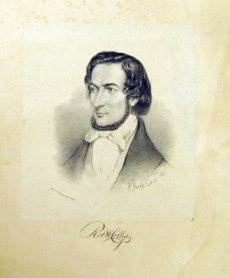
One of the first phrenomagnetists was this shady character named Robert Hanham Collyer. That’s Dr. Collyer to you, thanks to a one-year degree from Berkshire Medical College (long since defunct). Collyer had got into the phrenology game with his own handbook, but he wasn’t getting much attention compared to the Fowlers. He needed something new to distinguish himself. So he used animal magnetism to explore the phrenological organs. And surprise! He was able to report that he had detected a new phrenological organ using animal magnetism.

Collyer, a transatlantic trickster

Collyer, a transatlantic trickster

That put phrenomagnetism on the map. The Fowlers, not to be left behind, went looking for their own phrenomagnetist. They found Rev. La Roy Sunderland, a Methodist preacher, who was soon able to report he had found several new phrenological organs. The American Phrenological Journal proudly reported his results. Take that, Collyer!

Phrenomagnetism looked to be the coming thing. The nineteenth century was going to get its own version of mind control! But then it all fell apart.

The first problem to emerge came from the way animal magnetism was demonstrated. Far too often, the operator was man and the patient was a young woman. The sexual possibilities of a man bringing a woman under his control were too obvious. People grew suspicious. Collyer, slick fellow that he was, tried to spike such rumors about himself by publishing an account of how he had magnetized a young girl to make her forget an unsuitable suitor at her mother’s behest. It seems to have shifted suspicion away from him. Others were not so lucky. An anonymous pamphlet came out accusing a nameless individual who just happened to resemble La Roy Sunderland of using animal magnetism to seduce his second wife! Sunderland, who had indeed recently married for the second time, was forced to put out a pamphlet rebutting the charges. After that sort of scandal, a lot of people lost interest in animal magnetism. (Though lonely teenage boys would remain devoted to the idea of hypnotizing girls.)

You are under my power!

You are under my power!

The second problem emerged out of La Roy Sunderland’s attempt to find new phrenological organs. Oh, he was successful. Too successful. He found scores of them. His work threatened to undermine the standard phrenological model used by the Fowlers. They decided that animal magnetism was bunk, and broke off all association with Sunderland. His name and work never again appeared in the pages of The American Phrenological Journal.

The third problem was that at about the same time, Collyer was coming to the opposite conclusion, that it was phrenology that was bunk. He accidentally magnetized the wrong phrenological organ in a patient, and the patient reacted as if Collyer had magnetized the right one! Collyer was soon able to demonstrate that the entire power of phrenomagnetism came from the animal magnetism, and that the supposed layout of the phrenological organs was irrelevant.

That put paid to phrenomagnetism. Its heyday had lasted only a few years in the early 1840s. Its practitioners reverted back to either phrenology or animal magnetism, or abandoned the field altogether. The Fowlers continued as the champions of phrenology for decades thereafter. Joseph Rodes Buchanan abandoned the idea of one’s skull changing shape. Instead, he took up spiritualism and coined the term “psychometry” to describe the ability of people to read the history of an object by touching it. La Roy Sunderland increasingly turned to Abolitionism, and helped split the Methodist Church over the issue of slavery in the 1850s.

And Robert Hanham Collyer? He would turn up three decades later as a member of the Anthropological Society of London, a forerunner to the Royal Anthropological Institute. He was trying to claim to be the discoverer of anesthesia on the basis of his work in animal magnetism, and was dressing up his once-discarded phrenological ideas in the terminology of contemporary human anthropology. Still the trickster.

Posted in History | Tagged , , , , , , , , , , , , | 5 Comments

Chapter 19 of Dragon Lady, tweeting, and four weeks to the conclusion

“Stockbridge interlude,” chapter 19 of The Dragon Lady of Stockbridge is now available to read. Rebecca’s hunt for the villain Maverick has been interrupted by the dragon taking her to Stockbridge. What does the dragon want? Can Rebecca resolve the problems that face her in Stockbridge and get back to her home town before her absence imperils Abigail?

There has been an e-mail account associated with this blog for some time. (You hadn’t noticed? It’s mentioned on my About page.) I tend more toward logorrhea than pithy comments, so I was reluctant to add a Twitter account. But now I have one. (Addendum: well, no I don’t. I did have one, but Twitter messed it up, and I decided to delete it rather than go on arguing with them.)

I’ve been planning on the end of Dragon Lady for some time, rehearsing the plot in detail over and over again in my head. Wednesday night I put the finishing touches on chapter 19, and then just continued writing. And writing. And writing. I finally stopped at three in the morning. I had just written four chapters, and completed Dragon Lady. It still needs polishing, of course, but it’s not going to change substantially. So I can tell you all that the story will end with chapter 23, to be published on Friday, February 1, 2013.

Writing four chapters in one night has exhausted my creative energies for the moment. I’m sitting here in my study looking at the text of Dragon Lady in another window on my laptop, and realizing it’s not going to keep me up at night any more. There’s no more story to write. Rebecca and this story are done. I’m going to miss them. Maybe someday I’ll have someone make an actual physical copy of the walking stick. It would be a nice way to commemorate the story. Though I doubt I can afford to have the head made of solid sterling silver!

Meanwhile, you all still have five new chapters to read (including today’s). It’s going to be fun reading your reactions to these chapters, knowing what’s in them and that I don’t have to worry about finishing them. In the meantime, I leave you with a drawing of Rebecca’s beloved Berkshire hills.

Greylock, highest mountain in the Berkshires

Greylock, highest mountain in the Berkshires

Posted in Dragon Lady, Writing fiction | Tagged , , , , , , | Leave a comment