
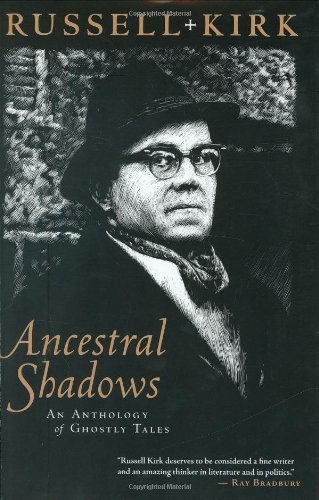
There are devils that lead to your downfall, and there are devils that make you extend yourself. My reader Judy of Janthina Images is of the latter kind. Knowing that my personal politics are a bit left, she sent me a collection of ghost stories by a conservative writer, Russell Kirk’s Ancestral Shadows: An Anthology of Ghostly Tales (2004).
Russell Kirk (1918 – 1994) is considered to be one of the fathers of contemporary American conservatism. I’d never heard of him.[i] So I went hunting on my bookshelf, and found his introduction to The Viking Portable Conservative Reader (1982), which turns out to be one of his notable pieces. Mr. Kirk reveals himself to be a thinking man’s Burkean conservative,[ii] dedicated to the idea that our social institutions embody the wisdom of the ages, and should be altered slowly and only as needed.[iii]
But why bring this up at all in reviewing Kirk’s ghost stories? Because Kirk’s conservatism, which most definitely includes his Catholism,[iv] is central to his stories, which he describes in an essay appended to this collection as “experiments in moral imagination.” And by and large, when Kirk’s moral imagination works well, so do his stories. When it fails, his stories fail, too.
One of the themes in Kirk’s moral imagination is that this is a Christian universe. Salvation and damnation are open to every man with free will, and by free will they so choose. “Lex Talonis,” a story about two criminals, one of whom isn’t quite what he seems to be, is a good example; so is “Saviorgate,” an amusing and even thoughtful look at what might lie beyond death. “Balgrummo’s Hell” is a more traditional scary ghost story of punishment in the vein of M. R. James, not the only one Kirk wrote by far, but probably the best.
While most of Kirk’s tales have a Christian background, late in his career he wrote two stories that are essentially pagan, “The Last God’s Dream” and “The Peculiar Desmesne of Archvicar Gerontion.” They feature a character beloved of conservative writers, the man who possesses a natural nobility, often paired with amazing abilities and sometimes even noble birth.[v] Kirk’s Manfred Arcane lacks nobility by birth, but he runs an entire country and is a naturally courteous man when not plotting to kill his enemies. While officially Christian, Arcane’s sympathies lie with such figures as Diocletian. The two stories explore the limitations of great power in wonderfully atmospheric settings.
Combine these two themes together, and you get the very best story in the collection, “The Princess of All Lands.” Kirk’s protagonist in this story is as extraordinary as Manfred Arcane, thanks to her special abilities, but her heart and soul are resolutely Christian. So when she is confronted by supernatural evil, her central concern is salvation. But for whom? And at what cost?
However, there is a sinister undercurrent that often sends Kirk’s moral imagination astray. He loves righteous violence and killing. The Christian God behind some of Kirk’s stories is not the God of the Beatitudes, not even the wrathful Jehovah of the Old Testament, but a macabre Vincent Price preparing to torture the damned, and feeling self-righteous doing so.
This is why I can’t praise the award-winning “There’s a Long, Long Trail A-Winding.” Kirk’s protagonist is an improbably chaste petty criminal and drifter names Sarsfield. Kirk tries to suggest Sarsfield is another extraordinary character, essentially pure in soul if dodgy as a social being, but the guy really comes off as a trimmer at best, one who is neither saved nor damned. Nevertheless [SPOILER ALERT: blue text], Sarsfield wins his way to Heaven by a spree of justifiable homicides. Now killing bad guys is usually considered a good thing in the secular world. But is it the right thing to do when a man’s immortal soul may yet be redeemed? We must assume for the sake of Kirk’s protagonist that these were hardened criminals, though we know almost nothing of their history. [END SPOILER ALERT] And that’s the problem with the story: it’s really a secular view of good and evil, Wild West-style, grafted onto a Christian universe.
In addition, “There’s a Long, Long Trail A-Winding” features another of Kirk’s weaknesses, his tendency to bring contemporary politics into his stories. Kirk misunderstood M. R. James’s warning against including sex in ghost stories. The problem isn’t sex per se; the problem is that including sex in a ghost story can easily jar the reader out of the atmosphere the author is trying to build up. Unfortunately, Kirk couldn’t resist tweaking his political opponents in his stories, often in ways that disrupt or diminish the effect of his stories. So in this story, our protagonist Sarsfield sometimes serves as a “jailhouse lawyer” to his fellow prison inmates. Yet he twice improbably disparages the Escobedo and Miranda decisions,[vi] which many inmates would have found useful. Since nothing in the story depends on this, the only reason this appears is clearly to allow Kirk to express his ire over those decisions, which displeased many conservatives. In another few decades, people will have forgotten this controversy, and it will be relegated to an explanatory footnote in Kirk’s story, if it should endure that long. But Kirk was willing to disrupt the believability of his story to make a political point. It’s not a good sign.
The larger problem with incorporating politics into religion is that it threatens to cheapen, trivialize, and corrupt religion. So by trying to mesh his own political issues with the Christian universe, Kirk sometimes trivialized Christianity and ruined his story. Perhaps the worst offender in this volume is the very first story, “Ex Tenebris,” an otherwise forgettable story of supernatural vengeance whose object is a civil servant trying to implement government housing policy! Well, yeah, we’d all like to see the “revenooers” get theirs, but in this story and the next, “Behind the Stumps,” we’re getting into bad 1950s EC Comics territory, without the benefit of the art.
I should note that those stories are among the earliest of Kirk’s in this volume. In general, Kirk got better as he got older and more experienced. The stories in this volume are very roughly in chronological order, and you’re better off sticking toward the back than the front. And to close, I’ll mention one other story worth reading, “The Reflex-Man in Whinnymuir Close.” It’s the only story set in the 18th century, it allowed Kirk to give his social conservatism free rein without getting into contemporary politics, and it’s a good yarn, too.
[i] In contrast, I knew quite a bit about his more media-savvy ideological colleague, William F. Buckley, Jr. (1925 – 2008).
[ii] And like Edmund Burke, Kirk’s conservatism has a religious basis. Critics of Burkean conservatism argue that it has a mystical basis, supporters, including Kirk, disagree, but I suspect that this is quibbling over a term because of its often pejorative connotations.
[iii] Although Kirk is called one of the fathers of contemporary conservatism, his Burkean conservatism is actually at odds with contemporary right-wing politics in America. To judge from the Wikipedia entry on Kirk, he understood this himself. It must have been a bitter realization.
[iv] He converted in 1963. Reading his ghost stories, I had to wonder why it hadn’t happened sooner.
[v] Readers of the Zimiamvian trilogy of high fantasy stories by E. R. Eddison (1882 – 1945) will recognize Lessingham as another of this type.
[vi] Escobedo guaranteed suspects the right to a lawyer during police interrogations, Miranda that police had to inform suspects of their rights.







 Sillyverse